Search
ORCAS Data Fair-Use Policy
Before you download ORCAS data, please first familiarize yourself with the ORCAS Data Fair Use Policy below and accept or decline the fair-use terms.
The ORCAS data provided on this public archive are freely available and were furnished by ORCAS scientists who encourage their use. Data users are encouraged to consider the following recommendations for fair, appropriate, and optimal use of data products.
ORCAS Scientist Interactions:
- Please kindly inform the ORCAS scientist(s) associated with each data product about the new data analysis activity near the beginning of the effort, and of any publication plans as the effort nears completion.
- Consult with the respective ORCAS scientist(s) concerning your data analysis plans to assure that the latest data product is being used and that it is being used appropriately.
- ORCAS science team members are listed at https://www.eol.ucar.edu/content/orcas-science-team and in the readme documents for select data sets. Alternatively, initiate contact with Dr. Britton Stephens (stephens@ucar.edu), Lead Principal Investigator.
Acknowledgments:
- Please acknowledge the use of ORCAS data products with (1) a citation to the DOI provided at the bottom of the NCAR/EOL web page for each data set, and (2) if appropriate a citation to the ORCAS overview paper:
- Please acknowledge the agency or organization (e.g., NSF Polar Programs) that supported the collection of the original ORCAS data when publishing new analyses and results using ORCAS data products.
- Please provide an electronic reprint of your independent work to the data archive (https://www.eol.ucar.edu/node/6213?field_project_name=ORCAS) so that all publications resulting from ORCAS data products may be tracked, recorded, and referenced via the ORCAS Publication Page.
Letter from the Project Manager
ORCAS Digital Camera Imagery and Movie Notes
NCAR / Scripps Airborne Flask Sampler
Visa Requirements
All HIPPO participants should be holders of a valid passport; this passport must be valid 6 months beyond the HIPPO deployment. No yellow fever vaccinations are required.
USA Citizens visa needs are, essentially no visas needed:
- Boulder CO USA; Anchorage, AK USA; Honolulu, HI USA
- Pago Pago, American Samoa
- VISA needed and issued ON ARRIVAL (valid up to 6 months). No need for pre-arrangements.
-
Christchurch, New Zealand:
-
No visa required for a stay of up to 3 months
-
Tahiti, French Polynesia
-
No visa required for a stay of up to 1 month
-
Easter Island, Chile
-
No visa needed, entry fee must be paid (USD$131). Each participant is to pay their own fee.
-
Costa Rica
-
No visa needed
-
Corpus Christi, TX USA
All crew members are to carry a certain amount of cash to cover applicable reciprocity or other immigration fees.
Citizens of South Korea need a visa to American Samoa, and a U.S. re-entry document.
Citizens of Colombia require visas to American Samoa, New Zealand, French Polynesia, Costa Rica and Chile, and a U.S. re-entry document.
All other nationals please visit the following website for information about your visa needs.
Work Schedule
HIPPO-2 project, field phase has ended. The project now goes into data processing and QC mode until HIPPO-3 is initiated in March 2010.
- 11/22 Sunday: RF11 from Anchorage to Jeffco, Colorado. Estimated flight duration 6 hours. There will be a missed approach at Campbell River, British Columbia. Schedule for preflight: 0700 bring up MEDUSA on power in the hangar; 0745 roll-out; 0815 power and access on the ramp; 1000 take-off. If there is precipitation the take-off will be as soon as practical after fueling because of possible ice accumulation on the wings. The instruments would have to complete preflight and warm-up after take-off. Taking measurements is optional on this flight. ETA at Jeffco is 1800 MST.
- 11/21 Saturday: RF10 from Anchorage to N. Pole. Roll-out at 0730, power and access at 0800, take-off at 1000. Estimated flight duration 7.5 hours. There will be a low approach in Fairbanks, followed by a high climb and dips, with the first one expected just North of Point Barrow. After this dip the GV will stay below 28 kft and continue North with dips to 500 ft. Expect 4 to 5 dips, depending on the head wind.
- 11/20 Friday: Maintenance day, power and access from 0900 to 1700 or earlier if all tasks are finished.
- 11/19: RF09 from Kona to Anchorage. Six dips, 0800-1000 schedule. Estimated flight duration 7.5 hours.
- 11/18: Hard down day, now power or access to the GV.
- 11/17 Tuesday: Second tuesday in a row due to the crossing of Date Line. Maintenance day in Kona, HI. Power and access from 1100 as needed.
- 11/17 Tuesday: RF08 from Honiara to Kona, HI. Power and access 0800, take-off at 1000. Estimated flight duration 8.5 hours. This is the longest flight of HIPPO-1 and HIPPO-2.
- 11/16 Monday: Maintenance day in Honiara, power and access from 0800 to 1600 or earlier if all maintenance tasks are finished.
- 11/15 Sunday: RF07 to Honiara, Solomon Islands. Dip clearance for Australia to overfly Wollongong is in hand. Power and access at 0800, takeoff at 1000, estimated flight duration 8.5 hours.
- 11/14 Saturday: Maintenance day, power and access from 0800 to 1600 or earlier if all maintenance tasks are finished.
- 11/13 Friday: Hard down day. No power or access to the GV.
- 11/12 Thursday: RF06 to 66S. Power and access at 0800, take-off at 1000, flight duration 8.5 hours. Expect overflight of Lauder if conditions on site are favorable at the time the GV would arrive.
- 11/11 Wednesday: Maintenance day in Christchurch. Power and access from 0800 to 1600, may be extended if needed to accommodate the outreach day. Expect visitors from 1400 to 1600, including TV1, TV3, staff from the Antarctic Center and students from Cantenbury and limited general public.
- 11/10: Missing day due to the crossing of the International Date Line.
- 11/9 Monday: RF05 to Christchurch, NZ. Takeoff at 1000 with a 2 hour warm up time. Food for lunch can be picked up at the airport food stand.
- 11/8 Sunday: Maintenance day in Rarotonga. Power and access from 0800 to 1600 as needed. Details of transportation on the island will be apparent upon arrival and will be updated later. Local media day from 1400 to 1600; cabin access to public will be limited as needed for maintenance activities.
- 11/7 Saturday: RF04 to Rarotonga, Cook Islands. GV crew will depart Outrigger Keauhou Beach at 0730. Power and access at 0800, takeoff at 1000. Estimated flight duration 8 hours; ETA in Rarotonga 1800 local time.
- 11/6 Friday: maintenance day for the GV. Power and access from 0800 to 1600 as needed.
- 11/5 Thursday: Hard down day for the GV. No power or access to the aircraft.
- 11/4 Wednesday: RF03 to Kona, Hawaii. Roll out at 0730, power and access 0800, take-off at 1000; times are tentative, we may push out earlier after we have flight duration to arrive in HI at a reasonable time. Missed approach at Cold Bay, then dips all along the way with a descent in the vicinity of Mauna Loa.
- 11/3 Tuesday: Maintenance day in Anchorage. Power and access from 0800 to 1600. Planning meeting in Capt Cook room 1464 at 1200; see your E-mail for dialing instructions. Media and students visit is expected from 1400 to 1600. We will not allow visitor access inside the GV unless maintenance activities are finished by that time.
- 11/2 Monday: RF02, N. Pole flight. Roll out 0700, power and access 0730, take-off 0930. Five dips: Fairbanks, Barrow, 165/70, 165/80, 145/65 approximate. Dips over the ovean are down to 500 ft on this flight only.
- 11/1 Sunday: Maintenance day in Anchorage. Power and access from 0800 to 1600. Weather briefing at 1200 in room 1464 of Capt. Cook. Meet at 0730 in the lobby for carpool to the hangar. RAF staff have hangar access cards; carpool with them or call once at the hangar to be let inside.
- 10/31 Saturday: Depart on RF01 to Anchorage. Roll out 0730, hands on 0810, take-off 1000.
- 10/30 Friday: Hard down day for the RAF GV crew. Maintenance day for the science team from 0730 to 1700.
- 10/29 The GV is back from Savannah. Power and access from 1500 to 1700.
- 10/27 If the GV is back 10/26, maintenance day. If not, standby mode.
- 10/26 GV in Savannah for repairs. Work is ongoing, status updates are frequent but no ETA yet.
- No access on the weekend. The aircraft is in Savannah, GA for service.
- 10/23 Maintenance on Friday.
- 10/22 TF02, 4-6 hours on Thursday, takeoff in the morning, exact time TBD.
- 10/21 Maintenance. Visit / media day in the afternoon, 3 to 5 pm on a non-interference basis.
- 10/20 TF01, 2 hours on Tuesday; takeoff at 1400.
- 10/19 Weigh the GV; Engine run-ups; safety briefing at 11 AM in RAF conference room; FRR (no activities on aircraft). Access to GV most likely after 3 PM.
- 10/17 Saturday power and access only if necessary.
- 10/16 SAR at 10 AM (system acceptance review, aka racks walkaround).
- 10/14 Install QCL, MEDUSA and CO-CO2 racks on the GV by Wednesday. Work on signals, plumbing, data system - ongoing as soon as the racks are in place.
Final Agenda
C-RITE Workshop Agenda
22-24 May 2017
UCAR Center Green Campus & NCAR Foothills Laboratory
Boulder Colorado
Final - 21 May 2017
For a PDF of one of the following presentations, click on the corresponding title. In some cases a PowerPoint Slideshow is also available (for presentations that contained embedded video) as well as a PDF version. A PowerPoint viewer can be downloaded from Microsoft.
Day 1 | Monday, 22 May 2017 (UCAR Center Green)
7:30-8:00: Registration & Continental Breakfast & set-up of posters
8:00-8:10: Welcome from NSF (Senior NSF Official)
8:10-8:25: Workshop Goals and Expectations (Vanda Grubišić)
8:25-8:30: Logistics (Jim Moore)
Session I: Boundary Layer Flow and Turbulence (All plenary sessions in CG Auditorium)
8:30- 8:40: Plenary - Goals and expectations of Boundary Layer Flow and Turbulence (Petra Klein)
8:40-9:40: Overview Presentations (three 20 min presentations)
1. Stable Boundary Layers Gunilla Svensson
2. Convective Boundary Layers and Entrainment Processes Wayne Angevine
3. Influence of Topography and Land Use Julie Lundquist
9:40-10:00: Discussion
10:00-10:15: Break (move to breakout rooms) set up posters (new and emerging technologies), posters will remain for 2 days
10:15-11:30: Session I Breakout Groups
- Stable Boundary Layers Jeilun Sun (CG1 room 3131)
- Convective Boundary Layers and Entrainment Processes Jordi Vila (CG1 Center Auditorium)
- Influence of Topography and Land Use Petra Klein (CG1 South Auditorium)
11:30-12:15: Plenary - Summary from each breakout session and brief discussion/clarifications
12:15-13:30: Lunch (on your own, NCAR Center Green Cafeteria)
Session II: Dynamics and Thermodynamics of Convection (All plenary sessions in CG Auditorium)
1:30-1:40: Plenary - Goals and expectations of Dynamics and Thermodynamics of Convection (Dave Raymond)
13:40-14:40: Overview Presentations (three 20 min presentations)
1. Continental Convection Matt Parker
2. Maritime Convection Larissa Back
3. Shallow Convection Paquita Zuidema
14:40-15:00: Discussions
15:15-15:30: Break (move to breakout rooms)
15:30-16:45: Session II Breakout Groups
- Continental Convection Steve Nesbitt (CG1 Center Auditorium)
- Maritime Convection Dave Raymond (CG1 room 3131)
- Shallow Convection Tammy Weckwerth (CG1 South Auditorium)
16:45-17:30: Plenary - Summary from each breakout session and brief discussion/clarifications
17:45- 20:00: Reception and Special Presentation (CG1 Auditorium)
Fred Carr, Summary of AMS work on observations from AMS Annual Meeting, focused on convection and turbulence
Day 2 | Tuesday, 23 May 2017 (UCAR Center Green)
7:50- 8:20: Continental Breakfast
8:20- 8:30: Logistics (Jim Moore)
Session III: Free Troposphere Flows and Turbulence (All plenary sessions in CG Auditorium)
8:30- 8:40: Plenary - Goals and expectations of Free Troposphere Flows and Turbulence (Bart Geerts)
8:40- 9:40: Overview Presentations (three 20 min presentations)
1. Mountain Winds and Turbulence [PPTX] Jim Doyle
2. Turbulence in Clouds Pavlos Kollias
3. Clear-air Turbulence [PPT] Robert Sharman
9:40-10:00: Discussions
10:00-10:15: Break (move to breakout rooms)
10:15-11:30: Session III Breakout Groups
- Mountain Winds and Turbulence Vanda Grubišić (CG1 South Auditorium)
- Turbulence in Clouds Bart Geerts (CG1 Center Auditorium)
- Clear-air Turbulence Stan Trier (CG1 room 3150)
11:30-12:15: Plenary - Summary from each breakout session and brief discussion/clarifications
12:15-13:30: Lunch (on your own, NCAR Center Green Cafeteria)
Session IV: Physical Processes in Convection (All plenary sessions in CG Auditorium)
13:30-13:40: Plenary - Goals and expectations of Physical Processes in Convection (Mary Barth)
13:40-14:40: Overview Presentations (three 20 min presentations)
1. Cloud Electricity and Lightning Larry Carey
2. Aerosols, Cloud Physics and Radiation Sue van den Heever
3. Chemistry Ken Pickering
14:40-15:00: Discussion
15:15-15:30: Break (move to breakout rooms)
15:30-16:45: Session IV Breakout Groups
- Cloud Electricity and Lightning Andy Detwiler (CG1 South Auditorium)
- Aerosols, Cloud Physics and Radiation Dave Turner (CG1 Center Auditorium)
- Chemistry Gretchen Mullendore (CG1 room 3150)
16:45-17:30: Plenary - Summary from each breakout session and brief discussion/clarifications
1730: Take down all posters
Time for Breakout rapporteurs to meet to produce summary information for synthesis session
Day 3 | Wednesday, 24 May 2017 (NCAR Foothills Campus FL2 Room 1022)
7:50-8:20: Continental Breakfast
8:20-8:30: Logistics (Jim Moore)
Session V: Plenary Synthesis (NCAR Foothills Campus, FL2 -room 1022)
8:30-8:45: Summary of Boundary Layer Flow and Turbulence (Petra Klein)
8:45-9:00: Summary of Dynamics and Thermodynamics of Convection (Dave Raymond)
9:00- 9:15: Summary of Free Troposphere Flows and Turbulence (Bart Geerts)
9:15-9:30: Summary of Physical Processes in Convection (Mary Barth)
9:30-9:50: Discussion
9:50-10:20: Break
10:20-11:40: Synthesis of Priorities and Recommendations (Vanda Grubišić)
11:40-12:00: Wrap Up (Senior NSF Official)
End of Workshop
Global Coordination Center
The purpose of the Global Campaign Coordination and Communications Center is to serve as the main communications and coordination hub between the PIs and the aircraft in the field. It will resemble a small operations center. It is important to note that HIPPO will range across 8 time zones and the International Date Line during the 21 day deployment. This will require flexibility in schedules and support to meet the needs of the aircraft mission. The major task of the Coordination Center will be to accumulate and distribute up-to-date information on mission planning, operations, science and logistics, in particular:
- Aircraft status
- Instrumentation status, RAF, PI and user
- Weather products and predicted conditions
- Chemical model output products
- Real-time in-flight contact and coordination, as required
- General project logistics
A team of EOL staff and interested PIs will be in the Center to support all aspects of the HIPPO deployment. A group of people representing these components will gather on a daily basis in person or teleconference. These people will also be present in the Center or on call during aircraft operations to assist with any questions or issues from the aircraft. The representatives are:
- Brigitte Baeuerle, Vidal Salazar - Global Operations Center Coordinator
- Al Cooper - EOL Aircraft Scientific Lead
- Karen Rosenloff, Eric Ray (NOAA/ESRL) - Project forecasters
- Steve Wofsy (PI, will call in from remote locations when possible)
- Pavel Romashkin (Aircraft Ops PM, will call in from remote locations when possible)
- Vidal Salazar (Ground Ops PM, will call in from remote locations when possible)
- Greg Stossmeister (Field Catalog)
- Bob Olson or designee - Aircraft maintenance
- Kurt Zrubek or designee - Instrumentation
- Scotty McClain or designee - Pilot, help with flight planning, changes etc. if needed
- Chris Webster or designee - SE
- (Contact information for all science groups to report immediate instrument issues)
We plan to have a HIPPO Daily Status Update Meeting during the field phase beginning on 5 January 2009 through 28 January 2009. The timing of the meeting each day may be adjusted to allow attendance by the participants deployed with the aircraft. The purpose of the meeting is to ensure that all Center representatives and personnel deployed with the aircraft are aware of all happenings since the last meeting, and to share any updated information they may have received directly at the Center. In addition it is documented in the operations part of the Field Catalog.
The Daily Meeting will include:
- Aircraft status
- Instrumentation status
- Weather and Chemistry brief
- Plans and schedules for the next 24-48 hours
- Logistics update
The status meeting will start with aircraft and instrumentation status. This will allow the technical staff to participate and leave, or stay if they choose to. The following discussion of the chemical and weather forecasts is intended to be brief but can be flexible as needed.
All information contained in the Daily Meeting will be posted to the HIPPO Field Catalog or on the RAF HIPPO Web site. The catalog will be updated at least once a day following this meeting and more often as changing conditions or status warrant. This will help ensure that anyone can see the status of HIPPO operations and facilities from anywhere, assuming they have access to the Internet. This includes all interested science groups, groups traveling to the main support stations (i.e. Anchorage, AK, Christchurch, NZ and San Jose, CR) with information such as aircraft delays, or particular instrument problems that may require bringing a critical spare into the field to the next support location.
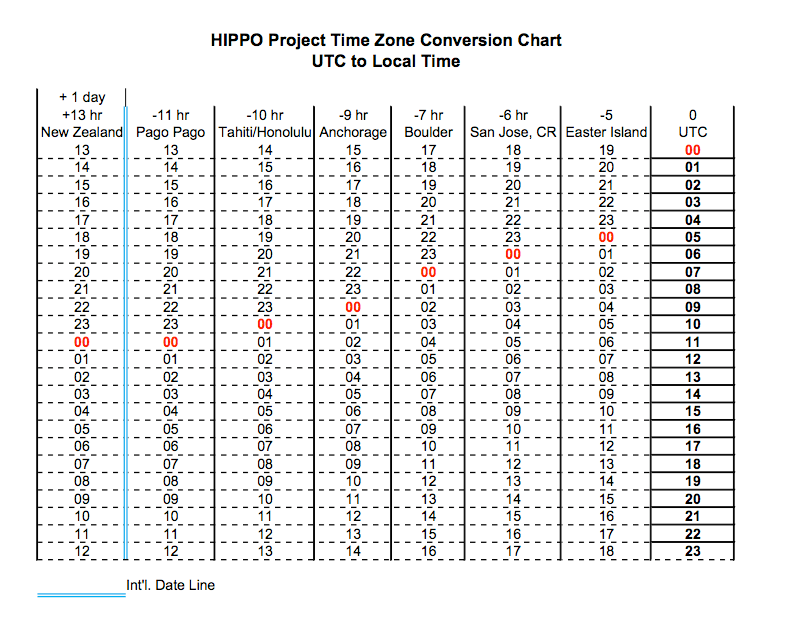
Time Conversion Chart
Below is a simple chart that shows all of the time zones we will visit during the upcoming HIPPO deployment. It includes a column of the 24 UTC time with conversions to all local time zones. Note that we will effectively range across 7 time zones and the International Date Line. Shown in red is the 'midnight' for UTC and local midnight for all local time zones.
Field Project SOCRATES
ARISTO 2017 Digital Camera Imagery and Movie notes
During ARISTO 2017, the NSF/NCAR GV HIAPER flew a forward-facing digital camera for in-flight image capture. The forward camera is a Point Grey Research Hi-Res Flea Hi-Color, 1024x768 resolution. The Navitar DO-412 lens has a focal length of 4 mm and the field of view is about 62 x 48 degrees with some barrel distortion. This camera is located on the right wing pylon.
Images were acquired once per second and stored as JPEG-compressed files, roughly 100 kB each. No image processing was performed beyond converting the raw pixel data to 24 bit color images. Applying a sharpening filter as is ordinarily done by consumer digital cameras will considerably improve the appearance. The UTC date and time are encoded in the filename as YYMMDD-HHMMSS.jpg.
For the preliminary MPEG-4 movies each image was processed with the linux ImageMagick toolkit. The image was slightly sharpened [SHARPEN(0.0x1.0)] and resized to 512x384 pixels. Each image was then annotated in the lower left with the time the image was recorded. These 1-second annotated images were compiled into a video stream running at 30 frames/s, 1000 kbps data rate using the MPEG-4/h.264 (AKA "MPEG-4 Part 10" and "AVC") codec. Final movies add data to the right. The movies are playable with Quicktime, Windows Media Player, mplayer, VLC, and others.
For questions, please contact:
Stuart Beaton or Janine Aquino
NCAR/EOL/RAF
2017-03-23
General information
Perdigao Data Submission Instructions
An initial master list of all Perdigão international datasets (with links) has been compiled to provide easy access to all operational and research Perdigão datasets. This list will form the Perdigão Long-term Data Archive at NCAR Earth Observing Laboratory where datasets are grouped and sorted by category (i.e., radar, satellite, etc.) and platform. Please review this list to verify that your dataset(s) are properly named, with the appropriate authors identified. Email any corrections, additions, or deletions directly to loehrer@ucar.edu. If you already have your datasets available on-line elsewhere, please email the link(s) or FTP access information.
To submit your dataset(s) and documentation to the Perdigão Long-term Data Archive, see the anonymous FTP instructions below. For users without Internet access, or if your dataset(s) are too large to FTP (e.g., 250GB or larger), please contact loehrer@ucar.edu. In these cases, users can submit their data on a USB drive to the shipping address below. If you have a large number of files to FTP, please tar or zip your files by day or what makes sense for your dataset.
It is critical that submitted datasets are accompanied by sufficient documentation. The minimum required metadata is shown below after the FTP instructions. More detailed documentation guidelines can be found here.
Data Submission FTP Instructions for the Perdigão Long-term Data Archive at NCAR/EOL:
FTP: ftp.eol.ucar.edu
Login: anonymous (No password required.)
cd /pub/data/incoming/perdigao (NOTE: This command should be done all in one step.)
It is very important to send an email to loehrer@ucar.edu once your file(s) have been FTPed. In your email or in your dataset readme file, please include the following minimum required information for your dataset(s):
- Dataset Title - The dataset title that will publicly appear in the data archive. EOL may modify for project consistency.
- Dataset Author(s) - List dataset authors. Indicate lead and corresponding authors. Include contact information.
- Time of Interest - Include begin and end dates (i.e., YYYY/MM/DD hh:mm:ss to YYYY/MM/DD hh:mm:ss).
- Area of Interest - Include GeoLocation information (latitude/longitude box) (e.g., 40.00 to 45.50; -95.37 to -110.00).
- Data Frequency - Frequency of data collection (5 minute, hourly, continuous, etc.).
- Data Spatial Type - ISO metadata SpatialRepresentation (vector, grid, textTable, tin, stereoModel, video, etc.) which describes how the geographic nature of the data is represented.
- General Dataset Description - Short description of this dataset.
- File Names - List names of files transferred.
- Data restrictions - All submitted Perdigão data sets will be password protected for one year as per the Perdigão Data Policy unless otherwise requested. The password protection is via a Perdigão specific "user ID" and "password." If you require additional security, please contact loehrer@ucar.edu to request a unique "user ID" and "password" for your data.
- Digital Object Identifier (DOI) - Indicate if you would like for NCAR/EOL to generate a DOI for your dataset. If your dataset already has a DOI, please include that link in your email.
- GCMD Keywords - See http://gcmdservices.gsfc.nasa.gov/static/kms/sciencekeywords/sciencekeywords.csv?ed_wiki_keywords_page
- Publications (Optional) - Please include a list of links to publications using this dataset, including "in press" and "submitted" publications, conference proceedings, theses, and reports. Submitted publications will be added to this project's publications list.
Thank you for providing data to the Long-term Data Archive at NCAR/EOL. Feel free to contact us with any questions or issues.
The EOL Data Management Team
NCAR Earth Observing Laboratory (EOL)
Email: loehrer@ucar.edu
Mailing address:
NCAR Earth Observing Laboratory
Attention: Perdigao Field Project Data Management
P.O. Box 3000
Boulder, Colorado, USA 80307
Shipping Address:
NCAR Earth Observing Laboratory
Attention: Perdigao Field Project Data Management
3090 Center Green Drive
Boulder, Colorado, USA 80301
Perdigão Planning Meeting (May 2016)
