Search
Upload Schedule
Perdigão Data Policy
Updated 26 May 2017
The Perdigão Data Policy is an informal agreement among the participating science teams to work together before, during, and after the field deployment to maximize sharing and access to the the rich data legacy from this project.
The basis for the Perdigão Data Policy is the World Meteorological Organization (WMO) policy, practice, and guidelines for the exchange of meteorological, hydrological, and related data and products, as embodied in Resolution 40 of the Twelfth WMO Congress 1995 (CG-XII), and Resolution 25 of the Thirteenth WMO Congress 1999 (CG-XIII); that is, free, timely, and unrestricted exchange of essential data and products to the maximum extent possible. The purpose of the policy is to simply document what the PI teams have agreed to with regard to the submission, access, sharing and publication of Perdigão data. It is meant to reinforce the data The basis for the Perdigão Data Policy is the World Meteorological Organization (WMO) policy, practice, and guidelines for the exchange of meteorological, hydrological, and related data and products, as embodied in Resolution 40 of the Twelfth WMO Congress 1995 (CG-XII), and Resolution 25 of the Thirteenth WMO Congress 1999 (CG-XIII); that is, free, timely, and unrestricted exchange of essential data and products to the maximum extent possible. The purpose of the policy is to simply document what the PI teams have agreed to with regard to the submission, access, sharing and publication of Perdigão data. It is meant to reinforce the data management approach being taken by the project. The complete Perdigão Data Policy is outlined below.
Perdigão Data Management Policy
It is appropriate that any policy for release and dissemination of Perdigão data should be consistent and in compliance with international standards and agreements including the World Meteorological Organization (WMO) policy, practice and guidelines for the exchange of meteorological, hydrological, and related data and products, as embodied in Resolution 40 of the Twelfth WMO Congress 1995 (CG-XII), and Resolution 25 of the Thirteenth WMO Congress 1999 (CG-XIII); that is, free, timely, and unrestricted exchange of essential data and products to the maximum extent possible.
In general, users will have free and open access to all the Perdigão data, subject to procedures to be put into place at the Perdigão Data Archive Center. The following is a summary of the Perdigão Data Management Policy by which all Perdigão participants, data collectors, and data users shall be requested to abide.
Prompt Submission of Data to the Perdigão Project Archive
All investigators participating in the Perdigão experiment agree to promptly submit their quality-controlled data to the appropriate Project Archive to facilitate intercomparison of results, quality control checks and inter-calibrations, as well as an integrated interpretation of the combined data set.
Reasonable Time for Data Availability
It is recognized that some special datasets, which include the tower data, Doppler wind LIDAR data, and Perdigão data, may not be entirely available until over 12 months following the end of the field collection on 15 June 2017. However, it is anticipated that the highest priority cases will be processed first and be available within one year of the completion of the field program. Therefore, an initial data analysis period is defined as 12 months following the end of the field collection. During this 12-month period, the Perdigão investigators shall have exclusive access to the data. This initial analysis period is set to accommodate the amount of processing required for all data products, to provide an opportunity to quality control the combined data set, and to provide the investigators ample time to publish their results.
Sharing of Special (Research) Datasets
During the initial data analysis period, the investigator(s) who collected the special data sets (from research observing facilities) must be notified first of any intent to use the data. In particular, this applies if data are to be provided to other parties via journal articles, presentations, and research proposals. It is expected that for any use of the Perdigão data investigators responsible for acquisition of data will be invited to become collaborators and co-authors on any projects, publications and presentations. If the contribution of the data product is significant to the publication, the Perdigão investigator responsible for generating a measurement or a data product should be offered the right of co-authorship or collaboration at the discretion of the investigator who collected the data. Any use of the data should include an acknowledgment (i.e., citation). In all circumstances, the Perdigão investigator or data source responsible for acquisition of data must be acknowledged appropriately.
Twelve Month Project Data Sharing Limited Access
During the first 12 months following the end of the field campaign, all Perdigão data will be accessible only to Perdigão investigators (password-protected) to facilitate inter-comparison, quality control checks and inter-calibrations, as well as an integrated interpretation of the combined data set.
No public release of the data (sharing with non-Perdigão colleagues, conference presentations, publications, commercial and media use, etc.) is allowed without the permission of the Perdigão PIs who are responsible for collecting the data.
Public Access
Following the end of the initial data analysis period, all data shall be considered in the public domain. A data set within the Perdigão archive can be opened to the public domain earlier at the discretion of the data provider for this particular data set. The Perdigão Data Center will coordinate their data management activities including developing consistent metadata generation, curation, and interoperability with other data centers.
Acknowledgement and Citation
The authorship decision for publications resulting from using Perdigão data should follow the ethics rules of the journals and professional organizations (e.g., EGU, AMS, AGU). Perdigão investigators responsible for field data collection are encouraged to make contributions to data analysis and writing of manuscripts, in addition to providing the data, to be co-authors of publications using Perdigão data. The following acknowledgements are suggested to be included in all publications using Perdigão data:
The xxxx data were collected as part of the Perdigão experiment, which was sponsored by (Agency Sponsor, NSF, etc.). The involvement of the NSF-sponsored National Center for Atmospheric Research (NCAR) Earth Observing Laboratory (EOL) is acknowledged (for ISFS, ISS data) or other University.
[The acquisition of the xxx data was carried out by YYYY (Facility or individual PI) under the support by wwww (funding agency) (if YYYY is not a co-author)]. The data are archived at the Perdigão Data Archive Center maintained by DTU, EOL, or UPORTO.]
When using data from the three DLR lidars, DLR’s microwave radiometer or DLR’s microphones, the following acknowledgement should be applied:
The [LIDAR, MWR, microphone] data from DLR were collected as part of the Perdigão experiment via the Projects “LIPS” and “DFWind Phase 1”, both funded by the German Federal Ministry of Economic Affairs and Energy on the basis of a resolution of the German Bundestag under Contract Numbers 0325518 and 0325936A, respectively.
Perdigão Planning Meeting (May 2016)
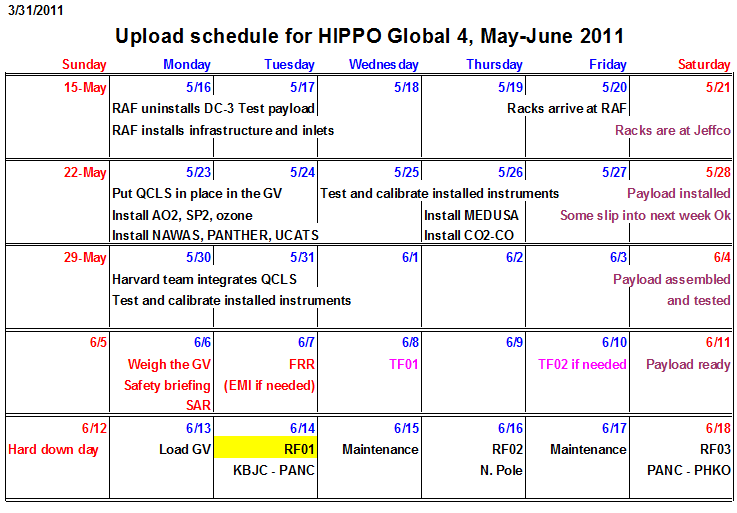
Work Schedule
HIPPO Global Phase IV is finished. No further updates to this work schedule will be posted.
Attention: As of 6/14/2011 the mission has been re-routed via Rarotonga, Cook Islands in order to conduct coincident sampling with the NOAA PFP flask program taking place on the island. Stop in Am. Samoa has been cancelled.
July 11, Monday: RF12 from Anchorage to Jeffco. Three missed approaches: Wrangell, Watson Lake and Bozeman. Estimated flight duration 6.5 hours.
July 10, Sunday: RF11 to the North Pole. Flight plan TBD; power and access at 0800, take-off at 1000. Meeting in the lobby of Captain Cook for departure at 0730.
July 9, Saturday: Maintenance day. Power and access on the ramp from 0800 to 1600 or until maintennace is finished. Flight planning telecon at 1100 AK time, which is 1300 MDT and 1500 EDT. Meeting in the lobby of Captain Cook for departure at 0730; Pavel will come back for telecon, people wanting to participate can come back from the maintennace at that time.
July 8, Friday: Hard Down Day. No power or access to the GV.
July 4, Monday NZ time: RF08 from Darwin to Saipan. Power and access at 0800; due to the need to re-supply the cryogens on Monday morning, expect delayed take-off at 1100 (to be confirmed). Both dry ice and LN2 will be replenished before the flight.
July 3, Sunday NZ time: Mainenance day in Hobart. Power and access from 0800 to 1600 as needed. Expect visitors to the GV. Telecon may take place at 0730, in which case participants will arrive at the airport about 30 min later. Departure from the hotel will be at 0730 for the RAF crew and people not participating in telecon.
July 2, Saturday NZ time: Hard Down Day in Darwin. No power or access. Rest recommended to all members of the crew.
July 1, Friday NZ time: RF07 from Hobart to Darwin. Expect an 8 hour flight with 5 low approaches, first one being at Cape Grim. Power and access at 0800, take off at 1000. Meet in the lobby at 0730 for departure to the airplane.
June 30, Thursday NZ time: Maintenance day in Hobart from 0800 to 1500. Meeting in the hotel lobby at 0745 for a ride to the airplane.
June 29, Wednesday NZ time: RF06 to the Southern Ocean, recovering in Hobart. Details TBD.
June 28, Tuesday NZ time: Maintenance day. Power and access on the GV from 0800 to 1600. Science team will meet in the lobby of the hotel at 0730 for departure to the GV.
June 27, Monday NZ time: Maintenance day. Power and access on the GV from 0800 to 1600. Science team will meet in the lobby of the hotel at 0730 for departure to the GV.
June 25, Saturday: RF05 from Rarotonga to Christchurch, New Zealand. Meet in th elobby of the hotel at 0730 for departure to the GV. Power and access at 0800, take-off at 1030-1100. Expect three standard dips. From 30S south the flight will stay below 18,000 feet. Estimated flight duration 7 hours.
June 24, Friday: Hard down day. No power or access to the GV.
June 23, Thursday: Maintenance day in Rarotonga. Power and access from 1100 to 1600 or as needed for instrumentation maintenance. Expect brief visits from the local media and VIPs. Meeting in the lobby of the Sanctuary at 1030 for departure to the GV.
June 22, Wednesday: RF04 to Rarotonga. We will meet in the lobby, checked out of the hotel for departure to the GV at 0930 to allow time for stopping to get lunch and for vehicle refueling. The time until 1100 will be without power, for replenishing cryogens and packing the baggage pit. Power will be provided at 1100 for a 1300 take-off. Expect three max altitude climbs, 8 dips and flight duration of 7.5 hours.
June 21, Tuesday: Maintenance day in Kona. Power and access from 0800 to 1600 or as needed for instrumentation maintenance.
June 20, Monday: Maintenance day in Kona. Power and access from 0800 to 1600 or as needed for instrumentation maintenance. Fred and Elliot meet with RAF staff in the lobby of King Kamehameha's at 0730 for the ride to the GV. Expect extensive work on NAWAS to repair the pump in addition to the regular maintenance of flask samplers and in situ analyzers. The rest of GV crew meet in #410 for a 0730 forecast meeting, then depart to the GV for maintenance (about 0815).
June 19, Sunday: Hard down day. No power or access to the aircraft.
June 18, Saturday: RF03 from PANC to PHKO. Estimated flight duration 8.5 hours, 8 dips with approach to Kona upwind from MLO. Power and access at 0800, take off at 1000.
June 17, Friday: Maintenance day in Anchorage. Power and access from 0800 to 1600. Please plan to come out to work on instruments starting at 0800. If people are finished working on instruments the RAF crew will power down the GV and leave, so don't expect to come out at 1400 for the first time and have access until 1600. Planning meeting at 1100 AK time (1300 MDT, 1500 EDT). Anchorage staff are welcome to meet in Pavel's room (T3, 1474).
June 16, Thursday: RF02 to 85N. Power and access at 0800, take off at 1000. Estimated flight duration 7.5 hours. All dips above the Arctic Ocean will be to 500 feet with a five minute hold at the low altitude. We expect 5 dips and return at cruise altitude.
June 15, Wednesday: Maintenance day in Anchorage. Power and access from 0800 to 1600. Please plan to come out to work on instruments starting at 0800. If people are finished working on instruments the RAF crew will power down the GV and leave, so don't expect to come out at 1400 for the first time and have access until 1600. Planning meeting at 1100 AK time (1300 MDT, 1500 EDT). Anchorage staff are welcome to meet in Pavel's room (#303).
June 14, Tuesday: RF01 from KBJC to PANC. Power and access ato 0800, take off at 1000; two dips, at Edmonton and at Watson Lake.
June 13, Monday: Maintenance and GV load-up day, power and access from 0730 to 1700.
June 12: Hard down day; EOL staff traveling to Anchorage.
June 11, Saturday: Day off unless access is necessary.
June 10, Friday: Maintenance day, power and access from 0730 to 1700.
June 9, Thursday: TF02 to the W. Texas. Power and access start at 0800; take off at 1030. Approximate flight plan can be seen here. Estimated flight duration is 6.25 hours.
June 8, Wednesday: Maintenance day, power and access from 0730 to 1700.
June 7, Tuesday: TF01 to Farmington with low approach; overfly Los Alamos TCCON site.
June 6, Monday: 0800 weigh the GV begins; 0900 - safety briefing for all personnel scheduled to fly on Test or Research flights, and for all stand-by personnel. 1030 - resume GV instrument preparations with the plan to conduct Systems Acceptance Review in the afternoon (1400 tentatively).
May 31 - June 3: Maintenance days. Continue work on instruments in the GV cabin.
May 28 - 30: Holiday weekend, no activities on the GV.
May 27, Friday: Continue with installation and connecting of the racks in the GV cabin.
Publication or Paper Isokinetic TWC Evaporator Probe: Calculations and Systemic Error Analysis
SOCRATES ISS
Data Set Documentation Guidelines
Data Archive Submission Instructions
Global Coordination Center
The purpose of the Global Campaign Coordination and Communications Center is to serve as the main communications and coordination hub between the PIs and the aircraft in the field. It will resemble a small operations center. It is important to note that HIPPO will range across 8 time zones and the International Date Line during the 21 day deployment. This will require flexibility in schedules and support to meet the needs of the aircraft mission. The major task of the Coordination Center will be to accumulate and distribute up-to-date information on mission planning, operations, science and logistics, in particular:
- Aircraft status
- Instrumentation status, RAF, PI and user
- Weather products and predicted conditions
- Chemical model output products
- Real-time in-flight contact and coordination, as required
- General project logistics
A team of EOL staff and interested PIs will be in the Center to support all aspects of the HIPPO deployment. A group of people representing these components will gather on a daily basis in person or teleconference. These people will also be present in the Center or on call during aircraft operations to assist with any questions or issues from the aircraft. The representatives are:
- Brigitte Baeuerle, Vidal Salazar - Global Operations Center Coordinator
- Al Cooper - EOL Aircraft Scientific Lead
- Karen Rosenloff, Eric Ray (NOAA/ESRL) - Project forecasters
- Steve Wofsy (PI, will call in from remote locations when possible)
- Pavel Romashkin (Aircraft Ops PM, will call in from remote locations when possible)
- Vidal Salazar (Ground Ops PM, will call in from remote locations when possible)
- Greg Stossmeister (Field Catalog)
- Bob Olson or designee - Aircraft maintenance
- Kurt Zrubek or designee - Instrumentation
- Scotty McClain or designee - Pilot, help with flight planning, changes etc. if needed
- Chris Webster or designee - SE
- (Contact information for all science groups to report immediate instrument issues)
We plan to have a HIPPO Daily Status Update Meeting during the field phase beginning on 5 January 2009 through 28 January 2009. The timing of the meeting each day may be adjusted to allow attendance by the participants deployed with the aircraft. The purpose of the meeting is to ensure that all Center representatives and personnel deployed with the aircraft are aware of all happenings since the last meeting, and to share any updated information they may have received directly at the Center. In addition it is documented in the operations part of the Field Catalog.
The Daily Meeting will include:
- Aircraft status
- Instrumentation status
- Weather and Chemistry brief
- Plans and schedules for the next 24-48 hours
- Logistics update
The status meeting will start with aircraft and instrumentation status. This will allow the technical staff to participate and leave, or stay if they choose to. The following discussion of the chemical and weather forecasts is intended to be brief but can be flexible as needed.
All information contained in the Daily Meeting will be posted to the HIPPO Field Catalog or on the RAF HIPPO Web site. The catalog will be updated at least once a day following this meeting and more often as changing conditions or status warrant. This will help ensure that anyone can see the status of HIPPO operations and facilities from anywhere, assuming they have access to the Internet. This includes all interested science groups, groups traveling to the main support stations (i.e. Anchorage, AK, Christchurch, NZ and San Jose, CR) with information such as aircraft delays, or particular instrument problems that may require bringing a critical spare into the field to the next support location.
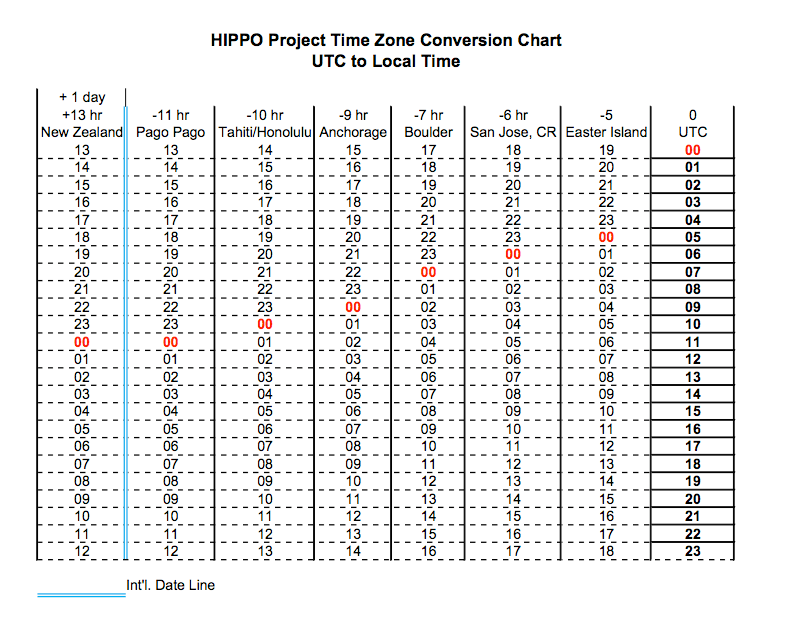
Time Conversion Chart
Below is a simple chart that shows all of the time zones we will visit during the upcoming HIPPO deployment. It includes a column of the 24 UTC time with conversions to all local time zones. Note that we will effectively range across 7 time zones and the International Date Line. Shown in red is the 'midnight' for UTC and local midnight for all local time zones.
HIPPO Merged Cross-Section Plots
SOCRATES Dropsondes
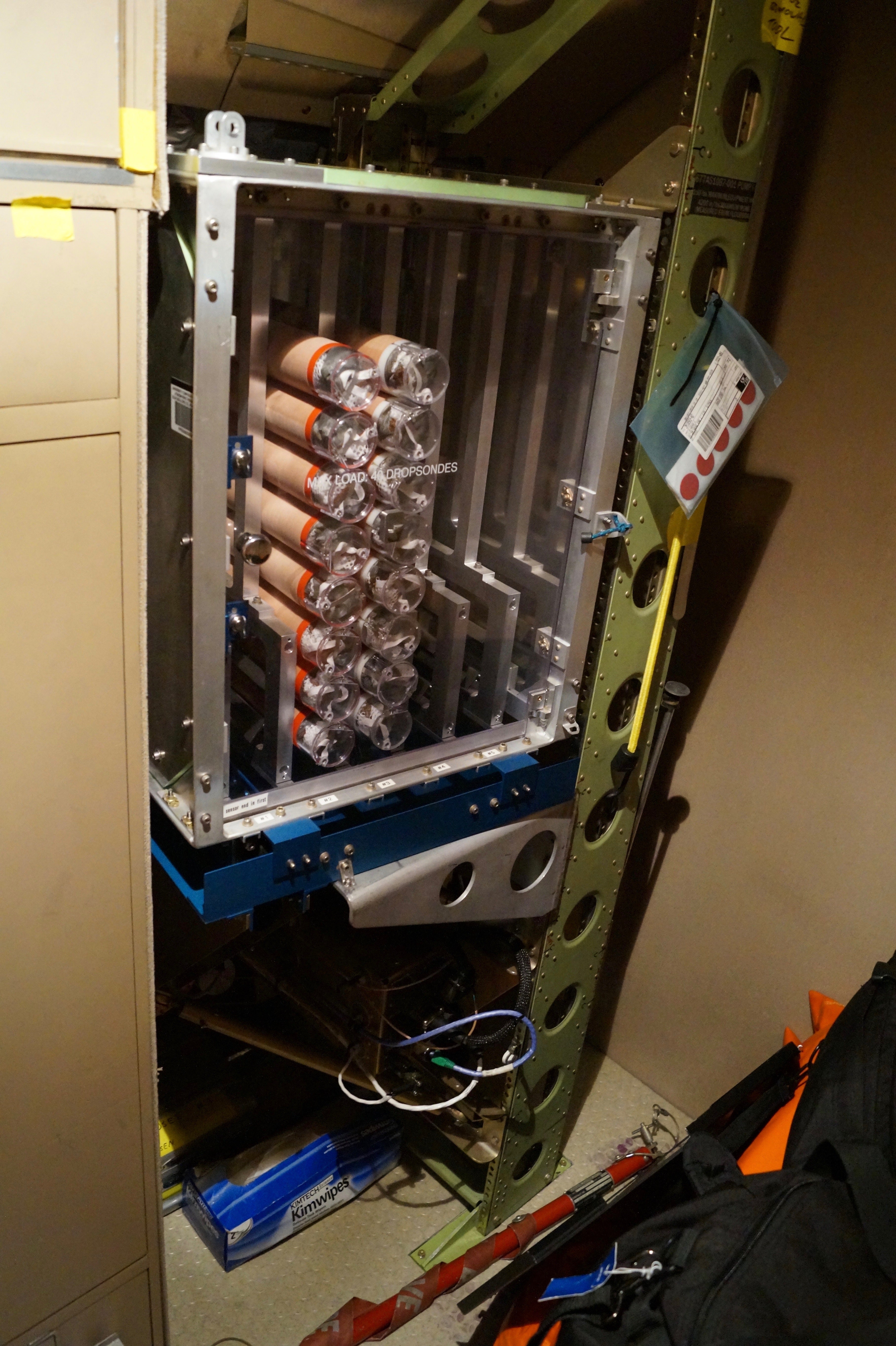
The NCAR GV was deployed on fourteen research flights over the Southern Ocean for the SOCRATES-2018 field campaign. One hundred eight soundings were collected by the NCAR AVAPS dropsonde system during eleven of those research flights between Jan 19 and Feb 24, 2018.
Flight Summary:
|
Flight # |
Date(d-m-yr) | # of Drops | Notes |
|---|---|---|---|
| RF01 | 15-01-2018 | 0 | Launcher Inoperable |
| RF02 | 19-01-2018 | 7 | Good Mission |
| RF03 | 22-01-2018 | 7 | Good Mission |
| RF04 | 24-01-2018 | 7 | Good Mission |
| RF05 | 25-01-2018 | 5 | Good Mission |
| RF06 | 29-01-2018 | 10 | Good Mission |
| RF07 | 31-01-2018 | 6 | Good Mission |
| RF08 | 03-02-2018 | 0 | Launcher Inoperable |
| RF09 | 04-02-2018 | 0 | Launcher Inoperable |
| RF10 | 07-02-2018 | 10 | Good Mission |
| RF11 | 16-02-2018 | 7 | No Sat Comm |
| RF12 | 17-02-2018 | 14 | Good Mission |
| RF13 | 19-02-2018 | 10 | Good Mission |
| RF14 | 21-02-2018 | 14 | Good Mission |
| RF15 | 24-02-2018 | 12 | Good Mission |
The atmospheric profiles collected by the dropsondes contain the following parameters:
| Field Number | Parameter | Units | Measured/Calculated |
|---|---|---|---|
| 1 | Time | Seconds | ----------------------------- |
| 2 | UTC Hour | Hours | ----------------------------- |
| 3 | UTC Minute | Minutes | ----------------------------- |
| 4 | UTC Second | Seconds | ----------------------------- |
| 5 | Pressure | Hectopascals (hPa) | Measured |
| 6 | Dry-bulb Temperature | Degrees Celcius (C) | Measured |
| 7 | Dewpoint Temperature | Degrees Celcius (C) | Calculated |
| 8 | Relative Humidity | Percent (%) | Measured |
| 9 | U Wind Component | Meters/Second (m/s) | Calculated |
| 10 | V Wind Component | Meters/Second (m/s) | Calculated |
| 11 | Wind Speed | Meters/Second (m/s) | Measured |
| 12 | Wind Direction | Degrees | Measured |
| 13 | Descent Rate | Meters/Second (m/s) | Calculated |
| 14 | Geopotential Altitude | Meters | Calculated |
| 15 | Longitude | Degrees | Measured |
| 16 | Latitude | Degrees | Measured |
| 17 | GPS Altitude | Meters | Measured |
Data Set Documentation Guidelines
Data Archive Submission Instructions
Headlines
A Lasting Legacy of the Bering Sea Project
Aging Murres in a Warming Sea
Bering Sea Ice
Bering Sea Krill and the Impact of Climate Change
Biophysical Moorings
Changing Wind and Ice Conditions in the Bering Sea
Circulation on the Bering Sea Shelf Revealed by Temperature and Salinity Measurements
Climate and Bering Sea Fisheries: Beyond a Northward March
Climate Change Could Stress Kittiwakes and Other Seabirds
Climate, Population Dynamics and Predator-Prey Overlap
Demography and Population Dynamics of Bering Sea Krill
Distributions of Bering Sea Forage Fish
Do Subsistence Harvests Reflect Ocean Ecology?
Documenting Nelson Island Natural and Cultural History
Does Water Temperature Influence Pollock Spawning?
Hidden Food in the Coldest of Times
Hot Spots in the Bering Sea
Hungry Fish Make a Difference
Late Winter in the Northern Bering Sea
Local and Traditional Knowledge of the Bering Sea Ecosystem
New Insights into Bering Shelf Circulation Structure
North-South Differences in the Eastern Bering Sea Shelf
Observation Synthesis and High Resolution Numerical Modeling
Organic Matter Mineralization in Bering Sea Sediments
Origin and Fate of Nitrogen on the Eastern Bering Sea Shelf
Protists - Tiny Predators of Phytoplankton
Return of the Zooplankton
Seabird Diets and Reproductive Success in the Pribilofs
Seasonal Bioenergetics in the Bering Sea
Steps Toward Predicting the Future of the Bering Sea Fish Catch
Subsistence Food Comes from a Vast Area!
Subsistence Harvests Show Continuity and Change
Summer Microzooplankton in the Bering Sea
Synergies Between Traditional and Western Environmental Knowledge
The Contribution of Dissolved Iron from Melting Ice in the Bering Sea
The Early Life of Walleye Pollock on the Eastern Bering Sea Shelf
The Impact of Changes in Sea Ice Extent in the Eastern Bering Sea
The Role of Edgy Phytoplankton in the Bering Sea Ice Environment
The Spring Bloom Matters
Understanding Bering Sea Groundfish Populations
Warm and Cold Years in the Southeastern Bering Sea
What is the Crystal Ball Saying about the Bering Sea?
Where You Are Is More Important Than Where You Started
Young Fish in a Warm Bering Sea
Zooplankton Populations in the Eastern Bering Sea
All Headlines Short Reports above combined in a single document
Bering Sea Project Management Plan
Bering Sea Project Presentation (30 April 2014)
NASA Science Focus: The Bering Sea