Search
DYNAMO Education & Outreach
Data Policy
Data Set Documentation Guidelines
Data Submission Instructions
HIPPO-1 Post Project Debrief
Data Set Documentation Guidelines
Data Submission Instructions
HIPPO-1 HIAPER Documentation Summary
PREDICT EDUCATION & OUTREACH
Data Set Documentation Guidelines
Data Submission Instructions
PREDICT HIAPER Documentation Summary
St Croix January Site Survey Report
Scientific Program Overview
Experimental Design Overview
Pre-Field Documentation
PREDICT Computer Data & Software Facility Staff
PREDICT Field Project Services Staff
PREDICT In-Situ Sensing Facility Staff
PREDICT Principal Investigators
Marsupial Tracking
IFEX-2010 Web Site at NOAA/AOML
IFEX proposed flight patterns
Caribbean Forecast Forum 2010
2010 National Hurricane Operations Plan
AVAPS History
DEVELOPMENT OF THE NCAR GPS DROPSONDE SYSTEM
NCAR's Atmospheric Technology Division (ATD) developed the first Omega-based dropwindsonde (ODW) in the early 1970's for the Global Atmospheric Research Program's (GARP) Atlantic Tropical Experiment (GATE). NCAR continued development and improvements of the ODW for the Global Experiment in the late 1970's and these sondes were used successfully (about 7,000 dropped) to study the influence of the tropical oceans on Northern Hemisphere weather and climate. After the Global Experiment, the dropwindsonde continued to be used by NOAA's Aircraft Operations Center (AOC) for hurricane research. In 1982 the ODW was adopted by the U.S. Air Force Air Weather Service's Hurricane Hunters for their mission to support the National Hurricane Program.
In 1987, EOL's Surface and Sounding Systems Facility (SSSF) began the development of an advanced digital dropsonde to support the Office of Naval Research's (ONR) 1988-1989 Experiment on Rapid Intensification of Cyclones over the Atlantic (ERICA). This development produced the Lightweight LORAN Digital Dropsonde (L2D2), a smart (microprocessor-based) sonde that was lightweight (300 grams vs. 1500 grams for the ODW), incorporated LORAN instead of Omega (Omega was added later in a redesign for the Air Force) for windfinding, and used digital instead of analog circuitry to measure the state parameters and telemeter the data back to the aircraft. This new digital sonde reduced or eliminated noisy data and also provided the capability (extra channels) for the incorporation of other measurements. The Lightweight Digital Dropsondes (LD2) have supported numerous national and international field programs, including STORMFEST, TOGA COARE, and CEPEX. They have been successfully launched from a variety of aircraft: the U.S. Air Force WC-130, the NCAR Electra, C-130, Sabreliner, and King Air, the University of Wyoming King Air, the NASA DC-8, NOAA P-3's, the Aeromet Learjet, and the DLR Falcon. In 1992 NCAR licensed the LD2 design to Radian Corp., Austin, Texas, which manufactured the sonde for use by the Air Force and the worldwide community.
In 1993, SSSF performed a feasibility study for the German Aerospace Research Establishment, DLR, for an advanced lightweight digital dropsonde incorporating GPS, in support of DLR's development of a new high-altitude research aircraft. The German aircraft company, Grob, had been contracted to develop a human-crewed stratospheric research aircraft, the STRATO 2C, designed to fly at altitudes between 16 and 24 km for up to 48 hours. A human-crewed aircraft flying at these altitudes would open up many research opportunities: studying the ozone deficit in the Antarctic and Arctic vortices, the effect of clouds and aerosols on radiation transfer, the global radiation budget, the distribution of climate-related trace gases, and the movement of tropical cyclones. Most of these research missions are aided by, or require, an atmospheric profile below the aircraft-a task best done, on a global basis, with a GPS dropsonde.
After completing of the DLR study, SSSF learned that NOAA's Aircraft Operations Center was purchasing a new Gulfstream IV (G-IV) jet for use in weather reconnaissance and research missions. A primary requirement in many of the new jet's mission profiles was that of measuring and recording the atmospheric conditions below the aircraft with a dropsonde system that could be operated worldwide.
The requirements for the DLR STRATO 2C and NOAA G-IV dropsonde systems were nearly identical, including the time schedule for delivery. In addition, NCAR's future support for national and international research programs with dropsonde systems both with the NSF/NCAR C-130 and Electra and in other research aircraft (e.g. NASA DC-8) also required a new system with worldwide operational capability to replace the existing Omega and LORAN systems. This need was primarily driven by the shutdown of the Omega navigation system in 1997 and the potential loss of the LORAN system around 2008. The marginal vertical wind resolution of Omega and LORAN was also a major consideration. Because of the required smoothing interval (60 sec), the vertical wind resolution is only on the order of 300 meters for LORAN and still worse with Omega. GPS promised far superior accuracy in wind profiling. As a result of the mutual requirements for a GPS dropsonde system, NCAR entered into a joint agreement with NOAA and DLR to develop the new GPS dropsonde and aircraft data system with the three organizations sharing the costs for the common portions of the program.
The following are the original NOAA/DLR/NCAR dropsonde system design requirements, now specifications of the operational system.
Global operation, at altitudes up to 24 km
Deployment at indicated airspeeds up to 250 kts
Simultaneous operation of up to four sondes (4-channel data system) in the 400-406 MHz Meteorological Band
Sonde descent time approximately 12 minutes when released from 12 km
0.5-second sample rate for wind and thermodynamic data
Sonde weight < 400 grams
Sonde size 2.75 inches (6.98 cm) diameter by 16 inches (40.6 cm) long
Sonde shelf life 3 years
Operational telemetry range of 325 km
AVAPS Aircraft Data System
Description of the AVAPS Dropsonde Aircraft Data System
The aircraft data system is completely different, both in system software and hardware, from all previous dropsonde systems NCAR has developed. The most significant development in the hardware is the narrow-band 400 MHz telemetry receiver. The design requirements of the aircraft data system are:
- Operation by one person
- Receive and process data from four dropsondes simultaneously
- Simple Graphical User Interface (GUI)
- Continuously output real-time PTH and wind for each channel to the aircraft computer systems as the dropsondes are descending
- Operation on aircraft with or without aircraft data systems.
The most significant feature of the AVAPS data system is its ability to receive and process data from up to 8 sondes simultaneously, essential for obtaining a fine horizontal distribution of soundings. Launch procedures are simple enough to allow releases less than 20 seconds apart, if desired.
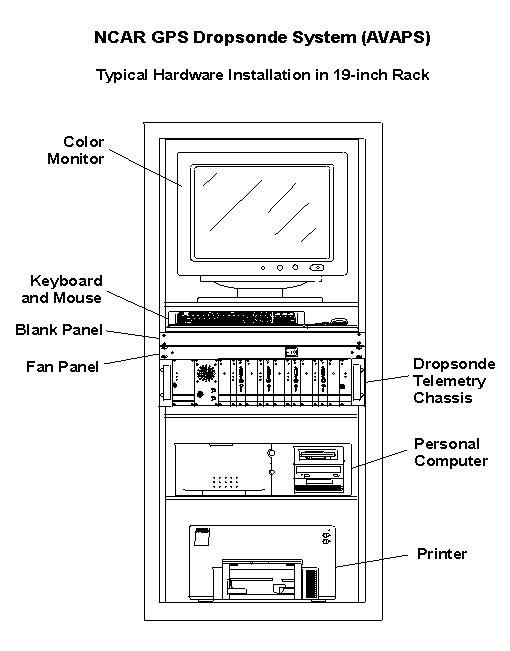
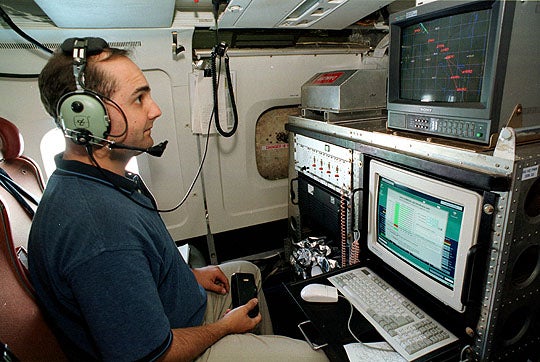
The aircraft hardware is typically composed of a computer, monitor, telemetry chassis, and launcher. The hardware is designed for installation into a standard 19-inch rack. The system also requires a GPS antenna mounted on the top of the aircraft and a UHF antenna, for receiving the dropsonde signal, mounted on the bottom of the aircraft. If available, an Ethernet connection to the main aircraft data system for flight level information is highly desirable.
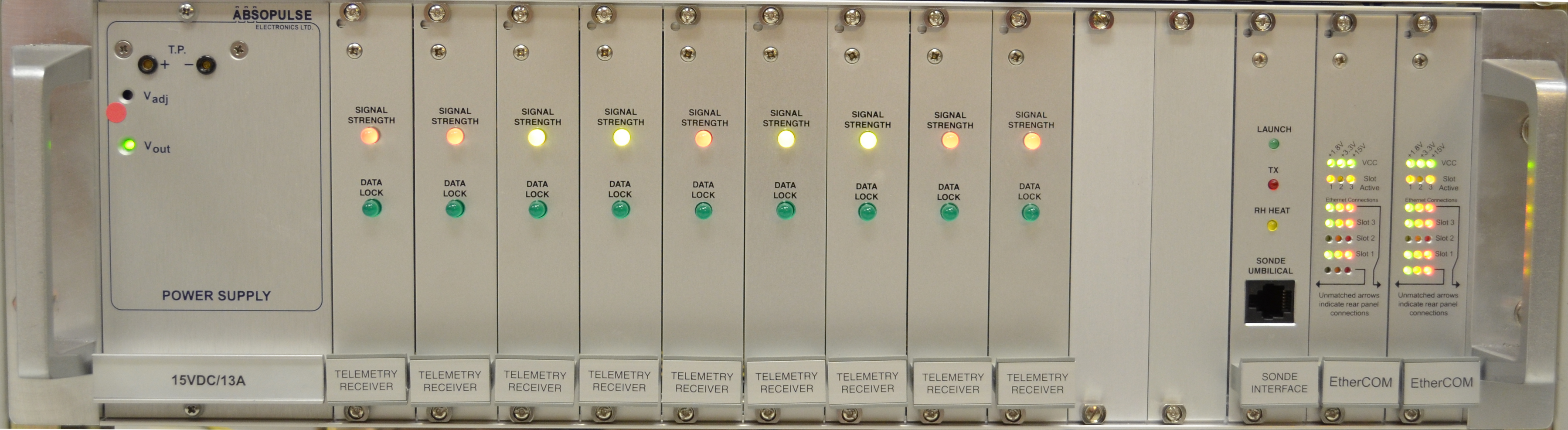
Telemetry Chassis Subsystem
Each install of AVAPS requires a receiver telemetry system. The receiver telemetry system comprises some sensitive 400MHz radio frequency (RF) modules with some tunable decoding hardware. All these components are integrated into a 3U (5.25") tall 19" rack that mounts into standard width computer racks. The chassis is constructed of the following electrically identical removeable modules:
- One Power Supply Module: A single Power Supply module provides the DC voltage required for telemetry chassis operation.
- Telemetry Receiver Module: The Telemetry Receiver module is a narrow-band 400 MHz receiver used to receive and demodulate the telemetry data from the dropsonde. Depending on requirements, there can be up to 10 receivers in a chassis, where 8 can track sondes, one records engineering data for all of the deployed dropsondes, and the last is a potential spare.
- Dropsonde Interface Module: The dropsonde interface module provides the local interface required to prepare a dropsonde for launch. The dropsonde is connected to the module using a specialized interface cable. Through this interface, dropsondes are initialized prior to dropping.
Each of the above modules, with the exception of the power supply, contains a microprocessor and a communication interface. The computer controls all functions and receives data from each module through I/O cards and displays the status of each module. All of the hardware in the telemetry chassis is designed and built by NCAR.
AVAPS Software
Real-Time Data System
The AVAPS system software is written in LabVIEW, a graphic programming language developed by National Instruments that permits multi-tasking in the Microsoft Windows operating system. Multitasking capability is critical for a multi-channel dropsonde data system. The system software performs several functions prior to release of a dropsonde. The software logs the current system configuration and flight mission information, and initializes all electronic hardware for the release. A graphical spectral analysis of the 400-406 MHz meteorological RF band is provided so that the operator can select a transmitter frequency free of interfering signals. The system then performs a functional test of the sonde's PTH sensors and the 400 MHz transmitter by displaying cabin PTH measurements from the sonde transmitted through the 400 MHz telemetry link. When configured, the PC also communicates with the aircraft's sonde launch system, via the Dropsonde Telemetry Chassis, to launch a sonde at the operator's command. If the host aircraft has a data system to provide flight-level meteorological data (pressure, air temperature, dew point, wind speed, wind direction, altitude, etc.), these are automatically received by the AVAPS PC. However, the AVAPS does not require an interface with a flight-level data system in order to function.
After launch, the software processes PTH and GPS data from up to eight dropsondes via the Dropsonde Telemetry Chassis. PTH data is available every 0.5 seconds and wind data is available every 0.25 seconds. The AVAPS system PC displays in real-time the PTH and wind data both in text and graphically, also displayed is the number of GPS satellites being tracked by the dropsonde, and geopotential altitude (computed hydrostatically from the PTH data). These and other parameters are also stored on the PC hard drive for archiving, and can be directed to other computers on the aircraft for further processing and transmission off the aircraft.
ASPEN Software - Post Processing
After a sounding is complete, the data can be analyzed and modified using a separate program, ASPEN (Atmospheric Sounding Processing Environment). The application functions identically in the Linux, Apple OSX, and MS Windows environments.
ASPEN capabilities:
- Automatically apply quality control procedures to the sounding data
- Present data in tabular and graphical forms
- Automatically determine levels and code them in WMO and BUFR message formats
- Transmit the WMO messages to other systems
- Save the raw and derived data products in various formats
Since Aspen can process data provided in the AVAPS "D" file, NCAR GAUS formats, it is able to analyze both dropsonde and upsonde soundings. Aspen is designed to operate as automatically as possible, while allowing the user to have some control over the Quality Control (QC) methods. For instance, as soon as the user selects a sounding file for processing, the data is brought into Aspen and automatically analyzed. In most cases this first pass will be the only one required. If the processing needs to be modified, the user can change the QC parameters and reprocess the data as many times as necessary. An extensive series of QC algorithms are applied to the data. These algorithms typically have one or two parameters that may be adjusted by the user if the default values are not suitable for a particular sounding. The user can save the modified options, so that when a new sounding is opened, the initial analysis will use the customized QC parameters. Aspen can have up to six sounding files open at the same time. This makes it convenient to compare soundings.
For more information about ASPEN software, go to this link.
AVAPS Launchers
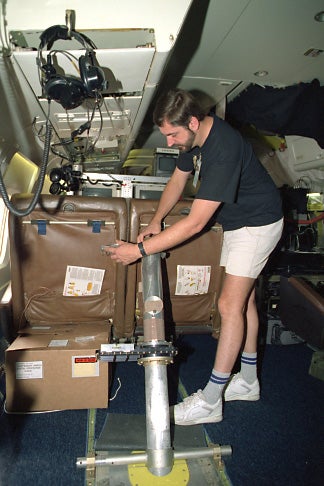
AVAPS launchers are either manually operated or fully automated. In manual launchers, an operator initializes and loads the dropsondes into the launch tube. The release valve may also be operated manually or through an electronically controlled valve. Fully automated launchers are much more complex and designed for remote controlled operation. In these launchers, the dropsondes are transported from a storage bin into the launch tube, initialized, and then launched by a fully robotic system. The operator controlling the system may be onboard the aircraft or may be located at the mission control center on the ground. Manual systems are still used by the bulk of AVAPS community, but there is growing interest in automated systems.Currently, there are only 2 fully automated AVAPS Launchers. One is implemented on the NSF/NCAR G-V and the other is on the NASA Global Hawk.
AVAPS Dropsondes
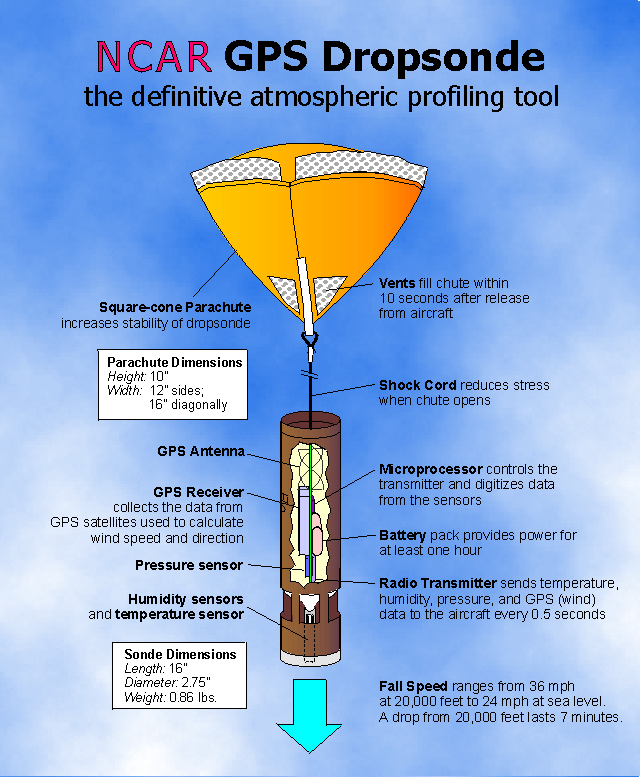
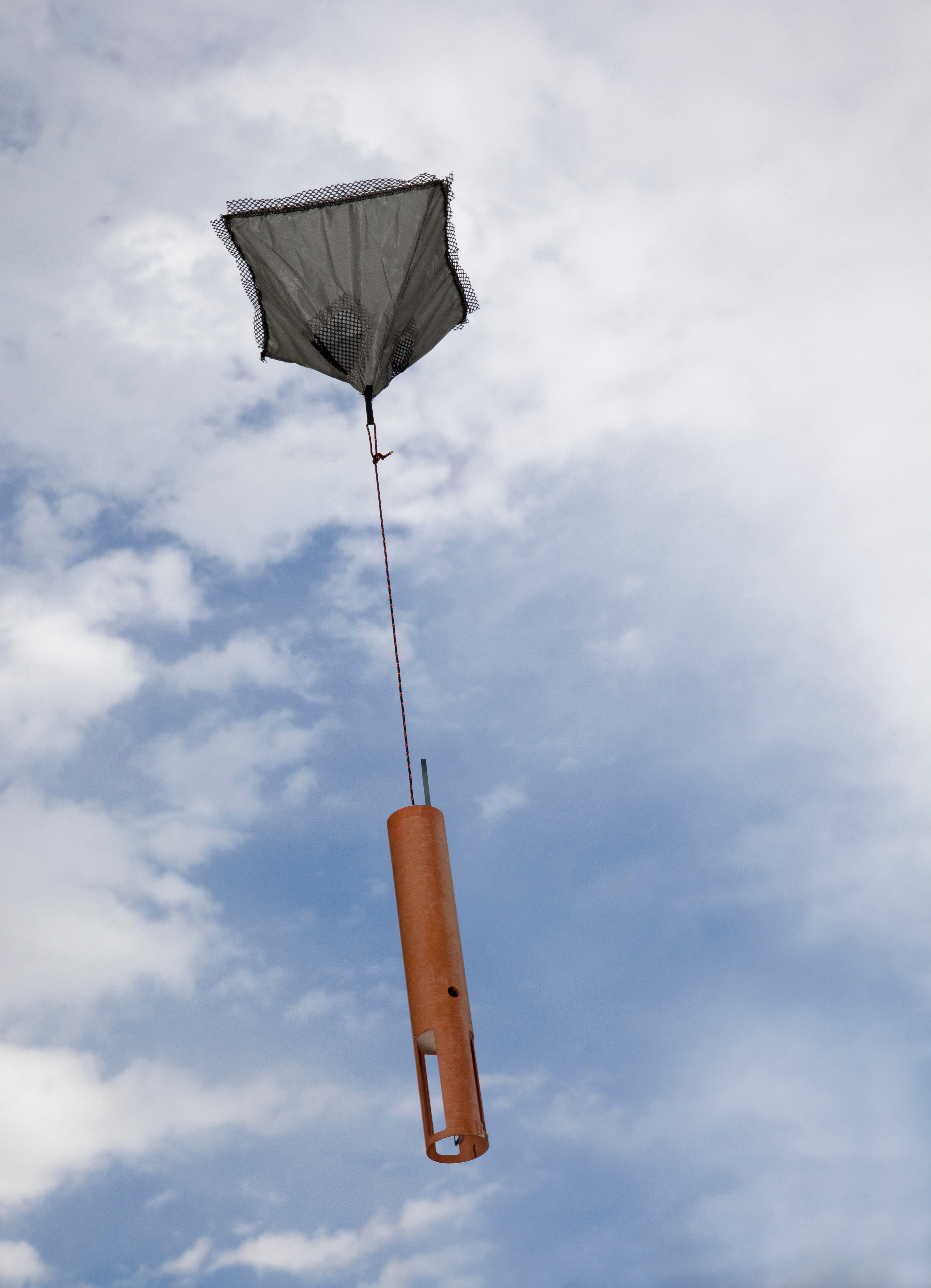
NCAR has developed many generations of dropsondes. The sonde model currently mass produced and supported by NCAR is the NRD41 dropsonde.
Link to What is a Dropsonde?
NRD41
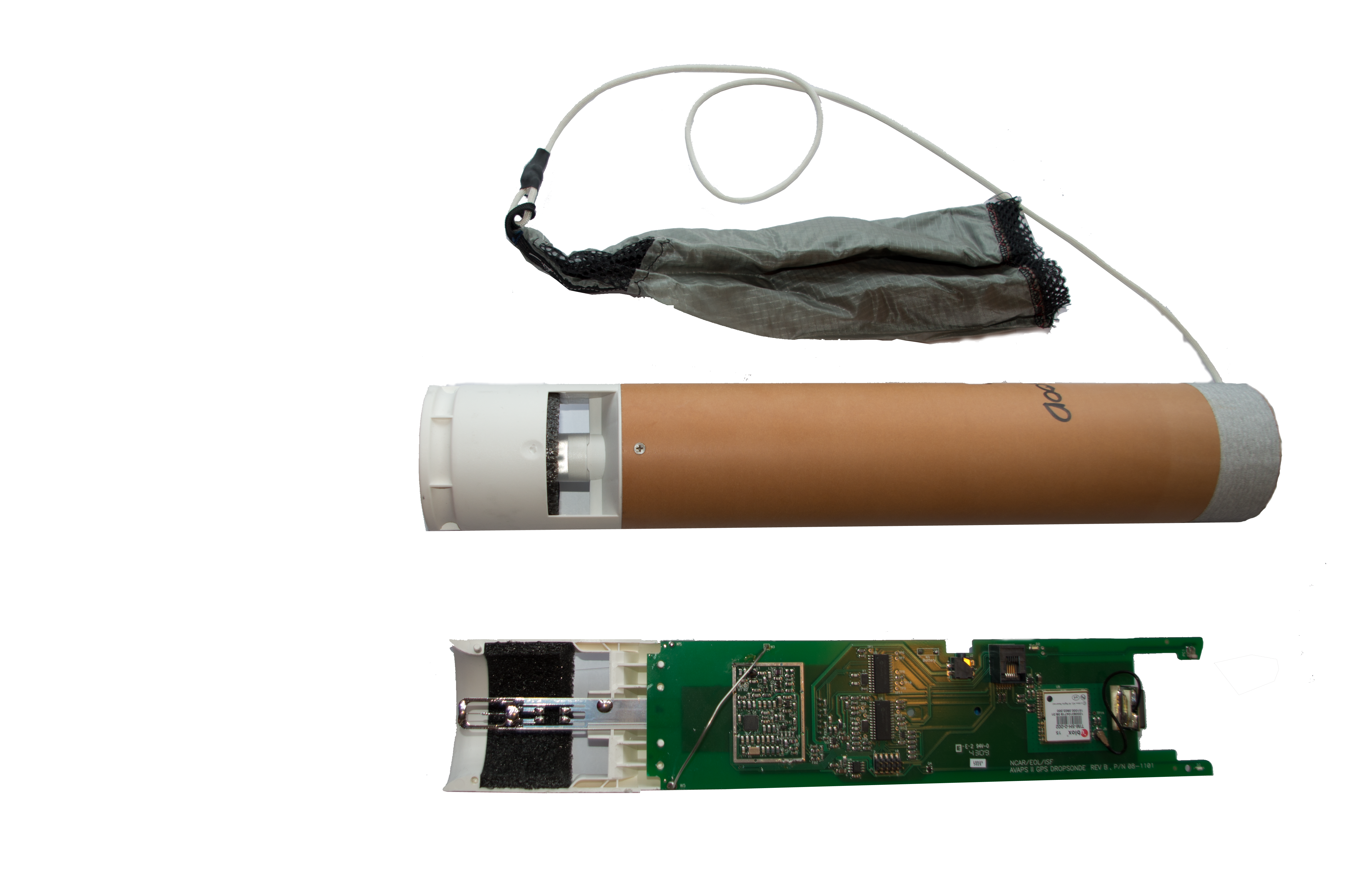
The NRD41 dropsondes incorporate a pressure, temperature, and humidity sensor module designed by Vaisala, Inc. for their RS41 radiosonde, and a GPS receiver module independent of the sensor module. UCAR has licensed Vaisala Inc. of Louisville, Colorado, to mass produce the NCAR GPS Dropsondes NRD41 and RD41.
The NCAR Research Dropsonde NRD41 is electrically equivalent to the larger RD41 dropsonde, and has been designed to work with both automatic and manual launchers using the smaller form factor.
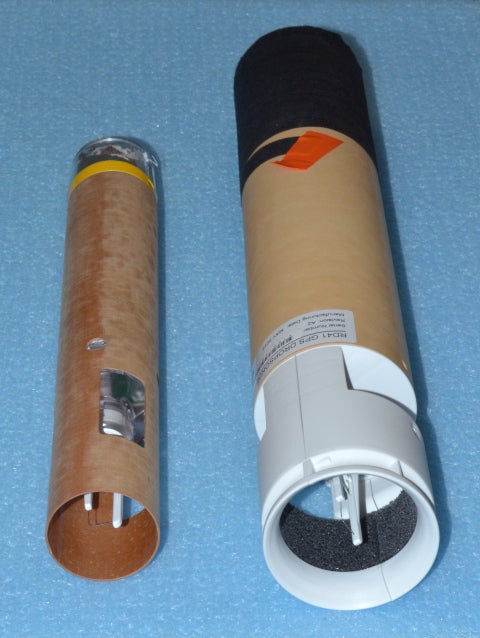
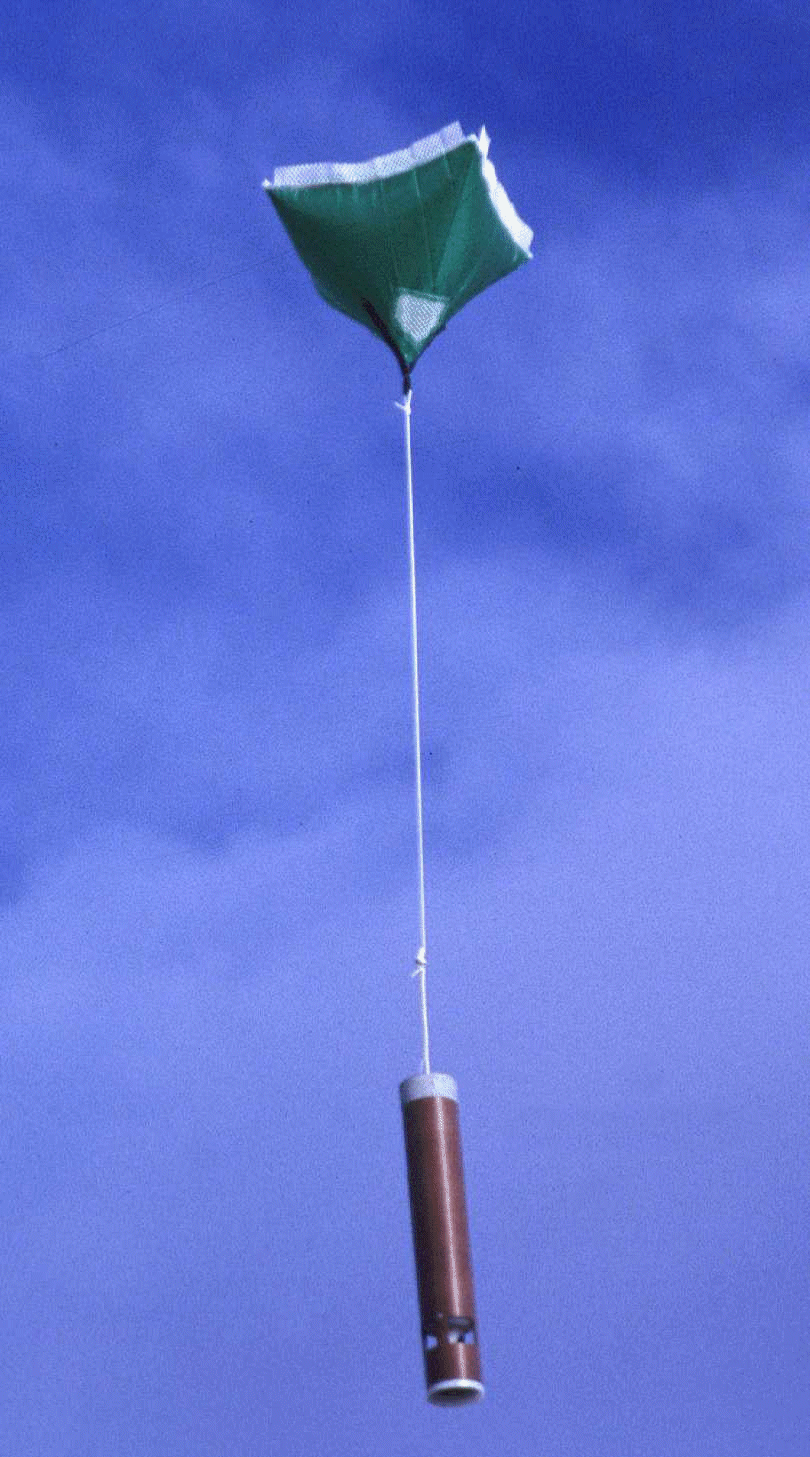
NCAR developed NRD41 (left) and RD41 (right) dropsonde models. Both dropsonde models have been licensed to Vaisala for mass production.
xRD41 Sensor Specifications
| Range | Uncertainty | Resolution | |
| Pressure | 1080-100 hPa | ± 0.5 hPa | 0.01 hPa |
| Temperature | -90 to +60 C | ± 0.2 C | 0.01 C |
| Humidity | 0-100% | ± 3% | 0.01% |
| Horizontal Wind | 0-200 m/s | ± 0.5 m/s | 0.01 m/s |
Older sonde models
RD41
The RD41 is the last of the larger form factor produced dropsondes. It is the same physical size as the older models RD94 and RD93 but uses the PTU sensor module of the Vaisala RS41 radiosonde. Electronically it is identical to the smaller NRD41 dropsonde, but uses a the older ribbon delayed parachute release. It can only be used in manual launchers.
NRD94
The NCAR Research Dropsonde NRD94 is electrically equivalent to the RD94 dropsonde, but has been designed to work with automatic or manual launchers using the smaller form factor. It was in used between 2010 and 2018.
RD94
The RD94 was produced between 2009 and 2018 and was the first dropsonde to incorporate a code correlating GPS for improved wind and position measurements.
MIST
The Miniature In situ Sounding Technology (MIST) dropsonde was used for driftsonde projects between 2006 and 2008. It was the first dropsonde in the 1.75"x12" form factor.
RD93
The RD93 was designed in the mid 90's and was used until 2010. It was the first dropsonde to use the GPS navigation system for wind finding.
Overview of NCAR GPS dropsonde models
| Dropsonde Type | Diameter (cm) | Length (cm) | Weight (g) | Parachute size (cm x cm) |
Launcher Type | Comments |
|---|---|---|---|---|---|---|
| NRD41 | 4.5 | 30.5 | 169 | 20 x 20 | Manual/Automatic | Currently in production at NCAR and licensed for production to Vaisala |
| RD41 | 7.0 | 40.6 | 323 | 30 x 30 | Manual | Produced from 2018-2023 |
| RD94 | 7.0 | 40.6 | 320 | 30 x 30 | Manual | Produced 2009-2018 |
| NRD94 | 4.5 | 30.5 | 167 | 20 x 20 | Manual/Automatic | Produced by NCAR for automatic launchers on NASA Global Hawk and NSF/NCAR G-V |
| MIST | 4.5 | 30.5 | 184 | 20 x 20 | Gondola only | Produced for Driftsonde in 2010 |
| RD93 | 7.0 | 40.6 | 400 | 30 x 30 | Manual | Produced 1996-2009 |
Historic dropsonde models
Dropsondes have been designed and built at NCAR since the 1960s. These include the Omega DropWindsonde (ODW), the Lightweight Loran Digial Dropsonde (L2D2) and the Lightweight Omega Digital Dropsonde (LOD2), which were in use between 1980 and 1995. These older models used the Omega and LORAN radio navigation systems for wind finding.