Search
HIPPO V Flight Plan
 This easily lends itself for comparison studies of the atmospheric gases in the northern hemisphere to those in the southern hemisphere. Additionally, the three-year window of this study will allow for sampling in every season in both hemispheres giving researched a complete and comprehensive picture of our atmosphere.
Britt Stephens, an NCAR scientist and HIPPO co-principal investigator, describes the field project's flight path and how the flights will help researchers determine carbon dioxide's influence in different regions of the globe.
Phase V Flight Plan
The HIPPO V mission is broken down into 13 Research Flights (RF) over a one month period. The flight plan is as follows:
- RF01 :: Local Research Flight
- RF02 :: Local Research Flight
- RF03 :: Boulder, Colorado to Anchorage, Alaska
- RF04 :: Anchorage, Alaska to Northern Polar Region #1, return to Anchorage
- RF05 :: Anchorage, Alaska to Kona, Hawaii
- RF06 :: Kona, Hawaii to Rarotonga, Cook Islands
- RF07 :: Rarotonga, Cook Islands to Christchurch, New Zealand
- RF08 :: Christchurch, New Zealand to Southern Polar Regions, return to Christchurch
- RF09 :: Christchurch, New Zealand to Rarotonga, Cook Islands
- RF10 :: Rarotonga, Cook Islands to Kona, Hawaii
- RF11 :: Kona, Hawaii to Anchorage, Alaska
- RF12 :: Anchorage, Alaska to Northern Polar Region #2, return to Anchorage
- RF13 :: Anchorage, Alaska to Boulder, Colorado
Boulder, Colorado USA
 The GV lives out at the NCAR's Research Aviation Facility (RAF) out at Rocky Mountain Metropolitan Airport (RMMA), in Jefferson County, when it is not out flying on research studies. The mission of the Research Aviation Facility is to develop and operate instrumented research aircraft for the atmospheric science community at a level of sophistication and operational complexity not generally available elsewhere.
Boulder, CO Weather
Current Conditions : 70.3F / 21.3C, Clear - 9:08 AM MST Feb. 10
Fri, 10 Feb 2017 09:08:00 MST
Temperature: 70.3°F / 21.3°C | Humidity: 15% | Pressure: 29.76in / 1008hPa (Steady) | Conditions: Clear | Wind Direction: NNW | Wind Speed: 10.1mph / 16.3km/h
Today as of Feb. 10 4:10 AM MST
Fri, 10 Feb 2017 04:10:00 MST
Today - Partly cloudy and unseasonably warm. Highs in the lower to mid 70s. West winds 20 to 30 mph at times.
Tonight as of Feb. 10 4:10 AM MST
Fri, 10 Feb 2017 04:10:00 MST
Tonight - Partly cloudy. Lows in the lower 40s.
Anchorage, Alaska USA
 The first stop of the GV will be in Anchorage, Alaska, where the plane can be serviced, resupplied and have any need maintenance performed.
Anchorage is a convenient location for the GV stop and refuel before heading up towards the North Pole. The amount of fuel that can be carried on any given flight dictates how far the aircraft can travel because it needs enough fuel to travel as far north as possible and have enough fuel to return Having a location that the GV can stop at to be serviced and refueled this far north allows for research to occur as far past the Arctic Circle (66.56083° N) as possible. The GV will actually get closer to 85° North, with enough fuel to travel safely back to Anchorage.
From Anchorage Alaska, the GV flies roughly an out-and-back flight towards the North Pole, then comes back to Anchorages for refueling and maintenance. The GV will then make its way south to Hilo, Hawaii on a 8 hour flight, all the while taking atmospheric samples from altitudes of 1000' - 45,000' above sea level.
Anchorage , AK Weather
North Pole (Towards 85° North)
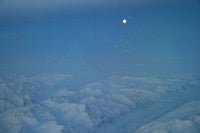 The GV will travel as far north as possible, getting as close to 85° north, just 5° shy of the North Pole (90° N, 0°W). The aircraft needs enough fuel to get back to Anchorage, so it can only reach 85° N, but it is still able to get great samples of the atmosphere at northern latitudes.
With the sun only rising and setting only a few hours apart during the polar autumn months, the crew on the Phase I mission were able to experience two sunrises on their 7.5 hour flight towards the North Pole and back. On their northbound route, they saw the sunrise in the east out of the right-side of the plane and on the southbound route they experienced yet another sunrise out the left side of the plane.
Image Narration | Shadow of the Earth by Steve Wofsy, Principal Investigator
Listen to Steve Wofsy, HIPPO Principal Investigator, narrate how this picture shows the shadow of the Earth in the Arctic.
This image shows the shadow of the Earth as it's reflected off of little ice particles that are in the Arctic atmosphere. In the sunset, anywhere in the country if the air is very clear and you look to the east you can sometimes see the shadow of the Earth, but this angle and this very cold atmosphere makes a particularly dramatic shot. And underneath you see the Alaska Range, which is obviously very forbidding and in many respects very starkly beautiful at this time of year.
Alert, Nunavut, Canada Weather | Closest Town to North Pole
Kona, Hawaii USA
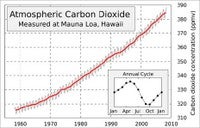 Another reason that sampling near Hawaii is important is that there is a NOAA research station based on Mauna Loa, Hawaii (Earth's largest volcano) where atmospheric carbon dioxide (CO2) is measured. The important difference is that the measurements taken on top if Mauna Loa are from a single fixed point, whereas the measurements and sampling taken during the HIPPO project come from a vertical profile of the atmosphere, so many samples from 1000' to 45,000', near Hawaii, will be taken and can be compared to the CO2 measurements taken from Mauna Loa.
Kona, HI Weather
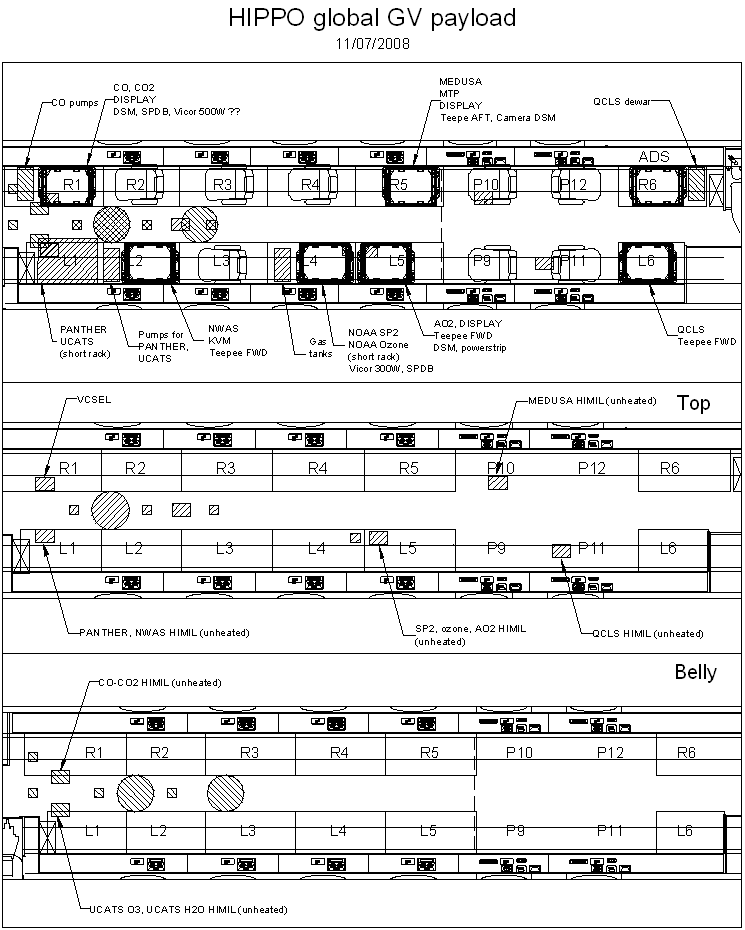
GV Floor Plan
This is the final floor plan (link to PDF version here).
The payload and aircraft ops require the following staff to be onboard:
- 1 for SP2-Ozone
- 1 for PANTHER, UCATS and NWAS
- 2 for QCLS, one of these is also mission scientist
- 1 for O2, MEDUSA
- 1 RAF mechanic
- 1 ADS technician / safety officer
- 1 RAF project manager
-------------------------------
8 total seats in the back.
Wing stores: The project will fly with 4 PMS instruments: RWI: MTP; RWO: UHSAS; LWI: CDP; LWO: 25 um 2D-C.
Rarotonga, Cook Islands
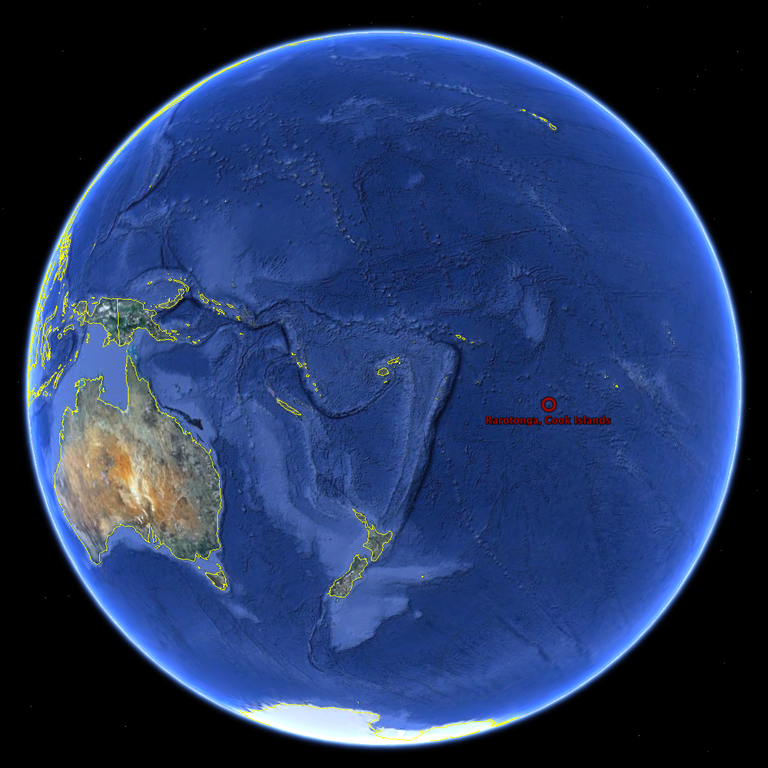
Rarotonga is the largest of the 15 islands in the Cook Islands, and home to the Rarotonga International Airport, which is able to provide the services needed for the GV during the stop-over. Complete aviation services are hard to come by in the South Pacific!
Additionally, a local air charter, Air Rarotonga, has been taking air samples for the National Oceanic and Atmospheric Administration (NOAA) for the last few years. The local community has been very welcoming to the HIPPO project and they are excited to have it visit for a few days, which is very much appreciated by the entire HIPPO crew.
Rarotonga, Cook Islands Weather
Current Conditions: 82F / 28C, Mostly Cloudy - 7:00 AM CKT Feb. 10
Fri, 10 Feb 2017 07:00:00 CKT
Temperature: 82°F / 28°C | Humidity: 89% | Pressure: 29.80in / 1009hPa (Steady) | Conditions: Mostly Cloudy | Wind Direction: NW | Wind Speed: 12mph / 18km/h
Forecast for Friday as of Feb. 10 7:10 AM CKT
Fri, 10 Feb 2017 17:10:00 GMT
Chance of a Thunderstorm. High:86 ° F.
Forecast for Friday Night as of Feb. 10 7:10 AM CKT
Fri, 10 Feb 2017 17:10:00 GMT
Chance of a Thunderstorm. Low:79 ° F.