Search
ICE-L Photos & Videos
PECAN ISS IOPs
Quick Questions for ORCAS PIs
Q: Tell us a bit about ORCAS and the background of the research.
 |
|
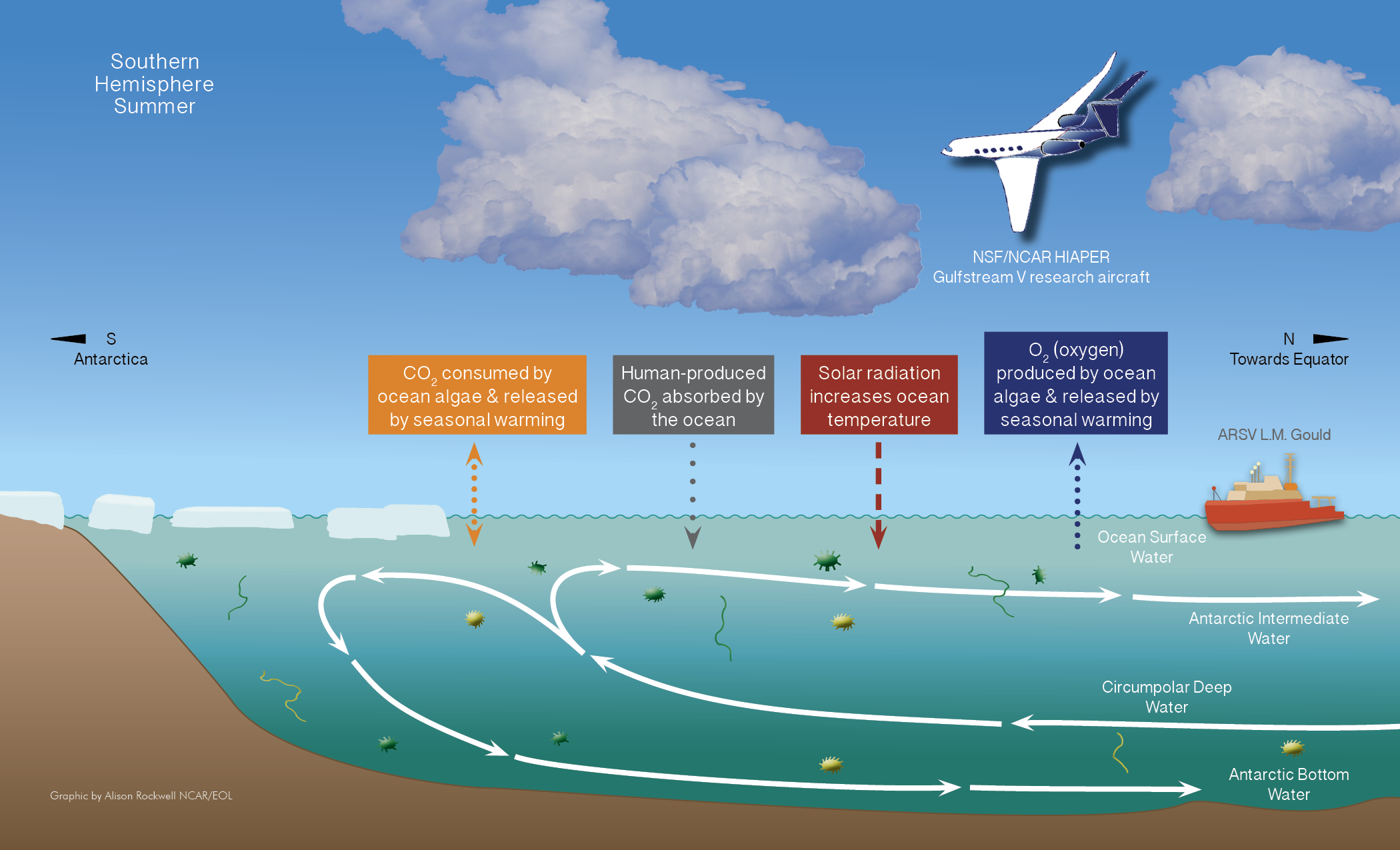
ORCAS infographic.
Click to enlarge. |
A: The O2/N2 Ratio and CO2 Airborne Southern Ocean Study (ORCAS) is a National Science Foundation (NSF) atmospheric research project that is based in Punta Arenas, Chile from 15 January - 28 February 2016, and is studying the role of the Southern Ocean in the exchange of oxygen (O2) and carbon dioxide (CO2). ORCAS will use the NSF/NCAR HIAPER Gulfstream V research aircraft with a suite of specially designed instruments on board to make measurements of gases in the atmosphere and other environmental conditions over the course of approximately 14 research flights.
Climate models do not represent this portion of the globe very well in part due to limited measurements, so the data collected through this study will help advance our models so the future trajectory of the climate can be better understood.
The project is led by scientists from the National Center for Atmospheric Research (NCAR), Scripps Institution of Oceanography, University of Colorado, University of Michigan, NASA/JPL, and University of Miami.
Results and questions raised by earlier studies, including HIPPO, a pole-to-pole study of greenhouse gases, are significant motivators for the ORCAS project.
Q: The Southern Ocean is unique in many ways, can you explain why it has such important implications to climate change?
 |
|
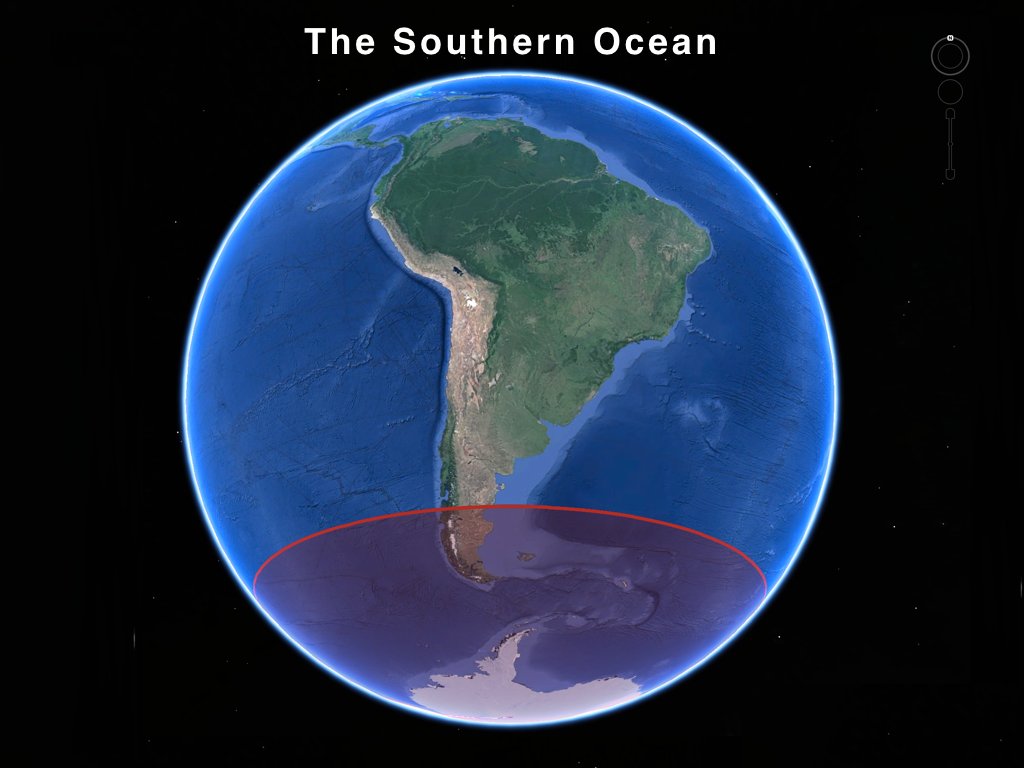
The Southern Ocean.
Click to enlarge |
A: The Southern Ocean, the water below approximately 45º South that circumnavigates Antarctica, plays a critical role in setting the overturning circulation for the global oceans, and determining the partitioning of heat and dissolved gases between the atmosphere and deep ocean. The region is particularly sensitive to climate change, and evidence suggests that it is already responding to observed changes. The Southern Ocean currently absorbs a significant amount of human emitted CO2, but the future trajectory of this reservoir is highly uncertain. Sparse observations and complex interacting physical and biological processes limit our understanding of biogeochemistry and climate feedbacks at high southern latitudes. The measurements proposed under ORCAS will add new observational constraints with unprecedented spatial coverage for Southern Ocean biogeochemical variables.
The Southern Ocean is the primary pathway for CO2 and heat to enter the deep ocean because it is one of the few locations on Earth where very cold waters from deep ocean currents are exposed to the atmosphere before the proverbial "conveyor belt" of ocean circulation brings them back down to the depths, these currents are vital in partitioning and distributing nutrients and heat throughout the entire ocean. Climate models are challenged to accurately predict the changes in uptake of CO2 and heat by the Southern Ocean.
Q: How are you collecting data for this project?
 |
|
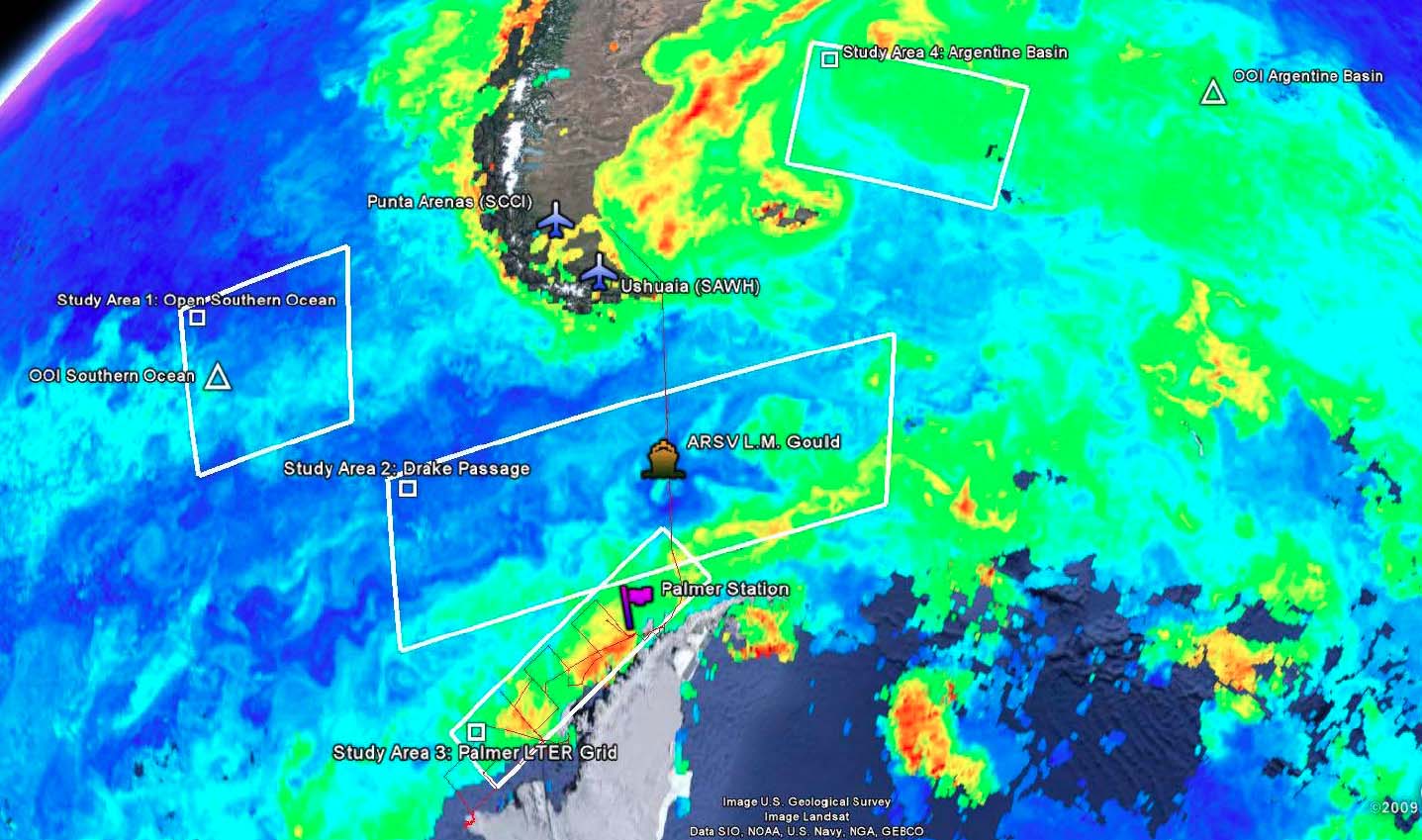
Map showing the four proposed ORCAS study areas (white boxes) overlain on a MODIS chlorophyll map from January 2006. The ARSV Gould ship track from the 2013 Palmer LTER cruise is shown as a red line. The locations of the OOI Southern Ocean and Argentine Basin nodes are shown as white triangles. Click to enlarge image
|
The NSF/NCAR HIAPER Gulfstream V research aircraft is a flying laboratory with a suite of instruments on board specifically suited for this research project. Instruments will make measurements of the carbon cycle, trace gases, aerosol and cloud microphysics, and ocean color through remote sensing.
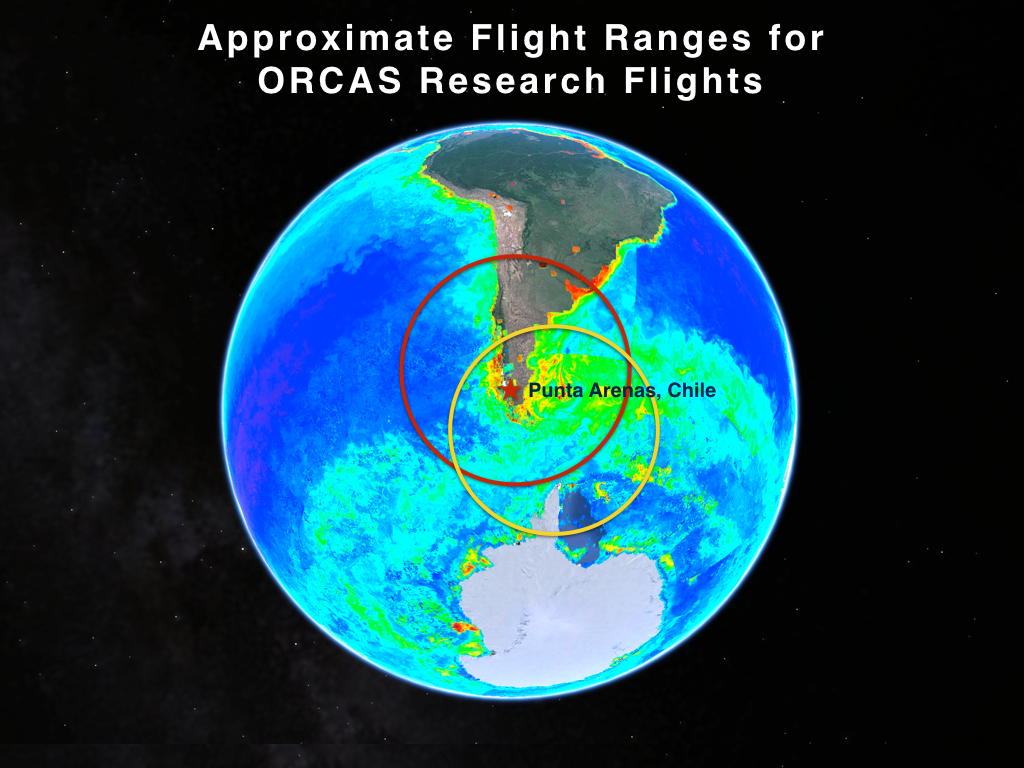
The aircraft will be based in Punta Arenas, Chile and make approximately fourteen 7-hour flights south and west over the productive Southern Ocean, and east of over the iron-rich Patagonian Shelf and surrounding areas. Flight patterns will include several "dips", meaning the aircraft will fly from approximately 30,000 feet to 500 feet over the span of 20 minutes allowing scientists to profile the atmosphere. Data from these maneuvers resemble a curtain, or slice of the atmosphere.
HIAPER will collect the majority of the measurements for this project, however, simultaneous collaborative projects are also taking place in the study area and will contribute to the overall research efforts of the project.
In addition to data collected by the NSF/NCAR HIAPER, a number of other collaborative measurements programs are either underway or planned in the ORCAS study region. The most significant of these is the Palmer Long Term Ecological Research (LTER) program, which seeks to obtain a comprehensive understanding of the marginal ice-zone ecosystem – the climate, plants, microbes, animals, biogeochemical processes, ocean, and sea ice along the western side of the Antarctic Peninsula. The LTER utilizes the Antarctic Research & Supply Vessel (ARSV) L.M. Gould to make measurements of water column profiles for hydrographic properties, dissolved inorganic carbon, phytoplankton and zooplankton stocks and rates, and biogeochemical processes.
Another important sampling program is the Ocean Observatories Initiative (OOI), an NSF funded network of sensing arrays with initially four global nodes. Each node consists of a 50 km triangular network of tethered buoys and autonomous profiling gliders collecting biogeochemical measurements including pCO2 (buoy only) [p indicates partial pressure of a substance], dissolved O2, and the ability to measure specific molecules in the water. One of these global nodes is within the ORCAS study area and was recently installed.
The data collected during ORCAS will be made freely available to carbon cycle researchers and the general public. By bridging traditional gaps between observationalists and modelers ORCAS will optimize the utility of the measurements and their ability to test and improve models. The ORCAS measurements will lead to the improvement of ocean biogeochemical models and associated Earth system models used to make climate projections of high societal relevance.
Q: Can you explain how gas from the atmosphere, such as CO2 and O2, is absorbed by the ocean, and does temperature play a role with how much can be absorbed by a liquid?
 |
|
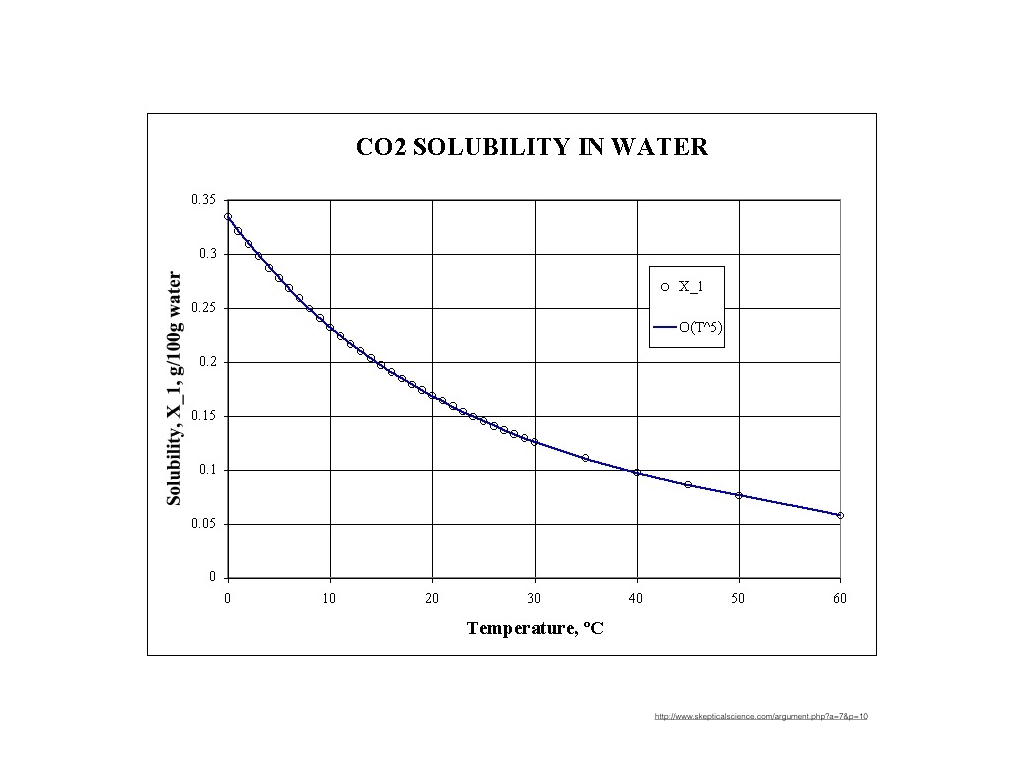
Solubility of CO2 in water. Solubility decreases as temperature increases.
Click to enlarge. |
There is a gas law that states "At a constant temperature, the amount of a given gas that dissolves in a given type and volume of liquid is directly proportional to the partial pressure of that gas in equilibrium with that liquid." In other words, at a given temperature a gas will dissolve into a liquid to a degree that is determined by the balance between the undissolved gas and the dissolved gas in the liquid.
However, another gas law needs to be considered as well. Temperature affects the amount of gas that can be dissolved in a liquid, or solubility. As temperature increases, solubility decreases and conversely, as temperature decreases solubility increases. This is one of the reasons data show seasonal fluxes of gases in the atmosphere and why increasing global temperatures may cause the ocean uptake of CO2 to slow down.
There is a concern that increased anthropogenic, or human-produced, CO2 in the atmosphere could creates a positive feedback loop, a cycle in which the effects of a change in a system increase the magnitude of the change. For example, if ocean temperatures warm, CO2 will be released from solution, increasing the atmospheric concentrations leading to further heat trapping mechanisms.
Q: Why is O2 important to measure?
 |
|
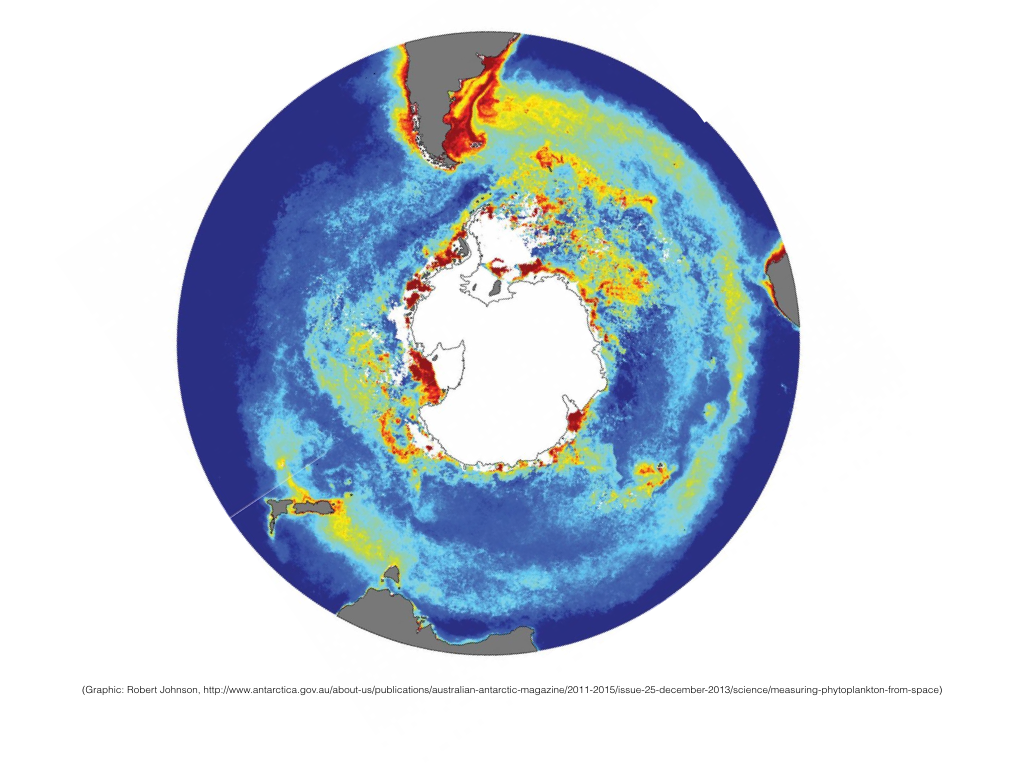
Concentrations of phytoplankton chlorophyll observed by satellites in the Southern Ocean averaged over summer from 2002 to 2012. Red and yellow indicates regions of high chlorophyll and blue indicates regions of low chlorophyll. Click to enlarge.
|
Direct measurements of O2 in the lower part of the atmosphere paired with remotely sensed chlorophyll and plankton taxonomy will provide a basis for scaling flux estimates up to broader regions and testing model skill. O2 levels have a direct relationship with CO2 and are easier to measure, therefore measurements of O2 can provide information on the processes influencing CO2 fluxes.
When O2 is released from the ocean due to seasonal warming, so is CO2, however when O2 is produced biologically from ocean algae, CO2 is absorbed. The air-sea flux of O2 has essentially no human-produced anthropogenic component.
The ORCAS project will take place during the Austral, or Southern Hemisphere, summer which will have the most abundance of ocean algae available, producing high levels of O2.
Collectively, the ORCAS measurements will improve understanding of the present day carbon cycle gases of Southern Ocean air-sea gas exchanges, laying the groundwork for increased physical representation of feedbacks to climate change.
Q: What kind of project management and support services are needed to put on a project of this caliber?
 |
|
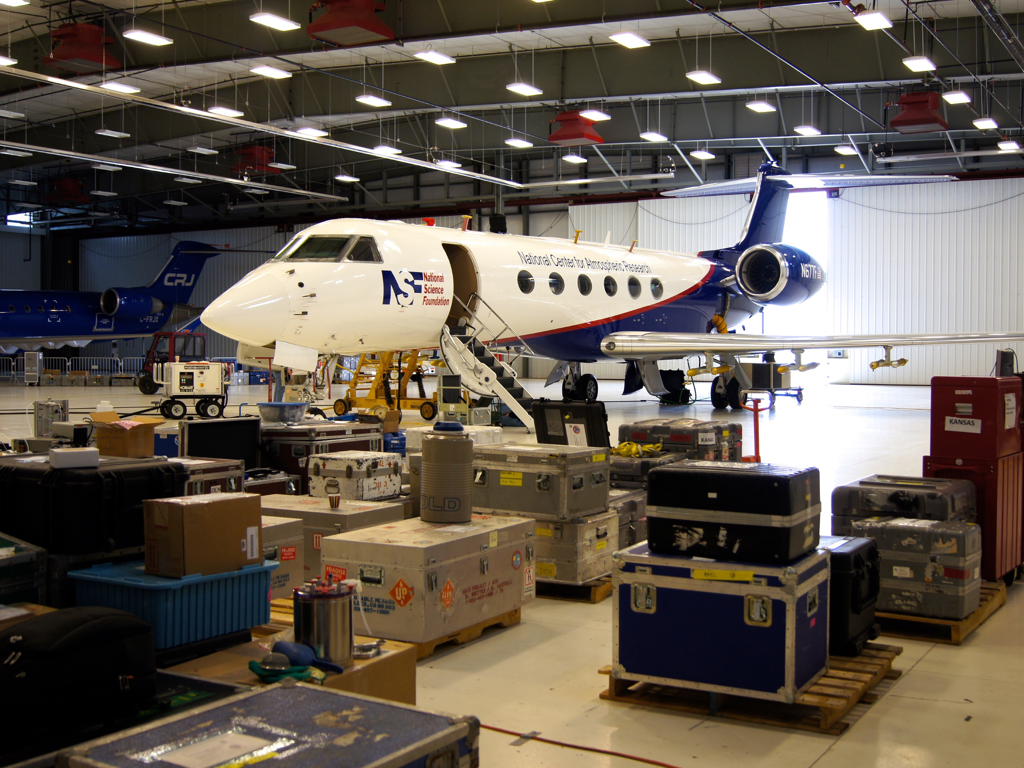
The NSF/NCAR HIAPER and some of the equipment needed during a field project. Click to enlarge.
|
Project management and planning starts years in advance to ensure the project is successful. Adequate time and planning strategies are needed to secure flight plans, diplomatic clearances, determine a safe location for the aircraft and crew, and shipping the needed equipment to Punta Arenas, among other things.
The systems administration team develops a field catalog to display and house data, as well as display the needed flight tracking tools and satellite overlays. They also ensure safety and reliability of communications and data transfer form the aircraft to servers.
The aircraft and instrumentation team need several months to properly upload the aircraft with the needed electrical wiring and tubing, as well as install the suite of instruments in the required configuration. The aircraft mechanics are continually working on the aircraft to ensure safe operations. The pilots work very closely with the PIs and EOL Project Management Office to plan the 14 seven-hour flights, taking into consideration Chilean and Argentine airspace regulations and concerns.
Q: What is the significance of the O2/N2 ratio?
Oxygen variations are really interesting because of what they can tell us about the processes influencing CO2, but by themselves are miniscule. This is because there is so much O2 in the atmosphere to begin with (~21%). The changes in O2 are so small that they can only be interpreted as relative changes in the O2/N2 ratio. Because the amount of N2 in the atmosphere (~78%) is less variable than O2, changes in the O2/N2 ratio primarily reflect changes in atmospheric O2. Over the Southern Ocean, these changes reflect various influences from biological productivity, heating and cooling of surface waters, and deep water ventilation.
ORCAS Science Team
ORCAS Lead-PIs
Britton Stephens | NCAR Earth Observing Laboratory

Britt Stephens is a Scientist III in the Earth Observing Laboratory (EOL) of NCAR. Britt's research has focused on developing and deploying new instruments for tower, ship, and aircraft-based observations of atmospheric O2 and CO2, and on synthesizing data sets and models to elucidate global carbon cycle processes. The overall motivation for his work lies in our need to better understand how the Earth's biogeochemical systems, such as forests and ocean regions, respond to natural and human-induced perturbations, so that we may more accurately predict and more effectively mitigate future climate change.
Britt was a co-PI on the HIPPO project, which conducted a global survey of greenhouse and related gases using the NSF/NCAR HIAPER Gulfstream V, including several flights over the Southern Ocean. He has also measured atmospheric O2 from the NSF Antarctic Research ship L.M. Gould since 2012. Results and questions raised by these earlier studies were significant motivators for the ORCAS project. [...]
Matthew Long | NCAR Climate & Global Dynamics

Matthew Long is Scientist I in the Oceanography Section of the Climate and Global Dynamics Laboratory at NCAR. The Southern Ocean has been a focus of Matt's research since his PhD work. This region mediates exchange between the atmosphere and deep ocean, and is therefore critical to understanding global climate and the carbon cycle.
Matt has worked as hydrologic engineer, developing hydraulic and water quality models for management of sewer networks and urban rivers, and spent two years teaching high school Physics in Tanzania, East Africa, as a volunteer in the United States Peace Corps. Presently, his research is focused on modeling marine ecosystems and ocean biogeochemistry in the context of the Community Earth System Model (CESM). Matt has particular interests in understanding the role of the ocean in the global carbon cycle, interactions between ocean physics and biology, and the impacts of climate change on marine ecosystems. [...]
ORCAS Co-PIs
Ralph Keeling | Scripps Institution of Oceanography

Ralph Keeling is the current program director of the Scripps CO2 Program. He is also a Professor and the Principal Investigator for the Atmospheric Oxygen Research Group at Scripps Institution of Oceanography. [...]
As the lead scientist for the NOAA Earth System Research Lab Aircraft Program, Colm Sweeney’s focus is on overall program development. This includes overseeing the existing network of aircraft sites; developing new ways to ensure data quality, as well as easy access to the data; and developing new tools and platforms for collecting vertical profiles of CO2 and other trace gases throughout North America. These vertical profiles are an essential component of quantifying the net impact that the North American continent has on atmospheric concentrations of CO2 and other greenhouse gases. [...]
Eric Kort | University of Michigan

Eric Kort is an Assistant Professor in the Department of Climate and Space Sciences and Engineering at the University of Michigan. The Kort group works on understanding contemporary and future levels of greenhouse gases and pollutants in the atmosphere by combining ground, airborne, and space-based observations with models probing scales from cities to the globe. On ORCAS, Eric is PI of the QCLS instrument measuring CO2, CH4, CO, and N2O, and also leads the atmospheric lagrangian transport modeling. [...]

Michelle Gierach's research interests include application of satellite observations, in-situ data, and model simulations to study biophysical interactions, ecosystem dynamics, air-sea interactions, ocean dynamics, atmospheric processes, and the oceans relation to climate variability. [...]
Elliot Atlas | University of Miami

Dr. Atlas' research interests are in the sources, transport, and transformation of atmospheric trace gases in the global atmosphere. This work has a primary focus on trace gases and aerosols associated with the formation and destruction of ozone in the atmosphere. The research involves development and application of advanced trace gas sampling and measurement techniques. His research group investigates the distributions and trends of a large variety of halocarbons (both natural and man-made), hydrocarbons, and photochemical oxidation products of these species (such as organic nitrates). The research extends from studies of sub-surface distribution of trace gases in the polar firn record to studies of urban and regional chemical distributions of short-lived tropospheric gases to measurement of halocarbons in the stratosphere up to 32 km altitude. The research platforms include tropospheric and stratospheric aircraft (C-130, P-3B, ER-2, WB-57), high altitude balloons, oceanographic research ships, and land and island-based experiments. [...]
ORCAS Collaborators
Carbon Cycle Instruments
- Jonathan Bent
NCAR Earth Observing Laboratory
AO2 and Medusa O2/N2, CO2, CO2 isotopes, Ar/N2 - Bruce Daube
Department of Earth and Planetary Sciences, Harvard University
QCLS CO2, N2O, CH4, CO - Kathryn McKain
Cooperative Institute for Research in Environmental Sciences, University of Colorado, Boulder
Picarro CO2, CH4, H2O - Eric Morgan
Scripps Institution of Oceanography
AO2 and Medusa O2/N2, CO2, CO2 isotopes, Ar/N2 - Tim Newberger
NOAA Earth Systems Research Laboratory
Picarro CO2, CH4, H2O - Mackenzie Smith
University of Michigan
QCLS CO2, N2O, CH4, CO - Andy Watt
NCAR Earth Observing Laboratory
AO2 and Medusa O2/N2, CO2, CO2 isotopes, Ar/N2 - Steve Wofsy
Department of Earth and Planetary Sciences, Harvard University
QCLS CO2, N2O, CH4, CO
Biogenic Reactive Gas Instruments
- Eric Apel
NCAR Atmospheric Chemistry Observations & Modeling
TOGA, reactive gases - Nicola Blake
Department of Chemistry, University of California, Irvine
TOGA reactive gases - Valeria Donets
Department of Atmospheric Science, University of Miami
AWAS reactive gases - Alan Hills
NCAR Atmospheric Chemistry Observations & Modeling
TOGA reactive gases - Becky Hornbrook
NCAR Atmospheric Chemistry Observations & Modeling
TOGA reactive gases - Rich Lueb
NCAR Earth Observing Laboratory
AWAS reactive gases - Sue Schauffler
NCAR Atmospheric Chemistry Observations & Modeling
AWAS, reactive gases
Remote Sensing Instruments
- Ernesto Diaz
NASA Jet Propulsion Laboratory
PRISM remote sensing - Heidi Dierssen
Coastal Ocean Laboratory for Optics and Remote Sensing, University of Connecticut
Remote sensing validation and algorithm development - Robert Green
NASA Jet Propulsion Laboratory
Remote sensing validation - Justin Haag
NASA Jet Propulsion Laboratory
PRISM remote sensing - Ian McCubbin
NASA Jet Propulsion Laboratory
PRISM remote sensing - Pantazis Mouroulis
NASA Jet Propulsion Laboratory
PRISM remote sensing - Scott Nolte
NASA Jet Propulsion Laboratory
PRISM remote sensing - David Thompson
NASA Jet Propulsion Laboratory
Remote sensing algorithm development - Byron Van Gorp
NASA Jet Propulsion Laboratory
PRISM remote sensing
Aerosol and Cloud Microphysics Instruments
- Minghui Diao
San Jose State University
VCSEL, E&O - Andrew Gettleman
NCAR Climate & Global Dynamics
Cloud microphysics modeling and analysis - Jorgen Jensen
NCAR Earth Observing Laboratory
Giant Nuclei Impactor and cloud microphysics - Bryan Rainwater
Graduate Student, Atmospheric and Oceanic Science, University of Colorado, Boulder
CLH-2 liquid water - Jeff Stith
NCAR Earth Observing Laboratory
Cloud microphysics observations and analysis - Darin Toohey
Atmospheric and Oceanic Science, University of Colorado, Boulder
CLH-2 liquid water
Atmosphere and Climate Modeling
- Abhishek Chatterjee
Global Modeling and Assimilation Office, NASA
GEOS-5 and OCO-2 - Jim Bresch
NCAR Mesoscale & Microscale Meteorology
Forecasting - Martin Hoecker-Martinez
Oceanography, Fluid Dynamics, University of Michigan, Ann Arbor
STILT modeling - Shawn Honomichl
NCAR Atmospheric Chemistry Observations and Modeling
Forecasting - Jordan Powers
NCAR Mesoscale & Microscale Meteorology
AMPS real-time model forecast support - Uriel Zajaczkovski
Scripps Institution of Oceanography
CESM modeling
External Collaborators
- Nicolas Cassar
Biogeochemistry & Ecophysysiology, Duke University
LMG O2/Ar - Scott Doney
Palmer Long-Term Ecological Research (LTER)
Modeling - Hugh Ducklow
Palmer Long-Term Ecological Research (LTER)
Observations - Oscar Schofield
Palmer Long-Term Ecological Research (LTER)
Gliders, remote sensing validation - Jorge Sarmiento
Southern Ocean Carbon and Climate Observations and Modeling project (SOCCOM)