Search
Publication or Paper Upper Ocean Cooling and Air-Sea Fluxes under Typhoons: A Case Study
Instrument Software Requirements
The design implied by the above diagram indicates specific requirements for the PI written software.
Command/Control Software
- Must send its commands via UDP datagrams
- Must allow the operator to change the host (IP) and UDP socket to which those datagrams are sent
- Must receive instrument status via UDP datagrams
- Must allow the operator to change the host (IP) and UDP socket on which those datagrams are received
Instrument Software
- Must receive its commands via UDP datagrams
- Must allow the operator to change the host (IP) and UDP socket on which those datagrams are received
- Must generate either a status datagram or data datagram which will allow the ground operator to observe affect of command
- Status datagrams will be forwarded to the command/control software running on the ground
- Data datagrams will be pulled in by the RAF Aircraft Data System and made available through that system
- Instrument PIs are encouraged to send both types of datagrams
- Must allow the operator to change the host (IP) and UDP socket to which status and/or data datagrams are sent
Ground control requirements
The Remote Instrument Control (RIC) software is installed on eol-ric.ucar.edu. In order to run it, the user must have current certificates for RIC and for the instruments you are connecting to RIC. Once the RIC Proxy is installed on a user's computer, they can connect to their instrument using RIC and control the instrument remotely.
Running RIC: User Tasks
Install the RIC proxy on your (users) computer
- Download RIC proxy from https://www.eol.ucar.edu/software/ric and follow installation instructions.
Get a copy of the latest RIC certification from an SE/ADMIN
- You will need a copy of the RIC certification file (eol-ric.crt) which should be placed into .ric/Certs in your home dir. (This dir is created automatically when installing on a Window's machine. Use "ls -a" to see it.)
- In addition, you will need the .key and .crt files for your instrument (<inst>.crt, <inst>.key). An SE or ADMIN can obtain these from .ric/Certs on eol-ric.
NOTE: <inst> is the name of your instrument: GNI, AVAPS, etc
Change the file permissions on your certs to be user read only
- From ~/.ric/Certs, run:
> chmod 0400 eol-ric.crt
> chmod 0400 <inst>.crt
> chmod 0400 <inst>.key
If you are running on a MAC, you will need to add eol-ric.crt to your keychain file (requires admin privileges)
- Finder -> Applications -> Utilities -> Keychain Access
- On the left in the upper window, under Keychains, click System
- On the left in the lower window, click Certificate (not "My Certificates)
- Click the plus sign in the upper left (by the red, yellow, and green window control buttons). If not available, try File -> Import Items
- You should get a file selector window. Select your eol-ric.crt file. You may need to hold down Command-Shift-Period to see the .ric dir
- eol-ric.crt will show up under System with a red x. Double click it. Click trust. When using this certificate, always trust.
Configure your .ini files
- Change the last line of .ric/Proxy.ini to point to a file with the name of your instrument and change the ProxyID near the top of the file to the string that you are using to start your UDP packets
ProxyID=<inst>
InstrumentFile=<inst>.ini
- Rename SAMPLEINST.ini in .ric/Instruments to the filename created above
>mv SAMPLEINST.ini <inst>.ini
- Edit the file you just moved and change InstName to the name of your instrument
InstName=<inst>
- Sample .ini files: AWAS.ini
At this point, you should have:
homedir/.ric/ _(where homedir is /Users/<username> on a mac, or C:\Users\<username> on Windows)_
Proxy.ini
Certs/ _(with file permission set to read-only for all files in this directory)_
eol-ric.crt
<inst>.crt
<inst>.key
Instruments/
<inst>.ini
Connect to your instrument
- From the user computer, run launch_app. For example, for a mac, run
> /Users/<you>/RIC-7009/RICProxy-7009.app/Contents/MacOS/launch_app
- Click connect.
- If RIC doesn't stay connected, confirm that your certs aren't corrupted:
>openssl x509 -text -in <file>.crt
should return begin and end dates that include today, and a subject line like:
Subject: C=US, ST=CO, L=Boulder, O=NCAR, OU=GNI, CN=eol-ric.ucar.edu
where the only difference you will see is the OU will be an abbreviation of your instrument. Also check that the certs have user only read permission:
>ls -l <file>.crt
should return "-r--------"
- Once connected, start the user's instrument client on the user's computer. The control software running from the ground, needs the following:
UDP_IP = 127.0.0.1
UDP_SEND_PORT and UDP_READ_PORT to be defined as listed here: https://wiki.ucar.edu/display/SEW/UDP-Data (internal access only). For example, for the GNI instrument:
AWAS:
UDP_SEND_PORT = 32103
UDP_READ_PORT = 32102
- For instruments mounted on the aircraft, the instrument software needs to write to:
UDP_IP = 192.168.84.xxx (use whatever is configured in /etc/dncp/dhcpd_ac.conf)
AWAS:
UDP_SEND_PORT = 32102
UDP_READ_PORT = 32103
UDP_NIDAS_PORT = 30131
Ports are listed here: https://wiki.ucar.edu/display/SEW/UDP-Data (internal access only)
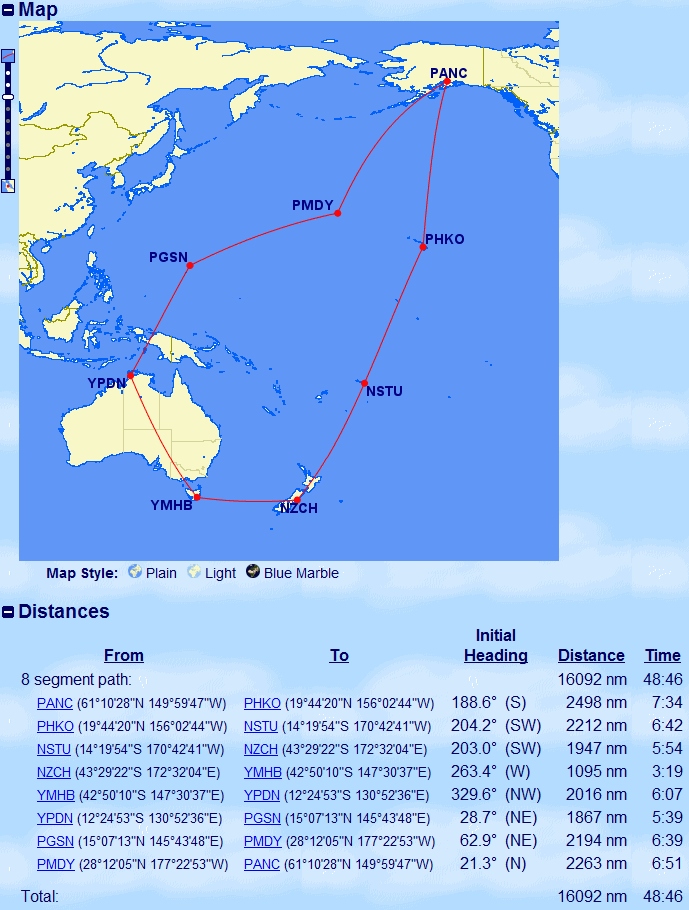
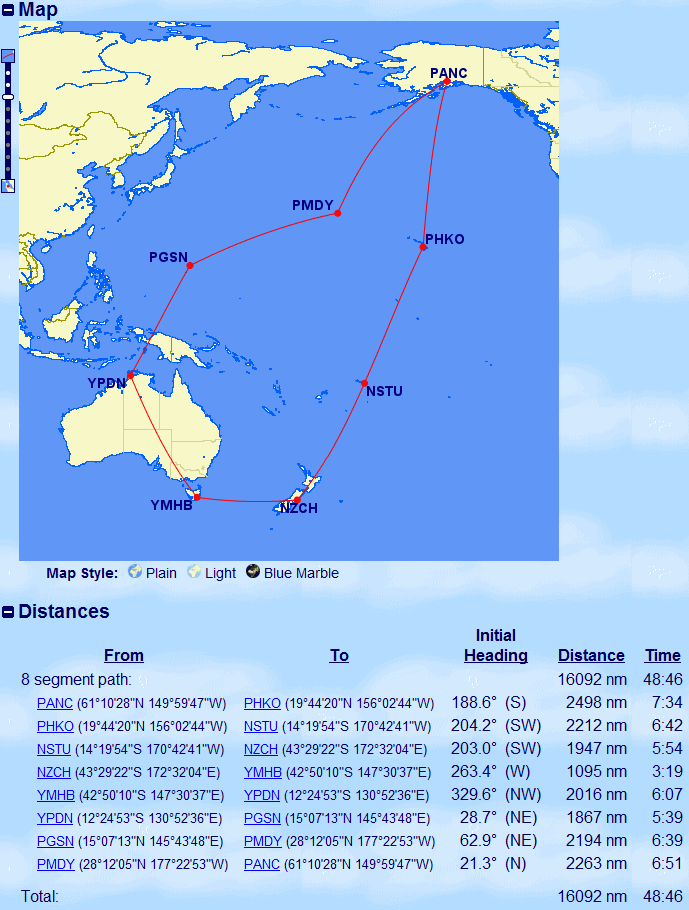
Mission Route
SOCRATES Outreach
Data Set Documentation Guidelines
Data Archive Submission Instructions
VERTEX Data Submission Instructions
A master list of VERTEX datasets (with links) has been compiled to provide easy access to all operational and research VERTEX datasets. This list will form the VERTEX Long-term Data Archive at NCAR Earth Observing Laboratory where datasets are grouped and sorted by category (i.e., flux, met tower, etc.) and platform. Please review this list to verify that your dataset(s) are properly named, with the appropriate authors identified. Email any corrections, additions, or deletions directly to eol-archive@ucar.edu. If you already have your datasets available on-line elsewhere, please email the link(s) or FTP access information.
To submit your dataset(s) and documentation to the VERTEX Long-term Data Archive, see the anonymous FTP instructions below. If you have a large number of files to FTP, please tar or zip your files by day or other organizing structure for your dataset. For users without Internet access, or if your datasets are too large to FTP (e.g., 500GB or larger), please contact eol-archive@ucar.edu. In these cases, users can submit their data on a USB drive to the shipping address below.
It is critical that submitted datasets are accompanied by sufficient documentation. The minimum required metadata is shown below after the FTP instructions. More detailed documentation guidelines can be found here.
Data Submission FTP Instructions for the VERTEX Long-term Data Archive at NCAR/EOL
FTP: ftp.eol.ucar.edu
Login: anonymous (No password required.)
Change directory: cd /pub/data/incoming/vertex (NOTE: This command should be done all in one step.)
It is very important to send an email to eol-archive@ucar.edu once your file(s) have been FTPed. In your email and in your dataset readme file, please include the following minimum required information for your dataset(s):
- Dataset Title - The dataset title that will publicly appear in the data archive. EOL may modify for project consistency.
- Dataset Author(s) - List dataset authors. Indicate lead and corresponding authors. Include contact information.
- Time of Interest - Include begin and end dates (i.e., YYYY/MM/DD hh:mm:ss to YYYY/MM/DD hh:mm:ss).
- Area of Interest - Include GeoLocation information (latitude/longitude box) (e.g., 38.23 to 39.50; -77.37 to -75.00).
- Data Frequency - Frequency of data collection (5 minute, hourly, continuous, etc.).
- Data Spatial Type - ISO metadata SpatialRepresentation (vector, grid, textTable, tin, stereoModel, video, etc.) which describes how the geographic nature of the data is represented.
- General Dataset Description - Short description of this dataset.
- File Names - List names of files transferred.
- Data restrictions - Indicate if dataset needs to be restricted. Password protection is available for a dataset upon request. A dataset will NOT be password protected unless requested at the time of submission or as specified in this project's Data Policy. If password protection is requested, you will receive a project-specific "user ID" and "password." If you require additional security, please contact eol-archive@ucar.edu to request a unique "user ID" and "password" for your data.
- Digital Object Identifier (DOI) - Indicate if you would like for NCAR/EOL to generate a DOI for your dataset. If your dataset already has a DOI, please include that link in your email.
- GCMD Keywords - See http://gcmdservices.gsfc.nasa.gov/static/kms/sciencekeywords/sciencekeywords.csv?ed_wiki_keywords_page
- Publications (Optional) - Please include a list of links to publications using this dataset, including "in press" and "submitted" publications, conference proceedings, theses, and reports. Submitted publications will be added to this project's publications list.
Thank you for providing data to the Long-term Data Archive at NCAR/EOL. Feel free to contact us with any questions or issues.
The EOL Data Management Team
NCAR Earth Observing Laboratory (EOL)
Email: eol-archive@ucar.edu
Mailing address:
NCAR Earth Observing Laboratory
Attention: VERTEX Field Project Data Management
P.O. Box 3000
Boulder, Colorado, USA 80307
Shipping Address:
NCAR Earth Observing Laboratory
Attention: VERTEX Field Project Data Management
3090 Center Green Drive
Boulder, Colorado, USA 80301