Search
Student Impact and Feedback
Students in both the AHS and STEM Ed programs responded to informal questionnaires / prompts asking them to summarize their reactions to the MARVELOUS project and experiences relating to it. Feedback was overwhelmingly positive, largely due to the fact that students not only had the opportunity to go out into the field during inclement weather, but also because they were able to participate in a wide array of outreach events as well as operations/data collection events. Several representative undergraduate student responses appear below, separated by intended major:
AHS majors:
“It was great having the DOW here. It tied in really nicely with the items we’ve talked about in class, and it was so cool to be able to program in our own scanning elevations, rotation rates and the like. It really made me excited to know that the data I was analyzing came from a project in which I participated.”
“Thanks so much for having the DOW and PODs here! Working in a group was challenging, but it forced us to work together to plan out how we were going to deploy the instruments, and we really had to think about a lot of different factors that we hadn’t thought of before. It encouraged us to think outside of the box, and that was really beneficial.”
“Being in this field, we don’t get a chance to go out to other schools all that much, and really not at all at the elementary level. It was so neat to see kids getting psyched about science! I loved going to the schools with the DOW and the PODs!”
“This was a great opportunity for us; thanks so much for having the instruments here! I learned a lot!”
“Using the DOW and the PODs really got me thinking about how it’s not all about one type of data or another. It’s often important to think about multiple levels of data and each one is interesting.”
“I never thought I would get a chance to operate a DOW; that was a dream come true! I enjoyed looking at the data and trying to make sense of it as well, even with SOLOII crashing as often as it did.”
STEM Ed majors:
“What a cool way to get out into the field and see 2nd graders really excited about science! I loved being able to answer their questions and ask them; they knew a lot. I really enjoyed this opportunity.”
“I found the opportunity to go out into the schools with the DOW and the PODs really enlightening as to how kids respond to cool gadgets. It makes me think about how important it is to have multiple ways of getting information across. Having something they can climb into or twirl around made them ask more questions, which they may not have gotten just from looking at pictures in a book or on a website. I really enjoyed interacting with them – they’re so smart! It really helped me see what it’s like to have a classful of smart, engaged students!”
“I liked the fact that the students and the teachers were able to see ‘science up close’, like we’ve talked about in class. It helps to have the methodologies we’re learning about in our classrooms play out in front of our eyes. I learned a lot about how to manage large groups of (sometimes very excited) kids in a variety of ways.”
Feedback from the local K-12 teachers and students was overwhelmingly (though perhaps unsurprisingly) positive, as well:
“The Doppler truck was really cool! I liked seeing the videos and pictures up close.” (AW, 2nd grade student)
“I got to deploy a POD, and I didn’t put it on my foot. It was really neat, though. I want to study weather when I am a grown-up.” (SW, 4th grade student)
“Science is awesome! I love weather! The truck was loud and the fumes were bad, but I want to go on it and look at snow and tornadoes when I get older.” (TK, 2nd grade student)
“The students and I really appreciated you all taking the time to come and teach us some things about the radar. We all thought it was very cool and appreciated the opportunity to go and look inside it. It’s nice to know more about how our weather is detected, since it’s so crucial and important.” (JD, 9th grade teacher)
“Thank you so much for coming; the kids and I loved it!” (JP, 4th grade teacher)
Summary & Lessons Learned
Summary, Lessons Learned, Conclusions and Future Goals
In total, MARVELOUS was a success for the student body of the AHS and STEM Ed departments and for the general public. The interdisciplinary nature of involving students from both the AHS department as well as the STEM Ed department in the project lent itself very nicely for multiple learning opportunities for K-12 students and the undergraduate students in a unique educational setting and atmosphere. This is an aspect of MARVELOUS which was anticipated to be an eye-opening experience for many involved, and it was met with very positive results, as demonstrated in the student, faculty and public feedback given to the PIs.
In future educational projects, it is anticipated that there will be even more student, faculty and public interest in both the meteorological and educational outreach opportunities that MARVELOUS offered. For example, the National Weather Service office in Duluth, MN, has expressed interest in working with the students in the AHS department on future deployments, as having a mobile Doppler radar would provide coverage in areas not well sampled by the stationary WSR-88D; this in and of itself would be a wonderful collaboration between budding and seasoned meteorologists.
As the need for meaningful and long-lasting science- and inquiry-based education and experiences for K-12 and college-aged students inevitably increases, we look forward to developing and organizing more projects like MARVELOUS at SCSU in the future.
Acknowledgements:
The PIs wish to thank all of the SCSU students who worked tirelessly to make this project truly marvelous. Thanks are also extended to all of the faculty and support staff who made it a rousing success. Additionally, we wish to thank Brian Pereira, Karen Kosiba, and Traeger Meyer of CSWR for their willingness to be “on call” in the event of technical difficulties during MARVELOUS. Finally, we also wish to thank Joshua Wurman for his willingness to work with our fall schedule to maximize the amount of time students had to work in, around, and with the instruments.
Field Project VORTEX-SE_2017
Real Time Data
A number of real time products will be available on the ground during research flight. These include the GV track and instrument data for GoogleEarth; a browser version of the instrument data; and data visualization using Aeros.
Real-Time Flight Position in Google Earth
To use, open the file in Google Earth and check the desired checkbox. The GV tracking will be updated automatically once the flight takes off. Real time variables can be viewed by using the most common check boxes, or click on the folder name itself to display the full list of variables available, then select one from the list. Please note that the full list of variables is not updated automatically as we add new variables to the data feed, so re-load the KMZ file every few days to make sure you can see the new variables (if any). Adjust transparency of the overlays as desired. Real time satellite imagery can be enabled by selecting the appropriate checkbox.
Browser Data Access
Selecting variables from the list will display them as a strip chart. The charts will not refresh automatically, so use your browser's "Refresh" function to update the plots. Access data here. The list of variables displayed using this method is dynamic and is automatically updated every flight, so you will be able to see all variables transmitted to the ground during the current flight.
Aeros Software
Use right mouse click in the Aeros window after connecting the RT-GROUND database to add new graphs, variables etc. Download Aeros Software here. Aeros is the most flexible way of viewing the GV data in real time, it allows to zoom in, out, select time intervals to display; it will show data as time series, X-Y plots, 3D flight track and many other ways but is only available for Windows or Linux at this time. Aeros is built around mouse clicks: to start working with Aeros, right-click to add items, right-click on existing items to modify them, etc. We hope you will find Aeros intuitive and easy to use.
Real Time Digital Imagery
The GV is equipped with a forward looking digital camera. The imagery from this camera is used to reconstruct the conditions along the flight track, identify cloud entry times, cloud base altitude etc. We are sending reduced size images to the ground every two minutes and these images are available as they are received from the HIPPO Global field catalog.
Field Catalog
HIPPO Global Field Catalog is a collection of data products, status reports and operation plans. Some real time data may also be available there, including not only the data from the GV (such as real time digital images from the wing mounted camera) but also semi-RT satellite imagery and model products.
You can also see the approximate location of the GV on FlightAware. Please realize that FlightAware does not use any data feeds from the GV and does not always provide an accurate real time position. Also, if the airplane is flying under Visual Flight Rules (VFR), the flight track will not be visible on FlightAware.
Data provided in real time should not be used in any publication as they are preliminary and will change after proper quality control. Even after formal data release these data should only be used with proper acknowledgment of the NSF and project researchers.
Data Documentation
Data Set Documentation Guidelines
Related Links
Data Set Documentation Guidelines
Related Links
Data Set Documentation Guidelines
Field Project WE-CAN
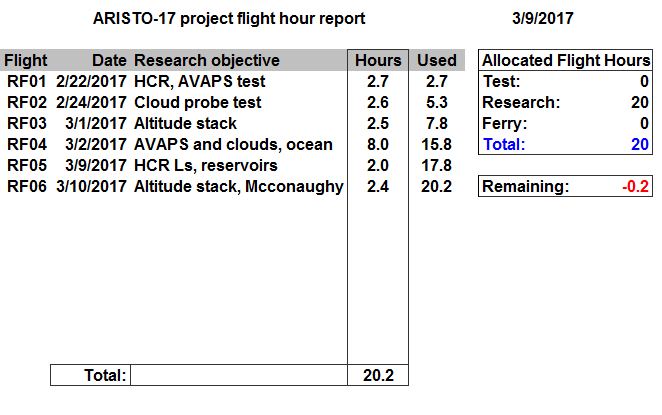
Flight hours