Search
Aerosols & Cloud Physics
- Cloud Droplet Probe | CDP
- Single Particle Soot Photometer | SP2
- Two Dimensional Cloud Probe | 2D-C
- Ultra-High Sensitivity Aerosol Spectrometer | UHSAS
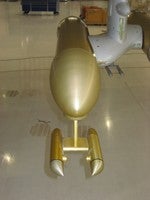 The Cloud Droplet Probe (CDP), is a miniature, lightweight, low-power cloud particle spectrometer measures droplets in the range of 2-50 m in concentrations as high as 2000 particles/cm3.
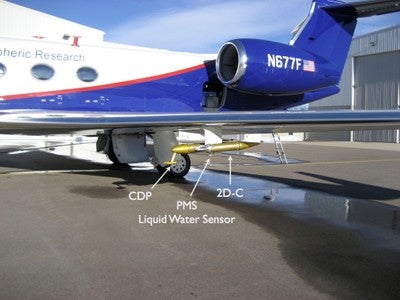
This instrument mounts under the left wing of the NSF/NCAR GV, next to the Two Dimensional Cloud Probe (2D-C) and the PMS Liquid Water Sensor.
Single Particle Soot Photometer | SP2
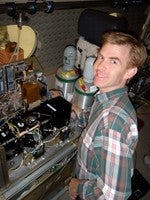
Represented by :: David Fahey, Ru-Shan Gao, Anne Perring, Ryan Spackman & Joshua Schwarz
Refractory black carbon (rBC) aerosol is the most important particulate absorber of solar radiation in the atmosphere, causing dramatic regional forcings in places like India and China, as well as very significant global radiative forcing. In addition to direct aerosol absorption, rBC has the potential to significantly impact climate through indirect (by cloud particle seeding), semi-direct (dehydration of clouds), and snow albedo (increased snow melt) effects. Traditionally, rBC has been a difficult species to measure. Although it is responsible for most of the aerosol absorption in the visible wavelength range, rBC typically forms only a small fraction of total aerosol mass and extinction. The fact that rBC is non-soluble and refractory (surviving high temperatures) means that traditionally effective techniques used to quantify sulfate, salt and organic aerosols are generally insensitive to rBC. Aerosol absorption has long been used as a proxy for rBC mass, but as its absorption properties depend on mixing state and age, relying on absorption measurements alone is not a robust approach.
The Single Particle Soot Photometer (SP2) has become increasingly recognized as a valuable tool for quantifying rBC aerosol. There are several ways in which the SP2 provides previously unavailable information. First, it unambiguously measures the mass of rBC in individual aerosol particles in the accumulation mode. Second, the SP2 is able to identify the presence of other non-rBC materials with rBC in individual particles and provide some information about their amount. Third, as the instrument detects individual aerosol particles, it is able to quantify rBC loadings even in very clean air; it is the most sensitive tool available to this end. During the HIPPO project the SP2 is configured to maximize its sensitivity, thus providing measurements of rBC loadings with high spatial resolution even in the relatively clean and remote areas explored. It's inclusion in the instrument payload allowed unprecedented latitudinal coverage of in situ rBC mass loadings. Measurements of rBC mass loadings are especially sparse in the Southern Hemisphere. Through these observations of the latitudinal and vertical distribution of rBC mass loadings, as well as their correlation to age-of-air and tracers such as CO, the SP2 data from HIPPO will provide powerful constraints on the global models that are used to assess rBC's impact on climate.
Two Dimensional Cloud Probe | 2D-C
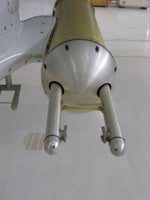 The Two Dimensional Cloud Probe, 2D-C, is an instrument developed by Particle Measuring Systems (PMS Inc., Boulder, Co) for the measurement of cloud and precipitation drop size distributions. These sensors are used primarily for the study of cloud microphysical processes, particularly the growth of cloud drops and ice crystals through aggregation, riming and coalescence into drizzle, rain drops, graupel or other forms of precipitation.
The 2D-C record the two dimensional shadows of hydrometeors as they pass through a focussed He-Ne laser beam. The shadow is cast onto a linear diode array and the on/off state of these diodes is stored during the particle's passage through the laser beam. This information, along with the time that has passed since the previous particle, is sent to the data system and recorded for post-flight analysis.
Information about a particle's shape and size is deduced from analysis of the recorded shadow with a variety of pattern recognition algorithms. The 2D Cloud Probe measures in the range from 25 µm to 800 µm.
The 2D-C is mounted under the left wing, next to the Cloud Droplet Probe (see above) and the PMS Liquid Water Sensor.
Ultra-High Sensitivity Aerosol Spectrometer | UHSAS
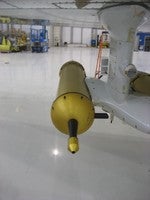 Aerosol particle spectra are measured using a PMI UHSAS probe, operating with a 100-bin resolution and covering the approximate size range of 0.05-1 µm diameter. The probe operates with 4 amplifier stages, and it produces nice continuous particle spectra on the ground. Unfortunately, at high altitudes (and cold temperatures) the stages do not overlap smoothly, and the spectra thus look somewhat jagged. The manufacturer states that the particle concentration is correct, thus the probe does not miss any particles or create any artifacts. RAF has processed the spectra based on the counts and bins as per the manual. RAF recommends that users create wider bins, thus producing smoother spectra; the choice of how to define wider bins is left to the individual user.
The UHSAS sits under the right wing of the aircraft, next to the the Microwave Temperature Profiler and the Forward Looking Camera.

Imaging & Photography
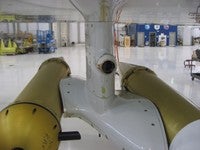 Anyone can access the forward looking camera images by access the HIPPO V Field Catalog. A forward looking camera mounted under the right wing of the aircraft takes both images and high-resolution video throughout each flight. In the image to the right, the camera is the dark circle located between the two instruments.
Once you have clicked on the link above to the Field Catalog and are on the Research Products page, select the date(s) for which you would like to the images from the under-wing forward looking camera, and then click retrieve products.
From the results page, either an image from a specific time can be selected, or the image loop of all of the images taken from that days flight may be selected by clicking on the small video camera icon.
The forward looking camera also takes high resolution video of each flight. You can see many of the condensed flight videos from previous HIPPO missions on the HIPPO Video Gallery page, just like the one below.
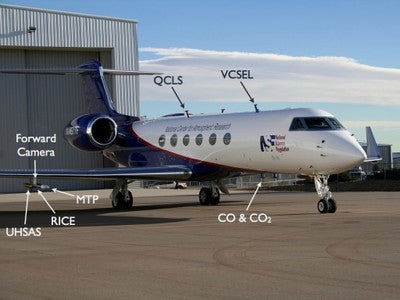
NSF/NCAR HIAPER Exterior Payload
The instrument suite on board the GV is specific to the science conducted during HIPPO. Several inlets take in air samples that can be distributed to up to three instruments. Click on the links below to get detailed information about each instrument.
Once the campaign is over, all of the instrumentation is removed so the upload of the new instrument payload for the next campaign may begin. Many instruments are used on other field projects but need to be removed in order to start the next upload in a systematic manner
Left-Side Instruments
Right-Side Instruments
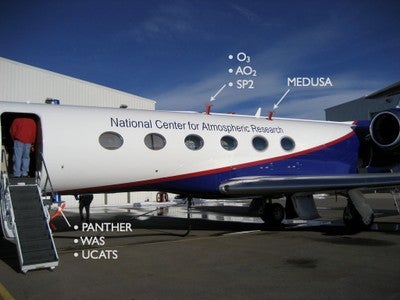
- PANTHER: PAN and other Trace Hydrohalocarbon Experiment WAS: Whole Air Sampler
- UCATS: Unmanned Aircraft Systems Chromatograph for Atmospheric Trace Species
- O3: Ozone
- AO2: Atmospheric Oxygen
- SP2: Single Particle Soot Photometer
- MEDUSA :: Multiple Enclosure Device for Unfractionated Sampling of Air
Field Project LAFE
Data Examples
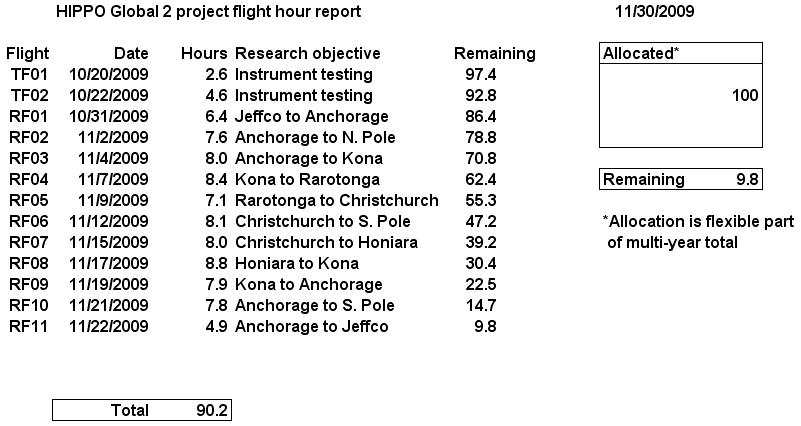
Flight Hours