Search
Mission Schedule
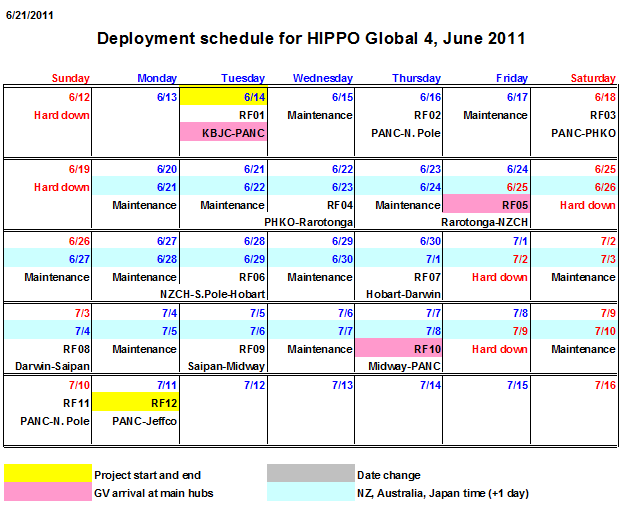
Note that in order to keep the mission duration less than four weeks, there is no returning to Christchurch after the S. Pole flight; this flight lands in Hobart. There are two maintenance days and a hard down day in Christchurch.
PDF version is available here. You can also see HIPPO-5 mission schedule.
Due to the severe earthquake damage in Japan the project is considering re-routing this deployment via Saipan and Midway Islands.

ISFS Data Report
Site locations
Both locations used in this study were in the eclipse path of totality. They were separated by about 50km, but mostly along a line parallel with the path of the eclipse.
The site labeled "museum" was west of the church at the Stuhr Museum of the Prarie Pioneer. This was in a grass field with a relatively open fetch to the north and a shorter fetch of 120--300m to trees to the south.
The site labeled "airport" actually was in rangeland. (By the time we learned that deployment at a nearby airport was not possible, it was too late to change our name for this site!) This terrain was somewhat rolling, representative of the transition to the Nebraska sand hills. There were some individual trees in the area, but the fetch was generally open to the north and for about 300m to the south.
We thank the Stuhr Museum Marketing director and the owner of the rangeland site for facilitating our deployments at both of these locations!
| Name | Latitude | Longitude | Altitude (m) |
|---|---|---|---|
| museum | 40d 52.7403' N | 98d 22.5248' W | 564 |
| airport | 41d 06.4993' N | 98d 53.6794' W | 662 |
Data recovery
There are some gaps in the QC data in the "prelim_qc_geotiltcor" dataset on 20 Aug. It isn't clear why they are there. It should be possible to fill them in.
Sensors data processing
Flux Sonic Anemometer
CSAT3 sonic anemometers were used at these sites. There was one data spike at about midnight on 19-20 Aug at the "airport" that appears to be caused by rain. It has not been edited. The orientation of the anemometer was determined with a compass and has been used in the production of the "geo" data set.
Infrared Gas Analyzer (H2O/CO2)
LiCOR LI-7500 open-path infrared gas analyzers were used to help measure the latent heat flux and CO2 flux. There were spikes again related to rain on 19-20 Aug and apparently due to dew the following 2 nights. These have not been edited. (A good start would be to ignore any data when the value of the "Wetness" variable is above 0.19V.)
The mean values for h2o and co2 were not calibrated prior to this project and thus are expected to have large offsets. The offset in h2o was approximately +1.5 and +3.5 g/m3 for museum and airport, respectively, as compared with the T/RH sensor. The mean value of co2 at the museum was approximately correct, but at the airport it was very low -- approximately 200ppmV (330mg/m3). This value has been added to the co2.museum values in the high-rate NetCDF files. Nevertheless, we expect the fluctuations, and thus the fluxes, to be nearly correct in magnitude.
2-D Sonic Anemometer
We used our standard Gill Wind Observers which operated normally. The "geo" dataset again has the correct orientation, as measured by compass.
T/RH
Temperatures from our standard T/RH probe were fine. However, all of the RH values were reported incorrectly. This was determined to be a problem in the method we used to calibrate these sensors before the project. (Only one temperature was used, and thus the temperature sensitivity of the RH sensor was unconstrained.) The post-project calibration was used to create the proper calibration coefficients for these sensors, which were applied in post-processing. This correction has been done point-by-point using the high-rate data and averaged to create the statistics. In the high-rate NetCDF data, we have removed all RH values to avoid being misleading.
Barometer
We used our standard Vaisala PTB220 barometers, which generally work well. However, the museum sensor had spikes, level shifts, and even a data outage. We suspected heat, but it still is not clear why these problems occurred. At this site, values reported by the LI-7500's internal barometer have been inserted into the P variable. At the "airport" the PTB220 was fine.
Radiometer
We used our Hukseflux NR01 radiometers, which operated normally, though we expect values to be off when the Wetness sensor indicates that liquid water may have been present. These values have not been removed.
Soil sensors
Tsoil
Our standard 4-prong Tsoil was used. For this project (and Perdigao), our software mishandled these data when the temperature was above 32degC. We have corrected this issue point-by-point and recalculated the 5-minute averages. Note that we have not corrected the high rate time series (but this shouldn't matter, since soil temperature is pretty slow response anyway).
Qsoil
We used our standard EC-5 probes, which operated normally. Gravimetric samples were taken during installation and analyzed a week later in Boulder. We expected these samples to have dried out, but were surprised to see values within 2% of the station readings. This could indicate that both were in error (the sites due to probes still settling into the soil, which was an expected source of error). Alternatively, the gravimetric samples were transported still surrounded by their brass sample core rings which may have prevented them from drying. In either case, we have no justification for changing the recorded values.
Gsoil
We used our standard REBS HFT plates, which operated normally. However, we were unable to apply the Phillip correction, as we normally do, since we did not deploy TP01 sensors to provide a value of the thermal conductivity of the soil. This correction generally is less than 10%.
Csoil
As mentioned above, all of our TP01 heat capacity sensors were still being shipped back from Perdigao, so we could not directly measure the heat capacity of the soil. Instead, we have used "book values" from a much earlier experiment in Kansas in the computation of the soil heat storage term. Our guess is that Kansas and Nebraska soils are somewhat similar.
SOCRATES Data Policy
Updated 23 October 2017
- Instrument teams will provide quicklook data products to the project PIs for merging with other data sets within 24 hours of a flight to support in field quality control and flight planning. Model output related to the SOCRATES data sets will be similarly made available to the science teams as soon as is practical.
- All instrument teams participating in SOCRATES agree to promptly submit their preliminary quality controlled measurement data to the SOCRATES Data Archive Center (SDAC) within 6 months after the project data are acquired. For real-time data collected in the field, this is by 26 August 2018. Similarly, model investigators agree to submit appropriate model products by 26 August 2018 to the SDAC. This will facilitate inter-comparison of results, quality control checks and inter-calibrations, and integrated interpretation of the combined data set. The preliminary data submission period for most data is therefore from 26 February 2018 to 26 August 2018. For measurements that require off-line analysis after the field project, including chemical analysis of samples collected, preliminary data should be released within 6 months of analysis.
- All instrument teams and model investigators participating in SOCRATES agree to submit their final quality controlled measurement data and appropriate model products to the SDAC within 10 months after the project data are acquired. For real-time data, this is 26 December 2018. This will facilitate final merging and quality control checks in advance of the initial public release on 26 February 2019. Thus, the time period for submission of most final products is from 26 February 2018 to 26 December 2018. For measurements that require off-line analysis after the field project, including chemical analysis of samples collected, final data should be released within 10 months of analysis.
- Preliminary and final data and model product submissions should include documentation in the form of a readme file describing the measurement and data processing procedures used to generate the data or the relevant model routines. Instrument investigators are encouraged to also submit raw data and all data processing routines used to get from the raw to final data products.
- All data, metadata and model products in the archive will be considered open to the public domain 1 year after the data are acquired; (i.e., 26 February 2019 and thereafter for most data). However, any data, metadata or product within the SDAC at EOL can be opened to the public domain earlier at the discretion of the responsible data/product provider in consultation with the SOCRATES Scientific Steering Committee.
- During the initial data analysis period, defined as from 26 February 2018 to 26 February 2019 (a one-year period following the end of the SOCRATES Field Deployment), SOCRATES Investigators will have exclusive access to the data and model products. This initial analysis period is designed to provide an opportunity to quality control the combined data set as well as to provide the investigators ample time to prepare manuscripts for publication and presentation.
- Quicklook and preliminary data sets and model products will be distributed within the SOCRATES team and may be shared outside the team (with permission of the investigator responsible for the production of the data set) to support early analyses. However, in no case shall quicklook or preliminary data be used in a publication or conference presentation without agreement from the investigator or modeler making the data or product available.
- A list of SOCRATES investigators will be maintained by NCAR/EOL and will include the investigators directly participating in the field experiment as well as collaborating scientists who are members of the SOCRATES Science Team and agencies who have provided guidance and data in the planning and analysis of SOCRATES data. All data shall be promptly provided to other SOCRATES investigators upon request if not available through the archive. All SOCRATES investigators will have equal access to all data. No restricted data will be provided to non-SOCRATES Investigators without the permission of the PI who collected that data.
- During the initial analysis period, the Investigator(s) who collected the data or generated model output must be notified of the intent to use the data or model products in the early phase of the research project and especially before any journal articles, presentations, research proposals are developed. If the PI makes a significant intellectual contribution to the research, or if the data are essential to the work, or if an important result or conclusion depends on the data, co−authorship would normally be expected. This should be discussed at an early stage in the work. Any published use of the data should include an acknowledgment and/or a citation as described below.
- All acknowledgments of SOCRATES data, metadata and model products should identify: (1) the SOCRATES campaign; (2) the crew and support staff at the NCAR Research Aviation Facility; (3) the providers who collected the particular datasets or conducted the model simulations used in the study; (4) the relevant funding agencies associated with the collection of the data or model simulations; (5) the role of EOL or relevant data archive center, and (6) use of any relevant Digital Objective Identifiers (DOIs). A suggested acknowledgment reads “The author(s) wish to acknowledge the SOCRATES Project, [xxx data provider] for the use of the [yyy particular data] funded by zzz [relevant funding agency], the SOCRATES Data Archive Center at NCAR’s Earth Observing Laboratory [and/or any other relevant Archive Center]. In addition, this text could include “This dataset is cited through doi:xx.xxxx/xxxxxxxx”, or preferably use the appropriate dataset citations(s) in the Publications References Section. The EOL expects to be assigning DOIs for all final datasets submitted to the main archive at EOL. Further, note that close collaboration and co-authorship with investigators collecting the data or creating the model products is highly encouraged.
- The EOL will be responsible for the long-term data stewardship of the SOCRATES archive.
| Event | Deadline |
|---|---|
| End of Field Campaign | 26 February 2018 |
| Preliminary Data Submission Deadline | 26 August 2018 |
| Final Real-time Data Submission Deadline | 26 December 2018 |
| Initial Data Analysis Period (SOCRATES Science Team members have exclusive access to password protected data during this period.) | 26 Feburary 2018 - 26 February 2019 |
| Real-time data becomes Public Domain | 26 February 2019 |
Data Set Documentation Guidelines
Data Archive Submission Instructions
