Search
IOP 4
17 March 2018
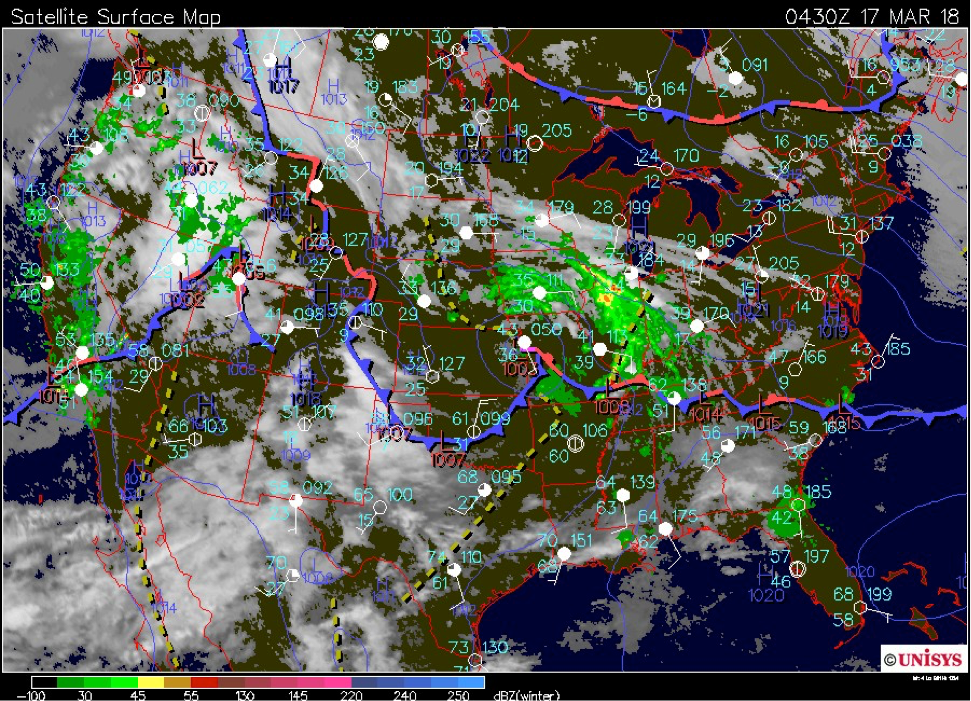
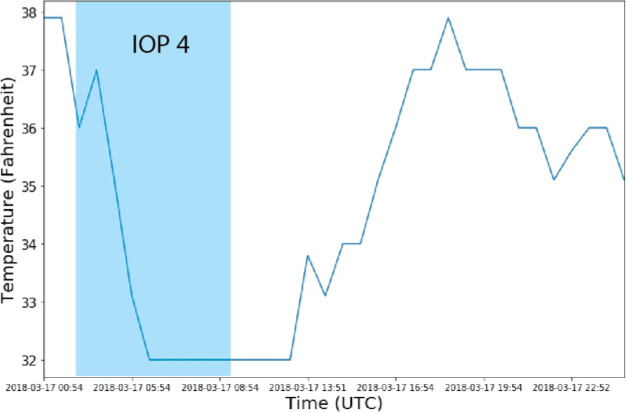
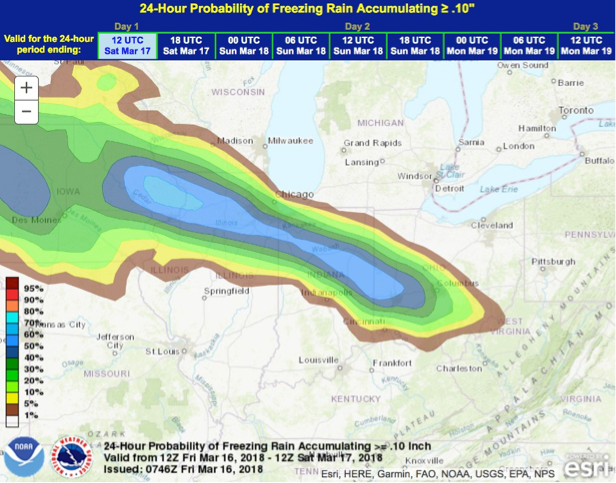
Following 10 days of quiescent weather, the final IOP of PurRad 2018 occurred on 17 March, the last day of the educational deployment. As a surface low (Fig. 19) passed over southern Illinois, cold Canadian air spilled into Indiana from the north and northwest, dropping surface temperatures to 0 °C across the Lafayette area (Fig. 20). In the North American Mesoscale model, a broad warm nose (not shown), centered around 850 mb, was forecast to persist for several hours after the surface frontal passage. Because of this forecast sandwiching of a relatively warm layer of air between two sub-freezing layers within the precipitation band, a widespread and long-duration freezing rain event was forecast, with the probability of freezing rain greater than 0.1 inch at ACRE greater than 50% (Fig. 21). Based upon this forecast, IOP 4 was conducted overnight as a refreezing signature hunt. From 0200 to 0900 UTC, deep volumes (0.5 to 20°) were collected, interspersed with RHI scans perpendicular to precipitation motion and a sequence of five birdbath scans at the end of each volume. An additional RHI was collected over a disdrometer deployed at the PI’s residence.
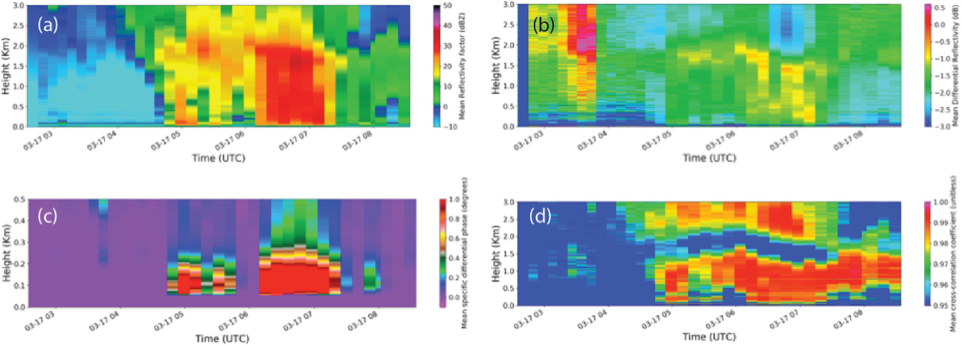
EAPS 52300 student M. Sharma generated QVPs from the 6° DOW PPIs (Fig. 19), revealing fluctuations of up to 500 m in the top and bottom heights of the melting layer over the ACRE site. Although ice glaze accumulated on the DOW and on the other instruments, no sleet was observed at ACRE, nor was a refreezing signature (Kumjian et al. 2013) conclusively identified in the QVPs. Attenuation and differential attenuation were observed above the melting layer during the heaviest precipitation at 0630 UTC (Fig. 22b).
Outreach Activities
Mr. Steven Smith, EAPS outreach coordinator, facilitated multiple public outreach events during this deployment, during which more than 500 people came in contact with the DOW. Unfortunately, owing to statewide mandatory standardized testing during Week 2 of the deployment and spring break during Week 3, no public schools accepted our offer of an on-site demonstration of the DOW. Instead, most of the public outreach effort was concentrated in a single, day-long event at a local science museum, described in the next section.
GLOBE Citizen Science Day at Imagination Station, Lafayette, Indiana
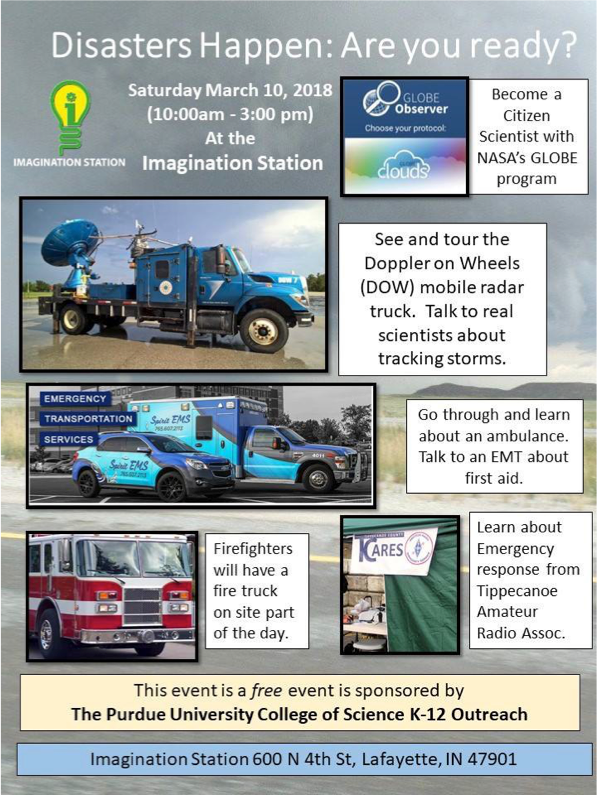
Mr. Smith, the regional representative of the Global Learning and Observations to Benefit the Environment (GLOBE) Program, arranged for a public demonstration of the DOW at Imagination Station, a science museum in Lafayette, Indiana targeting elementary school-age children. The DOW was the headlining attraction at a GLOBE-themed event entitled, “Disasters Happen: Are You Ready?” (Fig. 25). This event was promoted publicly on Imagination Station’s social media accounts and through flyers distributed in day care centers and public schools.
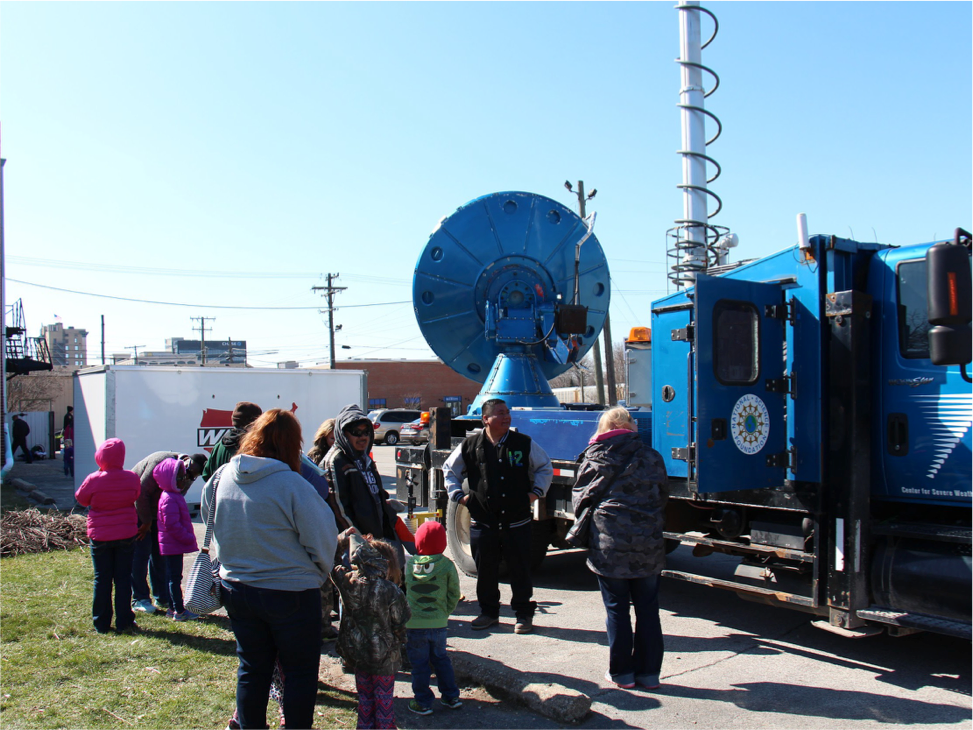
The DOW, situated in the parking lot at Imagination Station (Fig. 26), served as a first stop for many of the visitors arriving for the event. One CSWR staff member (A. Gilliland), an EAPS graduate student (D. Reano), and the PI allowed members of the public to climb inside the DOW, answered their questions, and distributed DOW stickers and bookmarks. Imagination Station board president P. Cardella reported that 468 people attended “Disasters Happen,” and the PI estimates at least 150 of these visitors climbed inside the DOW in groups of three to five. Many visitors arrived in family groups, with visitors ranging in age from infant to 87 years old. One family reported having driven more than 70 miles just to see the DOW.
Media coverage
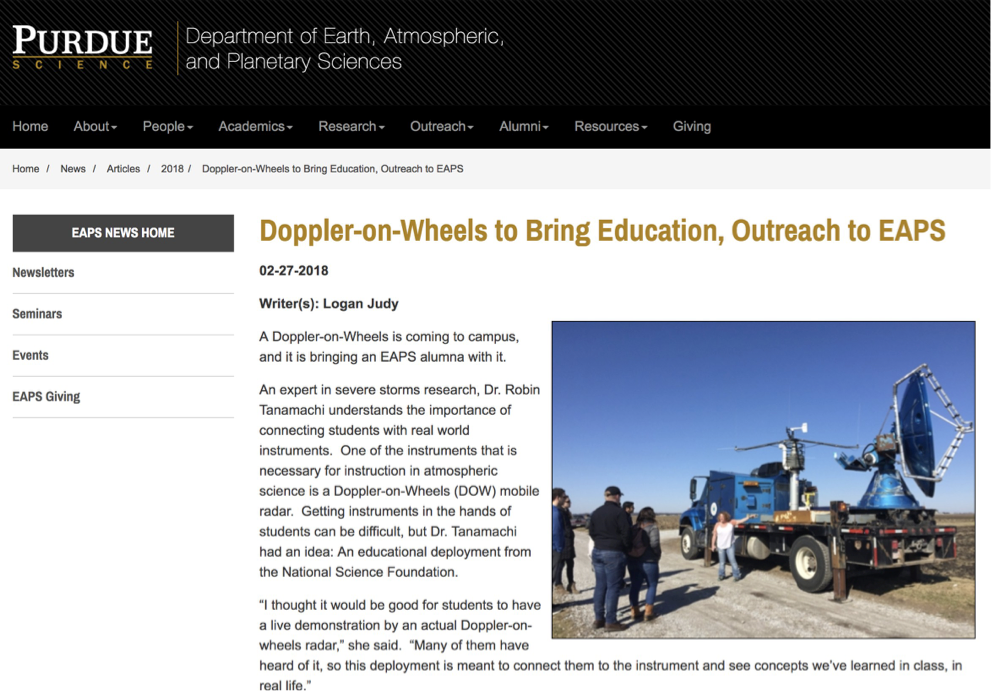
The EAPS department promoted the educational deployment and outreach events associated with it, including an internet news story (Fig. 28) and video interview with the PI. The PI and the EAPS department used their respective Twitter accounts (@tornatrix and @PurdueEAPS) to keep followers up to date on any scheduling changes to the demonstration times and locations.
A local TV news channel, WLFI-18 in West Lafayette, Indiana, broadcast a one-minute segment about the “Disasters Happen” event at Imagination station on 10 March 2018. The DOW can be seen prominently throughout the piece, and the transcript makes mention of the NSF-sponsored educational deployment.
Individual tours
The CSWR staff facilitated a private tour of the DOW for a high school student who contacted the PI saying he could not attend the Imagination Station event owing to college entrance examinations the
same day. This student and a family member traveled across the state to meet with CSWR staff and one of the Radar Meteorology students on 3 March 2018. He expressed gratitude for the opportunity.
WE-CAN Instrument Teams
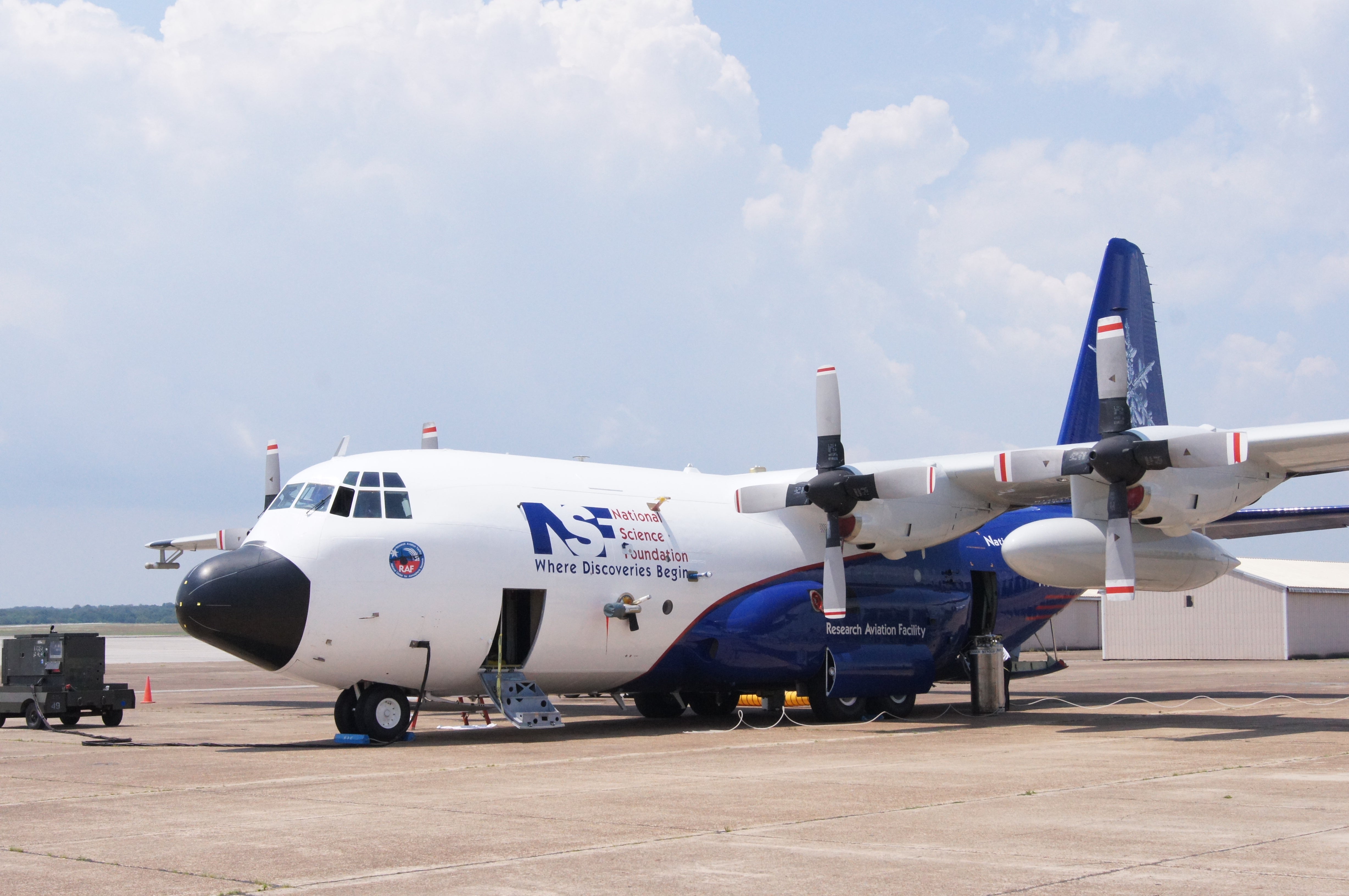 Many atmospheric scientists from universities and National Laboratories across the U.S. are involved with WE-CAN including the Colorado State University, the University of Colorado at Boulder, the University of Montana, the University of Washington, the University of Wyoming, and the National Center for Atmospheric Research (NCAR).
In addition to the complex project logistics that need to be arranged and the aircraft maintenance and operation, the NSF/NCAR C-130 has a suite of over 25 specialized research instruments on board specifically selected for WE-CAN. Each instrument required its own team to operate, calibrate, and maintain it for the duration of the project.
Below is a list of PI teams responsible for the instruments on board the C-130 during WE-CAN.
AEROSOL and CLOUD PARTICLE INSTRUMENTATION
Two-Dimensional Optical Array Cloud Probe [10 μm] (2DC-10)
NCAR Earth Observing Laboratory
EOL standard instrumentation
Two-Dimensional Optical Array Cloud Probe [25 μm] (2DC-25)
NCAR Earth Observing Laboratory
EOL standard instrumentation
Cloud Condensation Nuclei (CCN) Counter
Colorado State University
Paul DeMott, PI
Sonia Kreidenweis, Co-PI
Ezra Levin
Kevin Barry
Cloud Droplet Probe (CDP)
NCAR Earth Observing Laboratory
EOL standard instrumentation
Continuous Flow Diffusion Chambers (CFDC)
Colorado State University
Paul DeMott, PI
Ezra Levin
Kevin Barry
Kathryn Moore
Counterflow Virtual Impactor (CVI)
University of Colorado - Boulder
Darin Toohey, PI
Cindy Twohy, Co-PI
Stephanie Redfern
Bryan Rainwater
High-Resolution Time of Flight Aerosol Mass Spectrometer (HR-ToF-AMS)
Colorado State University
Delphine Farmer, PI
Sonia Kreidenweis, Co-PI
Lauren Garafalo
Matson Pothier
Ice Spectrometer (IS, with CFDC)
Colorado State University
Paul DeMott, PI
Thomas Hill
Ezra Levin
Kevin Barry
Kathryn Moore
Passive Cavity Aerosol Spectrometer Probe (PCASP)
NCAR Earth Observing Laboratory
EOL standard instrumentation
Particle into Liquid Sampler (PILS2)
Colorado State University
Amy Sullivan, co-PI
Scanning Mobility Particle Sizer (SMPS)
NCAR Atmospheric Chemistry Observations & Modeling
John Ortega (ACOM)
Paul DeMott, PI
Ezra Levin
Kevin Barry
Single Particle Soot Photometer (SP2)
Colorado State University
Paul DeMott , PI
Sonia Kreidenweis, Co-PI
Delphine Farmer, PI
Ezra Levin
Ultraviolet Absorption Hygrometer (UVH)
NCAR Earth Observing Laboratory
EOL standard instrumentation
Ultra-High Sensitivity Aerosol Spectrometer (UHSAS)
NCAR Earth Observing Laboratory
EOL standard instrumentation
Wyoming Cloud Lidar (WCL)
University of Wyoming
Min Deng
TRACE GAS INSTRUMENTATION
Advanced Whole Air Sampler (AWAS)
Colorado State University
Amy Sullivan
I-Ting Ku
Yong Zhou
CCD Actinic Flux Spectroradiometers (CAFS)
NCAR Atmospheric Chemistry Observations & Modeling
Sam Hall
Kirk Ullmann
Chemical Ionization Mass Spectrometer (CIMS)
University of Washington
Joel Thornton, PI
Brett Palm
Ben Lee
Qiaoyun Peng
CO2 / CH4 Picarro
NCAR Atmospheric Chemistry Observations & Modeling
Teresa Campos
Andy Weinheimer
NH3
Colorado State University
Emily Fischer, PI
Ilana Pollack
Jakob Lindaas
NO-NO2
NCAR Atmospheric Chemistry Observations & Modeling
Teresa Campos
Andy Weinheimer
Deedee Montzka
Geoff Tyndall
PAN Chemical Ionization Mass Spectrometer (CIMS)
NCAR Atmospheric Chemistry Observations & Modeling
Frank Flocke
Proton Transfer Reaction Time of Flight Mass Spectrometer (PTR-ToF-MS)
University of Montana
Lu Hu, PI
Wade Permer
Catie Wielgasz
Qian Wang
Trace Organic Gas Analyzer (TOGA)
NCAR Atmospheric Chemistry Observations & Modeling/University of California at Irvine
Eric Apel (ACOM)
Becky Hornbrook (ACOM)
Alan Hills (ACOM)
Alex Jarnot (CU)
Nicola Blake (CU)
RADIATION INSTRUMENTATION
HIAPER Airborne Radiation Package (HARP)
NCAR Atmospheric Chemistry Observations & Modeling
Sam Hall
Photoacoustic Absorption Spectrometer/Cavity Attenuated Phase Shift (PAS/CAPS)
University of Wyoming
Shane Murphy
Rudra Pokhrel

University of Washington Photo Gallery
 |
 |
 |
 |
 |
University of Washington Photo Gallery
 |
 |