Search
Calculation of soil heat flux at the surface
Preface
The following is lifted from "The energy balance experiment EBEX-2000: Part 1: overview and energy balance", Oncley, S.P., et al., 2007, Boundary-Layer Meteorology, 123:1--28, doi:10.1007/s10546-007-9161-1, updated with our procedure using current instrumentation.
Introduction
The surface heat flux G(0) is determined from measurements by heat flux plates at a depth zp and the heat stored by the soil between the surface and zp. Thus
G(0) = Ssoil + G(zp)
Soil Heat Flux
G(zp) is measured using REBS heat flux plates (HFT) at a depth zp of 50 mm. Philip (1961) correction for these plates is of the form (his Eq. 8):
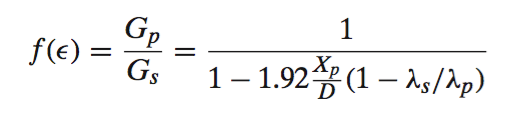
where Gp and Gs are the heat fluxes through the plate and through the soil, Xp = 3.93mm is the plate thickness, D = 38.56mm is the plate diameter, and λp = 1.22 W m-1K-1 and λs are the thermal conductivities of the plate and soil, respectively. Our plates were calibrated by the manufacturer in a water/glass bead medium with thermal conductivity λm = 0.906 W m-1K-1 and gave a measured value Gm based on this calibration coefficient. Thus, for our plates

ISFS now uses Hukseflux TP01 probes to measure soil thermal properties, including λs. For earlier projects, we have sometimes estimated λs
λs = Qsoil * λw + (1 - Qsoil)λd
where λw = 0.6 W m-1K-1 is the thermal conductivity of water, Qsoil is the volumetric soil moisture fraction, and λd must be estimated for the local soil type.
Soil Heat Storage
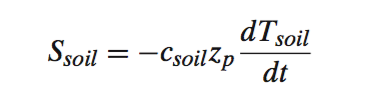
Next, we need to calculate the heat storage in the soil above zp where
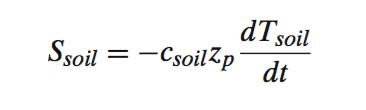
and Tsoil is the soil temperature. The TP01 now is used to measure Csoil. For earlier projects, we have simply used tables using estimates of the soil type.
Tsoil is computed from the linear average of 4 sensors evenly spaced through the first 50mm of soil depth. For some earlier projects, a single REBS linear soil temperature probe has been used positioned to average between 10 and 40 mm.
Reference
Philip JR (1961) The theory of heat flux meters. J Geophys Res 66:571–579

CSET Educational Module
INSTRUCTIONS FOR EDUCATORS
The goals of the CSET educational module are to demonstrate how observational field projects operate and allow students to (1) enhance their knowledge and understanding of meteorological processes, and (2) act as the mission scientists planning and leading the flight. By taking an inquiry-based approach with this activity, students will feel more engaged in the learning process as they get a feel for how scientific research is done using a real case study as an example.
This educational module has been designed for students with at least a basic understanding of meteorology, namely an introductory general education class at the college level (although advanced high school is also possible). Advanced undergraduate or graduate atmospheric science students will also benefit from this module to familiarize them with field research, especially if the simulated flight is combined with data analysis.
The CSET educational module was developed by Dr. Shaunna Donaher, a lecturer at Emory University, and a participant in the CSET study. If you use this module in the classroom and have additional useful hints to add to this list, please email them to shaunna.donaher@emory.edu.
ABOUT THE MODULE
The module is divided into 5 sections:
- HOME: This page has an introduction to the module, Instructions for Educators, and a Pre-lab activity which can be assigned as homework.
- SCIENTIFIC BACKGROUND: This page introduces/reviews main concepts that should be understood to get the most out of the module. There are also many links to take students to additional information about topics or to define a vocabulary word, and additional papers are suggested for outside of class reading.
- ABOUT CSET: This page is all about the experiment: what CSET intended to study, how observations were made to maximize data collection, background information about the team involved in the project, and basic descriptions and pictures of instrumentation.
- SIMULATED FLIGHT: This is where the inquiry-based activity can be found. Students are walked through planning of an outbound flight in the style of guided inquiry, with hints about what forecast data they should use to plan their flight. Once a flight is planned, they write up a Final Flight Plan and Weather Summary as if they were the mission scientists and a flight is going to occur the following day. Then, using the interactive map function in the CSET Field Catalog, students follow along with the actual flight that did occur the next day, tracking data collection, and summarizing with a Mission Science Summary. This also gives students an opportunity to reflect on why the flight path flown may have been different than the ones they planned, possibly due to a misunderstanding about the meteorological processes. The entire process is repeated for the return flight, this time with less guidance from the module.
- DATA ANALYSIS: This page suggests activities that analyze the data, either using the free Aeros software, or through Excel or another data management tool. Some activities on this page could be done with an intro class (dropsondes analysis, etc), while others are more suitable for upper-level students. Based on the time you want to commit to this module, you may want to pick and chose activities from this page.
Go to the online CSET Educational Module
SUGGESTED BEST USES
One (~3 hour) lab period (or the equivalent in class meeting time)
Assign the pre-lab activity on the home page as homework before the lab. Ideally this should be completed individually, so every student is familiar with the scientific background and goals of CSET. During the lab, have students work in groups of 3-5 through the simulated flight planning. The flight planning activity is best done in groups to encourage students to consider multiple ideas and discuss their opinions and understandings. We recommend instructor-assigned or randomized groups, as many pedagogical studies show that instructor-assigned groups are more effective than student-chosen groups. Students should be reminded that scientists at CSET always worked together on mission planning, and many did not know each other at the start of the experiment.
Two lab periods
In addition to the best uses above, you can also add a second lab period for data analysis activities, either individually or in groups.
1-2 lectures plus a 3 hour lab
Instead of giving the pre-lab activity as homework, the information on the Scientific Background page could be taught in a lecture, which would allow students more opportunities to ask questions. You may still want to have students fill in the pre-lab activity sheet to ensure that they understand the background information.
A longer unit about meteorology instrumentation
An entire instrumentation class could be based on CSET. Start with the background information and have students delve deeper into how each instrument works (either through instructor lectures or student projects and presentations), and then use the simulated flight with an emphasis on looking at the many satellite products available on the maps page of the Field Catalog. For data analysis students can work on analyzing one instrument data set at a time to reinforce knowledge about operation of that instrument.
An upper-level data analysis class or graduate class
Semester-long student research projects could be made from the data analysis page, either having students work individually and then collaborate to write a sample scientific paper* as co-authors, or having the students work in groups on data analysis and writing sample scientific papers*.
*Please keep in mind that data given on the Data Analysis page has not been quality controlled, so any research results are probably not up to peer-reviewed publication standards. If your students do decide to present their research results from this project in some way, they should plan to contact the PI (Bruce Albrecht, balbrecht@rsmas.miami.edu) and should always give credit to the CSET team and the NSF grant (AGS-1445832 ) that made this project possible.
USEFUL HINTS
-
We recommend explaining to students that the simulated flight activity is inquiry-driven and that there is not a correct answer (although some options will be better than others). Students that are unfamiliar with inquiry-based activities may struggle with not having concrete instructions. They should be reminded that scientists do not have step-by-step instructions to follow in the field and have to analyze available data and make the best decisions they can based on that information.
-
When following along with the flights, students can see where dropsondes where planned and actually launched by clicking the box for NSF/NCAR HIAPER (GV) Dropsonde Points on the Field Catalog map tool.
-
The pre-lab activity is currently appropriate for an introductory-level college student. However, it has been provided as a .docx so it can be modified for each particular use, especially if you want students to view more videos or answer more questions about instrumentation, or want to increase the level of difficulty.
-
The actual mission science summary reports from RF14 and RF15 may be useful tools when grading student-generated mission science summary reports.
Go to the CSET Educational Module