Search
CONCORDIASI Driftsonde - Seychelles test
| What |
|
|---|---|
| When | May 11, 2009 12:00 AM to May 28, 2009 12:00 AM |
| Where | McMurdo Station |
The CONCORDIASI program is the result of a joint USA-French initiative for atmospheric science in the Polar Regions. It aims at improving the meteorological, dynamical and chemical analysis and forecast over Antarctica. The measurements from Concordiasi will also advance our understanding of the dynamical and physical processes critical to the climate and weather of Antarctica and knowledge of the role of polar processes in the Earth System. Concordiasi is designed to make major contributions to the research goals of two major international programs; the WMO/ICSU-s International Polar Year (IPY) and the WMO-s The Observing System Research and Predictability Experiment (THORPEX) program.
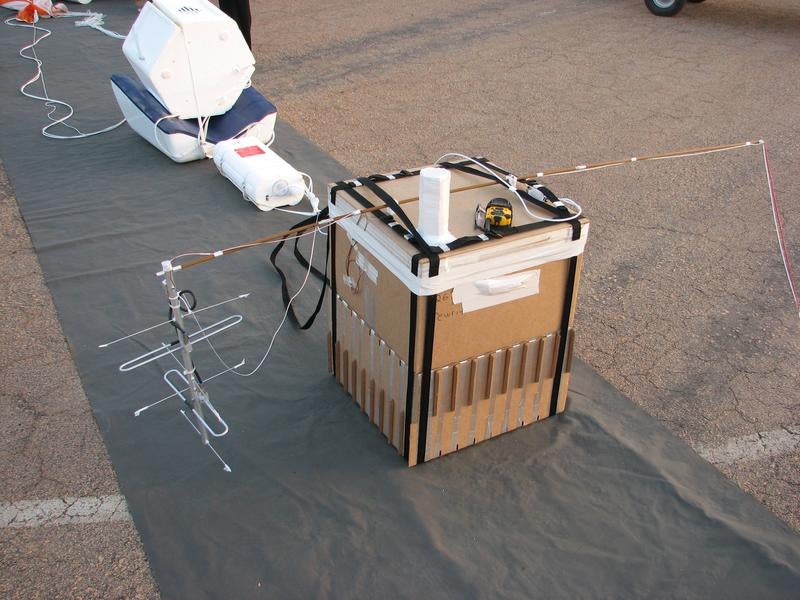
CONCORDIASI consists of a measurement campaign over the Antarctic region utilizing stratospheric balloons as a research platform carrying several types of instruments and performing in situ, and remote measurements of the atmosphere. These measurements are performed in conjunction with operations of space borne instruments, in particular the IASI atmospheric sounder aboard the METOP satellite, and with radiosonde observations conducted from several Antarctic stations.
The CONCORDIASI project includes for most of the systems a full development period that requires full coordination between the participants. One important part of this effort is the "pre-Concordiasi" flight campaign that will take place from Mahé (Seychelles Islands) between March 31, 2009 and April 30, 2009 (for a full schedule click here). The main goals for this test campaing is to:
- Verify the proper operations of the driftsonde system for the CONCORDIASI campaign
- Verify the web interphase
- Verify the scheduling of sonde relasing during the flight and its proper release
- Verify the proper operation of the solar panel heating system
- Verify the thermal model for the gondola
Presentations of Concordiasi Workshop, Boulder, Colorado, USA, 21-22 October 2011
Long Duration Balloon Missions (LMD)
Network for the Detection of Atmospheric Composition Change (NDACC)
Concordiasi Web Pages:
Meteo-France Concordiasi Home Page
Meteo-France Concordiasi Archive
University of Wyoming
Concordiasi Workshop (29-31 March 2010)
Seychelles Test
CONCORDIASI Driftsonde - Seychelles test
Deployment of the NCAR/NSF Driftsonde development facility in McMurdo Station, Antarctica.
CONCORDIASI Logistics - Seychelles
This page contains all related logistics information for the upcoming Seychelles test, please check back often or contact Vidal Salazar vidal@ucar.edu
Technical talk - Driftsonde
Presentations of Concordiasi Workshop, Boulder, Colorado, USA, 21-22 October 2011
Long Duration Balloon Missions (LMD)
Network for the Detection of Atmospheric Composition Change (NDACC)
Concordiasi Web Pages:
Meteo-France Concordiasi Home Page
Meteo-France Concordiasi Archive
University of Wyoming
Concordiasi Workshop (29-31 March 2010)
EOL External Advisory Committee
EOL's External Advisory Committee (EAC) ensures that our scientific priorities and divisional practices remain in alignment with the needs of the community that we serve. The Panel includes university faculty, scientific researchers, and instrumentation specialists who are well-versed and provide advice in all aspects of EOL's program, including field services, development activities, human resources, education, strategic partnerships, and emerging technologies.
The last EAC meeting took place July 15-16, 2021.
EAC Membership
|
Dr. Stephan P. Nelson (Chair) |
Dr. Melissa Yang Martin |
| Prof. Kenn Davis Penn State University |
Captain Carl Newman (Ret.) NOAA/Aircraft Operations Center |
| Prof. Belay Demoz University of Maryland, Baltimore |
Mr. Giri Prakash ARM Data Center Oak Ridge Laboratory |
| Dr. Andrew Gettelman National Center for Atmospheric Research Climate & Global Dynamics and Atmospheric Chemistry & Modeling Laboratories |
Dr. Mohan Ramamurthy University Corporation for Atmospheric Research Unidata |
| Dr. Michael Hardesty CIRES University of Colorado at Boulder |
Prof. Robert Rauber University of Illinois Urbana-Champaign |
| Dr. Petra Klein University of Oklahoma |
Dr. Graeme Stephens Center for Climate Sciences NASA Jet Propulsion Laboratory California Institute of Technology |
| Prof. Sonia Kreidenweis Colorado State University |
Field Project LATTE
Workshops
WINTER Digital Camera Imagery and Movie Notes
During WINTER, the NSF/NCAR C-130 (N130AR) flew two digital cameras for in-flight video capture: forward- and downward-looking. The forward-looking camera is a Point Grey Research Flea 3 (FL3-FW-14S3C-C) - Color, 1280 x 960 resolution equipped with an Edmund Optics 6mm lens (#67-709). The field of view is 68 x 51 degrees with approximately 6% barrel distortion. This camera is located in the cockpit.
The downward looking camera is a Point Grey Research Grasshopper (GRAS-14S5M) monochrome camera, 1280 x 960 resolution equiped with a Sony zoom lens set at about 15 mm focal length giving a field of view of 30x23 degrees. It is located on the belly of the plane. The top of the image is to the front of the plane.
Images were acquired once per second and stored as JPEG-compressed files, roughly 100 kB each. No image processing was performed beyond converting the raw pixel data to 24 bit color images. Applying a sharpening filter as is ordinarily done by consumer digital cameras will considerably improve the appearance. The UTC date and time are encoded in the filename as YYMMDD-HHMMSS.jpg.
H.264 compressed, half-resolution movies (.mp4) were created. Each 1-second image was processed with the linux ImageMagick toolkit. The image was first cropped to 512x384 pixels. Sharpening was then performed [SHARPEN(0.0x1.0)]. Each image was then annotated in the lower left with the time the image was recorded and in the upper right with the pointing. Finally, the images were combined into a single block. For final movies, data values at the image time for a select set of data parameters chosen by the researchers were appended to the right of each image block. These 1-second annotated images were compiled into a video stream running at 15 frames/s, 1500 kbps data rate.
The movies are playable with Quicktime, Windows media player from Windows 7, mplayer, VLC, and others.
J. Aquino
S. Beaton
NCAR/RAF
2015-06-25
Dataset Documentation Requirements
CSET Digital Camera Imagery and Movie Notes
During CSET, the NSF/NCAR GV HIAPER flew forward, left, and right-facing digital cameras for in-flight image capture.
The forward camera is a Point Grey Research Hi-Res Flea Hi-Color, 1024x768 resolution. The Navitar DO-412 lens has a focal length of 4 mm and the field of view is about 62 x 48 degrees with some barrel distortion. This camera is located on the right wing pylon.
The right-facing camera is a Point Grey Research Flea 3 (FL3-FW-14S3C-C) - Color, 1280 x 960 resolution equipped with an Edmund Optics 6mm lens (#67-709). The field of view is 68 x 51 degrees with approximately 6% barrel distortion. This camera was looking out a right-side cabin window, tipped slightly down and aft from perpendicular to the fuselage.
The left-facing camera is a Point Grey Research Hi-Res Flea Hi-Color, 1024x768 resolution, same as the forward camera. This camera was looking out a left-side cabin window, tipped slightly down and aft from perpendicular to the fuselage.
Images were acquired once per second and stored as JPEG-compressed files, roughly 100 kB each. No image processing was performed beyond converting the raw pixel data to 24 bit color images. Applying a sharpening filter as is ordinarily done by consumer digital cameras will considerably improve the appearance. The UTC date and time are encoded in the filename as YYMMDD-HHMMSS.jpg.
Movies were created by combining the three camera pointings into a collage and adding data to the right. The movies are playable with Quicktime, Windows Media Player, mplayer, VLC, and others.
For questions, please contact:
Stuart Beaton or Janine Aquino
NCAR/EOL/RAF
CSET Data Submission Instructions
Dataset Documentation Requirements
Letter from the Project Manager
GV Project Manager Data Quality Report