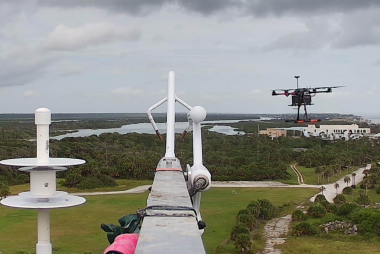
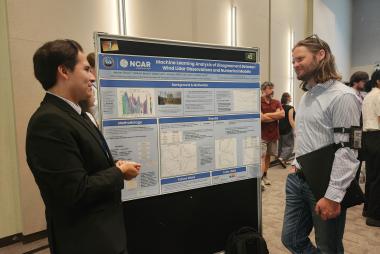
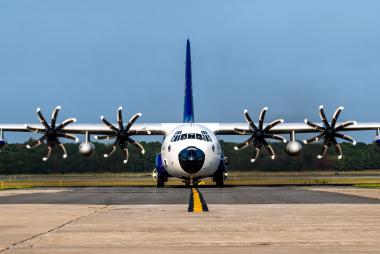
EOL Summer 2026 Research Interns
EOL SUPER and NESSI 2026 Interns Showcase Summer Research
Another summer of research is in the books! From late May through July, undergraduate interns in the NSF NCAR Earth Observing Laboratory's Summer Undergraduate Program for Engineering Research (SUPER) and the NSF NCAR Earth System Science Internship (NESSI) dove into hands-on research projects alongside our scientists and engineers.
Their work culminated at the NSF NCAR, UCAR, UCP, and CIRES Summer Student Conference — a full day of poster sessions, lightning talks, and a postdoc Q&A panel celebrating student research across the organization. Four of our SUPER and NESSI interns took the stage (and the poster boards) to share what they'd researched.
None of this happens without the mentors who guide these projects day to day — our thanks to them for the time, patience, and expertise they invested in this year's cohort.
Below, meet these four students and discover what they accomplished this summer.
🔷 Adrian Flores presented "Machine Learning Analysis of Disagreement Between Wind Lidar Observations and Numerical Models."
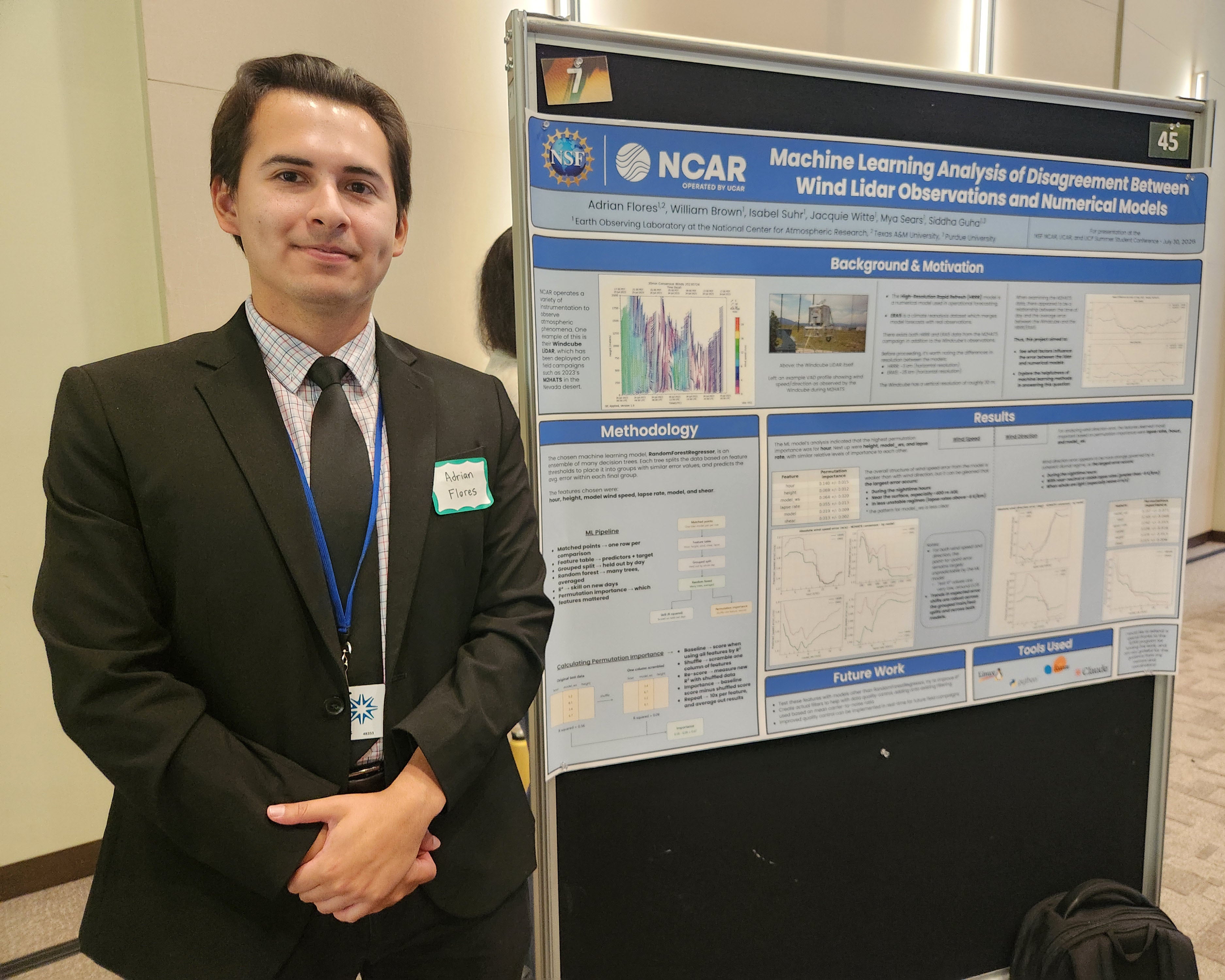
Adrian's poster compares measurements from a Doppler wind lidar deployed at the M2HATS field campaign with output from the HRRR (High-Resolution Rapid Refresh) forecast model and the ERA5 ECMWF reanalysis, using random forest machine learning. The models generally agreed well with the Doppler lidar, though he identified systematic differences tied to lapse rate, hour of the day, altitude, wind speed, and shear. Wind speed and direction differences were largest at low altitudes during overnight hours in light-wind stable conditions, reaching roughly 2 m/s and 20 degrees against ERA5 and somewhat less against HRRR. His work offers insight into when wind lidar and numerical models agree and when they diverge.
Adrian's mentors are Bill Brown, Mya Sears, Isabel Suhr, and Jacquie Witte. 🔷
🔷 Sid Guha presented "Machine Learning Quantification of Radar Wind Profiler Uncertainty Against Wind Lidar for M2HATS and LOTOS-2025."
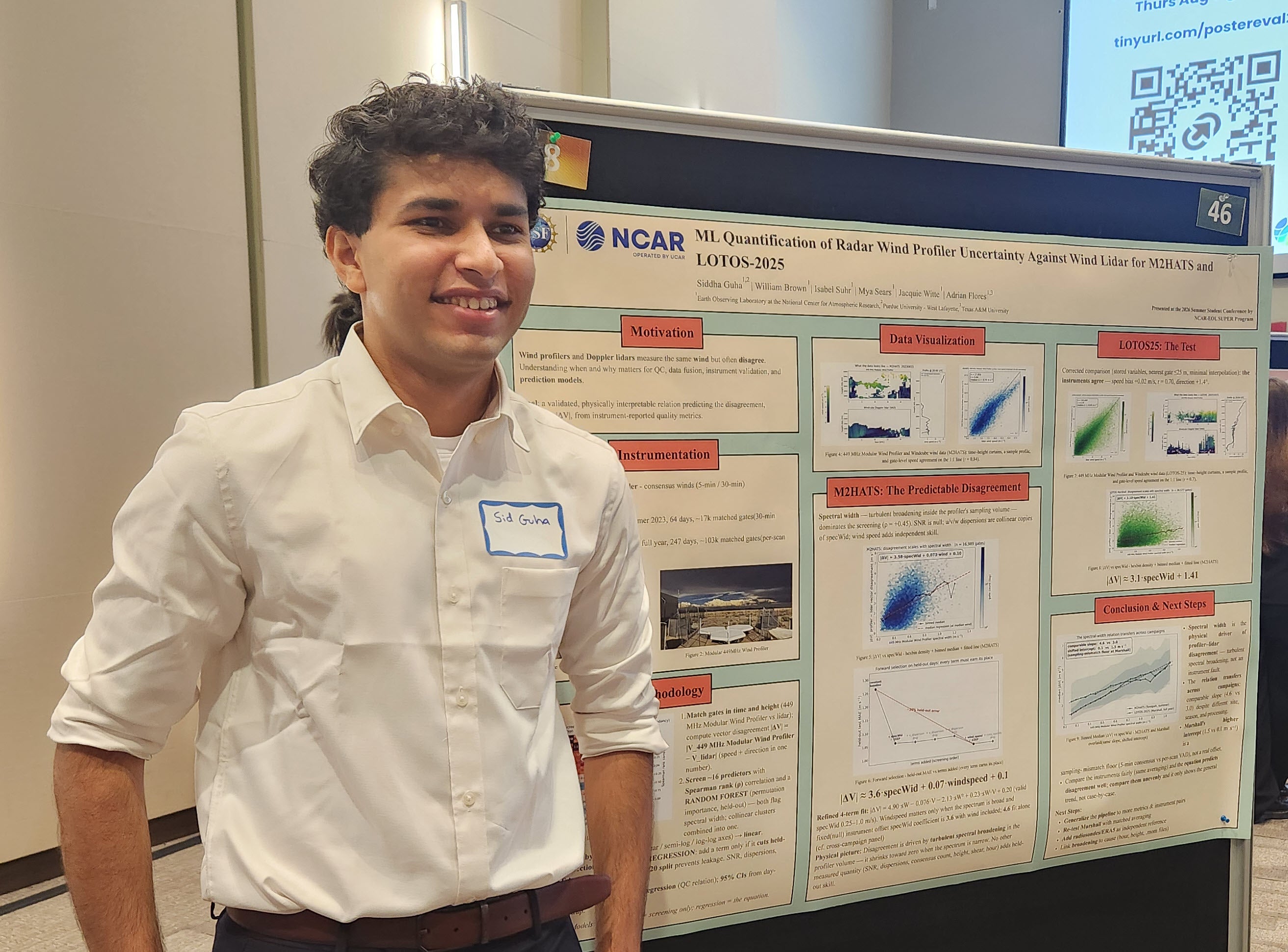
Sid's poster examines wind measurements from the 449 MHz Modular Wind Profiler and the Windcube Doppler lidar during the M2HATS field campaign and during testing of LOTOS node components at the Marshall Field Site. Using machine learning techniques, he looked at how well the two agreed as a function of various factors and found that Doppler spectral width, which is related to turbulence, was the strongest predictor of disagreement, followed by wind speed. The relationships held across both campaigns, and he built simple equations that can be used to quantify uncertainty in wind measurements.
Sid's mentors are Bill Brown, Isabel Suhr, Mya Sears, and Jacquie Witte. 🔷
🔷 Simran LaBore, who joined us through NESSI, presented "Characterizing Downslope Windstorms at NCAR's Marshall Field Site: Toward a Site-Specific Observing Strategy."
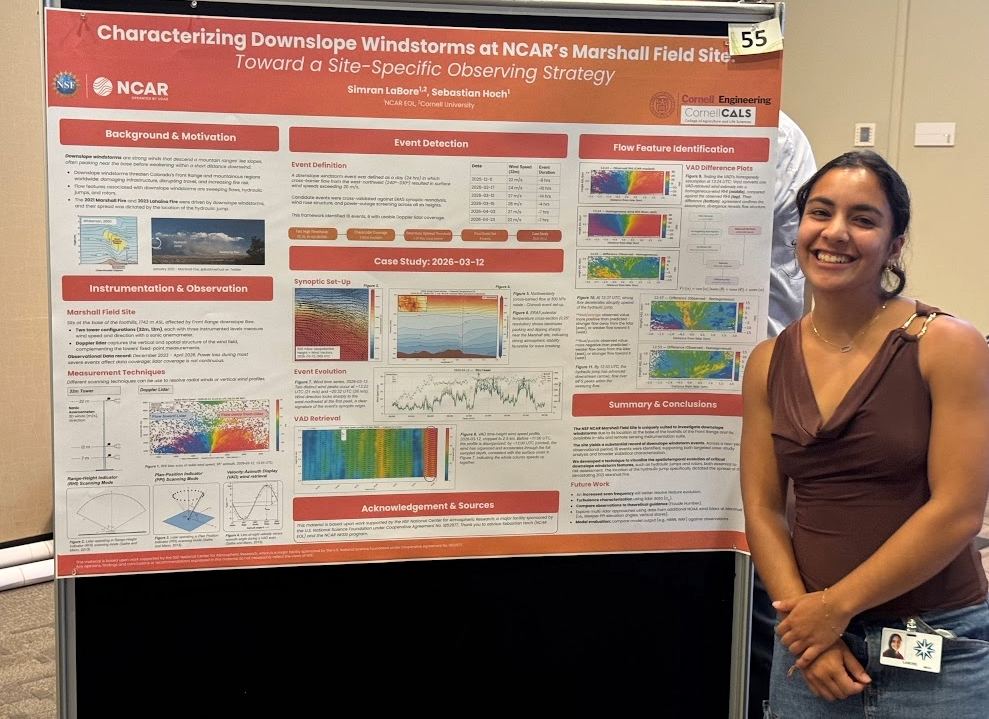
Her work looks at how often downslope windstorms occur at NSF NCAR's Marshall Field Site and how they behave there, drawing on data from meteorological towers and a Doppler lidar to trace how the events evolve in space and time. Using the 12 April 2026 windstorm as a case study, she shows how combining different scan strategies can pinpoint critical flow features such as hydraulic jumps and rotors. Those features matter for risk assessment and helped drive the spread of the devastating 2021 Marshall Fire.
Simran's mentor is Sebastian Hoch. 🔷
🔷 Naowal Rahman presented "Scaling Atmospheric LiDAR Retrieval Speed and Robustness with Differentiable Forward-Model Regularizers."
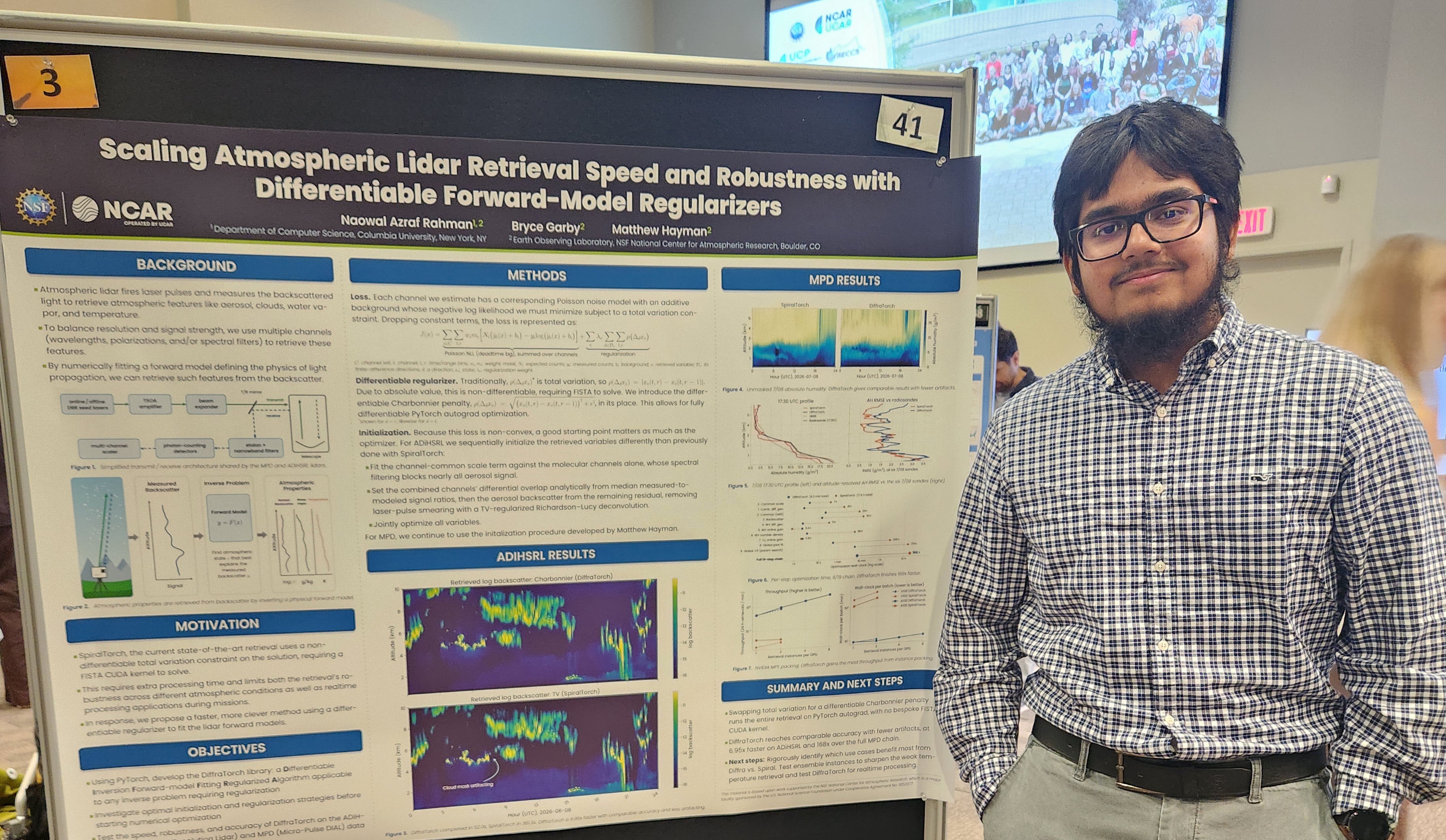
Naowal's work targets a bottleneck in atmospheric lidar retrievals. Poisson Total Variation (PTV) is the current state of the art, but its non-differentiable penalty term requires a complicated and computationally expensive solver. Naowal instead uses a differentiable total variation regularizer within the Differentiable Inversion Forward-Model Fitting Regularized Algorithm (DIFFRA), implemented in PyTorch as the DiffraTorch library. Tested against classic PTV using real data from EOL's ADiHSRL and MPD instruments, the new approach is both simpler and one to two orders of magnitude faster.
Naowal's mentors are Bryce Garby and Matt Hayman. 🔷
NCAR | UCAR Internships program information
We wish our interns the best in their future endeavors!