Search
Classroom Integration
MILLERSVILLE UNIVERSITY METEOROLOGY COURSES
Meteorological Instrumentation, Measurement, and Observing Systems (ESCI 447, Clark)
Synoptic Meteorology Lecture-Laboratory (ESCI 441, Sikora)
Mountain Meteorology (ESCI 390, Billings)
Atmospheric Thermodynamics (ESCI 341, Clark)
Atmospheric Dynamics (ESCI 342, Sikora)
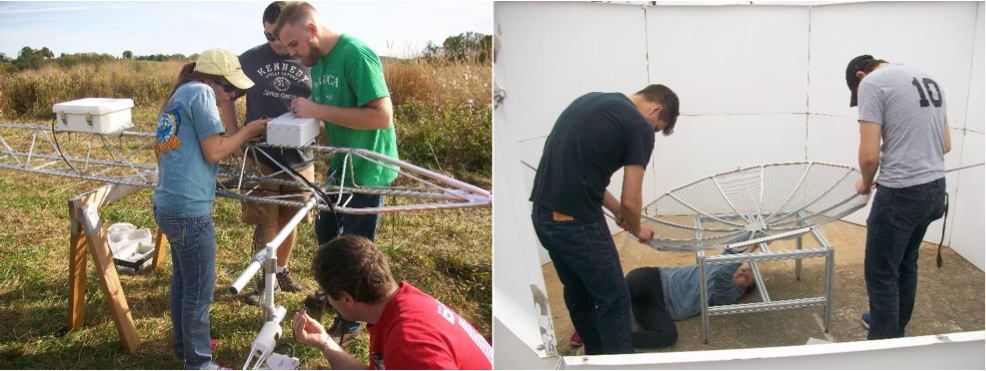
SEAR-MAR took place in mid-semester (4-18 NOV) and can be defined by three characteristics: disruptive, challenging, and exhilarating. A typical project day started early and continued between classes, and for the flight crew, sometimes did not end until late in the day. For the 20 students enrolled in ESCI 447, Meteorological Instruments, Measurement, and Observing Systems, not only were they expected to complete the mission preparation tasks (e.g., preparing forecasts, flight updates, sounding deployments across the SEAR-MAR domain), but they also had the course expectations since ESCI 447 was inextricably integrated into SEAR-MAR. The most significant of these responsibilities was the set-up our ground measurement site located about six miles from campus. The Millersville Atmospheric Research and Aerostat Facility (MARAF) was a significant component of SEAR-MAR research and research training in which students installed, operated, and dismantled a 10 m flux tower used for eddy-covariance measurements, ScinTec MFAS SoDAR with RASS extension for time-height profiles of wind, virtual temperature and turbulence statistics, MPL-111 Micropulse LiDAR for backscatter, PBL height, and cloud height, and two upper-air sounding systems for fixed and mobile atmospheric profiling. PSU and UMBC each had their own upper air sounding systems: 1) UMBC with the Vaisala RS41-SGP radiosonde, which was identical to the MU profiling system, and 2) the PSU Windsond identical to the MU mobile system. As part of the integrated course work, students were required to select an instrument that would be their primary responsibility, although as part of the lecture every student was taught the theory of operation of each instrument platform. ESCI 447 is a 3-credit/4 contact-hour a “writing intensive” course requiring students to complete a 2500 paper with revised prose on their instrument/sensor of choice. To take advantage of the concurrent educational deployment, students were required to write about half the paper on the instrument/sensor itself, including specifications and operational theory, one-quarter on how it complimented and integrated into the observing system that it comprised, and finally what was its value as part of the SEAR-MAR scientific mission. Coincidentally, the class was also exposed to a new set of MetEd learning modules being developed as a collaborative project between MU, the COMET program, and NCAR/Earth Observing Laboratory and with funding from the NSF (NSF Award # 1642643, PI: Clark). The module on Instrument Performance Characteristics was particularly relevant and useful to the class and its involvement in SEAR-MAR because students could relate the learning exercises to the authentic experience that SEAR-MAR provided. (see https://www.meted.ucar.edu/training_module.php?id=1349#.WosNF6gbPZs, registration and login required).
While the Instrumentation class was given preferred access to the King Air and other SEAR- MAR activities, the ability to perform field research in complex terrain with a research aircraft was a great opportunity for students in a special elective course titled ESCI 390 Mountain Meteorology. The course was offered specifically for students taking part in those SEAR-MAR scientific missions that focused on the influence of complex terrain on the lower troposphere. The first integration of SEAR-MAR into class for these eight students was after a site visit by the Wyoming flight crew on 13 Sept 2017. Using information they provided, the evening lecture began with some guidance on how to prepare a flight path using Google Earth. Students were then encouraged to submit their own missions over the next two weeks. While only two students chose to attempt this, these plans did become the CAD and cold pool missions discussed previously. Later in the semester, there were two required project assignments related to SEAR- MAR. First was a participation project, which simply required that students involve themselves during the two-week deployment. To increase engagement, they had to participate in two out of four defined areas. One was to volunteer for the student forecasting team described in Section XX. Another was to assist with a radiosonde launch, which occurred both with Vaisala sondes at the base site and the Windsonds during the CAD and cold pool missions. A third possibility was to serve as a ground-based flight tracker. These individuals remained in the Weather Center for the duration of the flight following its progress using Aeros and NCAR Mission Coordinator and communicating using chat. They would pass any requested weather information to the aircraft, note any required deviations from the original flight path, and help to coordinate any changes to the mission plan. Three students would volunteer as flight trackers, and in each case, aspects of the operations plan were modified after takeoff. The fourth assignment object was to be attendance at any SEAR-MAR based classroom lectures or seminars, but when none of these occurred, this was replaced by a night where the Mountain Meteorology class was moved to the Lancaster Airport to coordinate with an aircraft visit by the department’s freshman orientation course.
The second SEAR-MAR project in the Mountain Meteorology course was after the operations had ended. Students worked in pairs, and the four groups were required to analyze and give a short oral presentation on one of the four flights related to complex terrain processes (CAD, cold pool, mountain waves, and leeside cold front). Due to other course requirements near the end of the semester, this project was not done outside of class but instead occupied the final three-hour meeting before finals week. Despite the short time frame, groups were still able to pick out a significant finding in their track data. They also created interesting and personalized presentations with good use of images, such as Aeros and IDV track output, King Air camera stills, and supplemental operational weather data. Some students would later state that the Aeros experience for this project helped with later construction of posters for the AMS Annual Meeting in Austin.
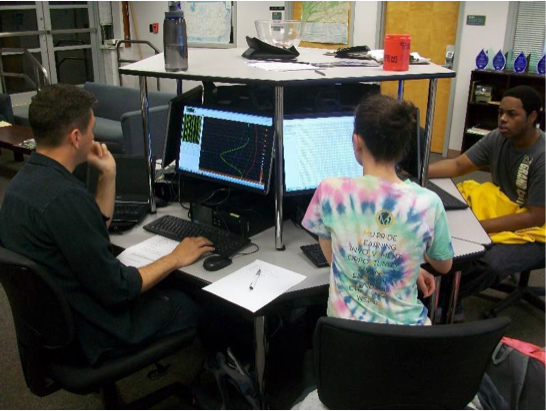
ESCI 441 Synoptic Meteorology (LECT/LAB) is a 3 credit, 6 contact-hour required course in the major. Synoptic Meteorology covers the application of atmospheric dynamics and atmospheric physics to the theoretical and empirical investigation of mid-latitude synoptic-scale meteorological processes. Topics include the diagnosis of synoptic-scale vertical motions, the circulation at fronts and the life cycle of the extratropical cyclone and was nicely aligned with the many of the scientific missions, in particular, the fine structure of fronts and cold air damming. However, it could be that the greatest value that ESCI 441 was its forecast preparation for students involved in SEAR-MAR. Students, with instructor supervisor, prepared three forecasts each day for SEAR-MAR: 1) the 5-day forecast, 2) 24-hour forecast, and 3) the 3-hour-prior pilot/crew briefing. These forecasts required considerable time gathering, analyzing, and interpreting model output, imagery, and surface and upper air data to produce a reliable forecast and guidance for all missions, including for flight operations from other partner schools. In addition to SEAR-MAR offering unique integrated experience for students in this course, the forecasting component elevated the competency levels of students and better prepared them for what they are encountering in the spring semester in a special skills course that we offer, ESCI 442, Advanced Weather Analysis and Forecasting.
At Penn State, six enrolled and four auditing graduate students in Penn State’s Meteorology 597, The Global Carbon Cycle, planned and analyzed three research flights as part of the SEAR-MAR project. The students were in the process of learning about the pools and fluxes of carbon in the earth system, focusing especially on the processes governing the atmospheric pool of these greenhouse gases. Early in the course students are introduced to a variety of atmospheric methods used to study sources and sinks, both natural and anthropogenic, to the atmosphere. Students were divided into three groups of three students, and asked to plan a research flight that would address a research problem in the field of carbon cycle science. Students were asked to write a brief scientific justification for the flight, including references to current research literature, and to design and submit flight plans that could accomplish their research objectives.
After modest feedback from the course instructor, Prof. Kenneth Davis, the students were invited to submit the flight plans to SEAR-MAR PI, Prof. Richard Clark, and to take part in flight planning discussions. The graduate students self-organized such that representatives cognitive of the group’s three flight plans attended planning meetings before and during the flight campaign. All three flight plans were conducted during the course of the field campaign. One student flew on the King Air as a scientific observer for the research flight that his group designed.
Students were invited to analyze their flight data as a final project for the course. Five of the six enrolled students chose to analyze SEAR-MAR flight data for their final course project, and three of the five chose to apply a simple atmospheric boundary layer (ABL) mass-balance approach to quantifying greenhouse gas emissions from anthropogenic sources. A few of their findings are summarized here.
Also at PSU, undergraduate meteorology majors enrolled in Dr. P. Markowski’s Mesoscale Meteorology course were actively involved in supporting each scientific missions and collaborated with MU on several mesoscale events. In particular, the PSU undergraduates deployed their Windsond upper air sounding system to support frontal fine structure, cold-air damming, cold pools, and others.
Rutgers and UMBC used SEAR-MAR for special studies and Honors College capstone projects. Rutgers integrated SEAR-MAR into Physical Meteorology, exposing 20-30 students to aircraft operations while conducting a first-ever inter-comparison of its PAM site. Three (3) Honors Scholars doing research in cloud physics in the marine BL were took advantage of SEAR-MAR to study stratus/nimbostratus moving on-shore in the mid-Atlantic region.
UMBC engaged 20-30 students who took their experiences back to present a series of seminars for undergraduates, and to integrate their courses in graduate level atmospheric physics.
Outreach
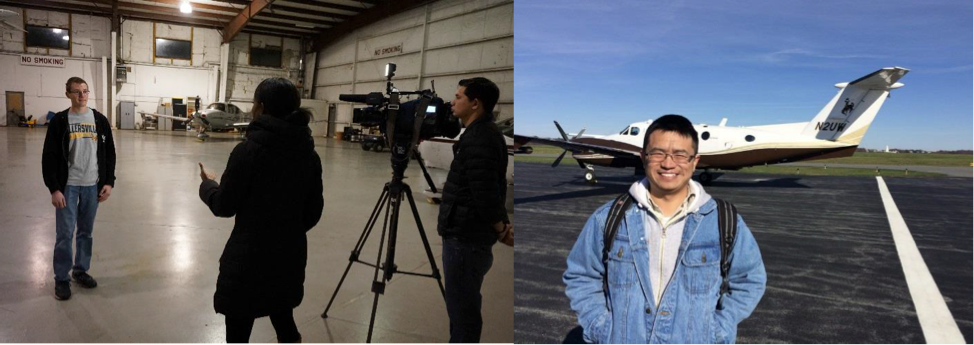
The four partner institutions were committed to leveraging SEAR-MAR for outreach to the public, academic, and scientific communities. This took on several different forms depending on the institution and the logistics of engaging their communities. UMBC and Millersville created PR media overviews for SEAR-MAR, which bookmark this final report at the beginning and end, and/or were interviewed for the local news media distribution with articles appearing in local newspapers and online media or as video segments on local TV stations. The photos in Fig. 39 below of a Millersville undergraduate (left) and a UMBC Ph.D. student (right) are example of the interaction with media.
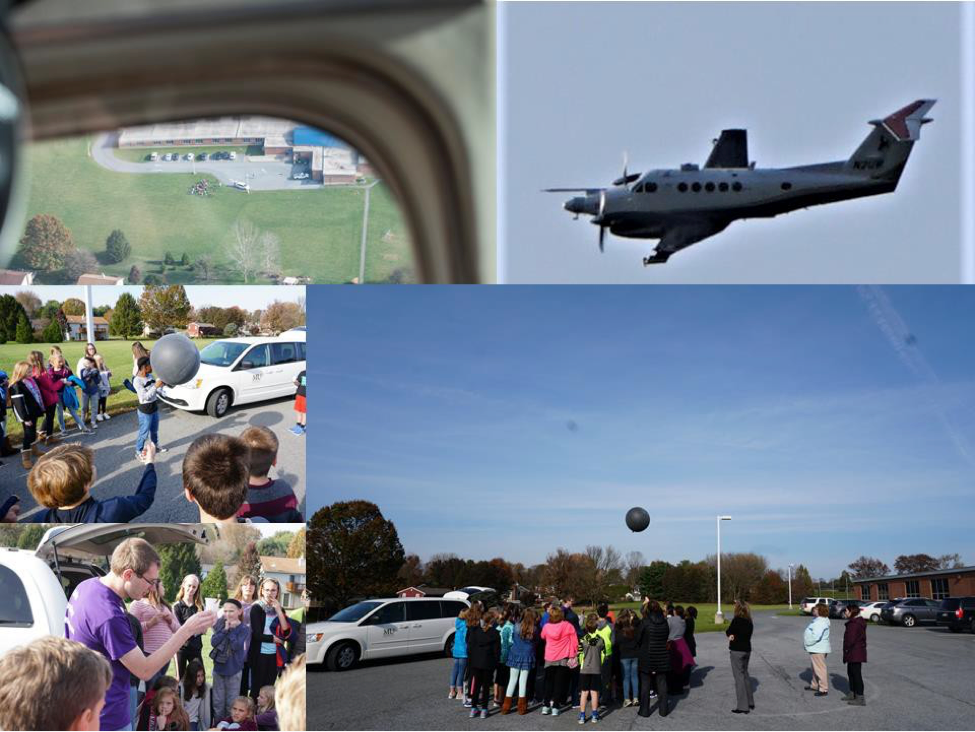
More substantive outreach had many tentacles including a special Millersville University Weather Watch segment produced by students who took part in SEAR-MAR (https://www.youtube.com/watch?v=XlQxwsfX5CY&feature=youtu.be (see time between 1:54 to 5:09 minutes). MU had the advantage of having the UWKA nearby at KLNS so that we were able to host visits such as the STEM Sisters, a group of middle school girls who participate in a program of this name, which is offered by the North Museum of Nature and Science in Lancaster, PA (https://northmuseum.org/stemsisters/), and over 50 freshmen meteorology majors from MU program. In addition, 58 6th-graders and half-dozen teachers and the principal from Ann LeTort Elementary School in Manor Township, Lancaster County had the chance to see the plane as it flew a low over the school and launch and track a radiosonde as part of a visit during SEAR-MAR. Two Millersville students spoke to the 6th-graders about SEAR-MAR and weather in general. PI Clark discussed general topics in science and careers in atmospheric science. The visit to LeTort School was coincidentally aligned with their current lesson about weather and climate, so our timing could not have been better. Students were highly engaged and participatory.
The period from 4-18 NOV 2017 when the partner institutions were actively involved in the UWKA deployment, spending extended time on outreach was a challenge. Now that the field campaign is behind us, the partners are committed to continued collaboration and outreach. On April 26 Dr. Ken Davis from PSU will give a seminar at MU on methane emissions, which will include the SEAR-MAR data collected over western PA during the coal mine and Sugar Run missions. With this spring and summer offering opportunity for further investigation of the scientific missions, we anticipate that students and project scientists will be invited to give talks at partner institutions, non-partner institutions, and present papers at professional conferences on SEAR-MAR. One event currently on the calendar is that R. Clark will lead a break-out session at the UCAR October Meeting on the value of using the NSF-NCAR/EOL deployment pool for educational enhancements.
Photo Gallery
Click images for full resolution.
 |
 |
 |
 |
 |
 |
 |
 |
 |
 |
 |
 |
 |
 |
 |
 |
 |
 |
 |
 |
 |