Airborne Phased Array Radar (APAR)
Implementing APAR: The Next Era of NSF NCAR’s Airborne Radar
The purpose of the Airborne Phased Array Radar (APAR) is to provide a leap forward as the scientific community’s next generation airborne weather radar. The ambitious plan originally placed four C-band PAR panels in strategic locations on the NSF NCAR EC-130Q aircraft to provide significantly advanced, high-resolution volumetric observations of high impact weather systems, such as hurricanes, tornadoes, derechos, atmospheric rivers, and severe winter storms and blizzards. NSF NCAR is commited to the advancement of this state of the art weather radar concept, while implementing a new flexible architecture approach that facilitates enhanced capabilities across both research and operational communities.
Scientific and Operational Motivation
In a recent study by NOAA, billion-dollar weather and climate related disasters are becoming more frequent in the United States, with such events affecting the nation on an average of nine times per year between 1980-2024. However, over the past five years (2020-2024), the average number of such events jumped to 23. Providing crital observations to both researchers and forecasters from an airborne weather radar system allows specific operation in hard-to-reach environments, such as over the oceans or highly variable terrain. Operating an airborne weather PAR utilizes advanced technology to enhance our understanding of mechanisms that intensify severe weather hazards and improve our forecast accuracy to assist decision-makers in preparation for and mitigation of associated damage.
Bridging the Gap
The Electra Doppler Radar (ELDORA) was a previously available and community supported airborne weather radar for monitoring significant weather events but was retired from service in 2013. Without this instrument, the resources for collecting airborne observations are stretched to other agencies with different obligations and requirements. Continuing to push for this advanced weather radar technology is necessary to fill the current gap in observing capabilities for the research community.
Flexible C-130 Architectural Approach
NSF NCAR uses its EC-130Q aircraft for various scientific studies and field campaigns. The C-130’s versatility makes it ideal for operating a PAR for observing significant weather events because of its unique ability to fly in and around severe weather. Determining the best implementation and installation options for a future airborne PAR requires creative architectural collaboration. Analysis is underway of “Commercially Off The Shelf” (COTS) options for mounting one or multiple PAR’s on the NSF NCAR C-130 without modifying the main aircraft structure to support an adaptable infrastructure to test airborne PAR instruments. Additionally, NOAA has initiated the process to transition from their current WP-3D to the C-130 aircraft. NSF NCAR’s updated, C-130 agnostic approach for testing airborne PAR promotes activities that enhance cross-agency partnerships.
Collaboration is Key
Whether through support from internal and external agencies, expertise within the scientific community, or partnership with the private industry sector, the contin- uation of the airborne weather PAR program is dependent on strong collaboration. Finding ways to connect resources and knowledge along the new path is vital for ensuring that NSF NCAR can close the airborne weather radar gap and provide such a vital facility to the research community.
Forging Ahead
The development team continues to achieve significant milestones in software design, scientific simulation, and infrastructure improvement. These advancements serve as a launching pad for ongoing activities that create opportunities for a future airborne PAR:
- Optimization of size, weight, and power requirements for reduced implementation risk while meeting scientific requirements
- Leveraging recent COTS radar technology
- Ongoing studies for risk reduction and shaping the future of airborne weather radars
- Airborne Test-bed Feasibility Study for technology maturation evaluation and efficient model development to assess capabilities of community-supporting experimental RF instrumentation
- Integrated PAR Digital Twin to define optimal connections between engineering and science requirements
- Multi-frequency Implementation Study using the APAR Observing Simulation, Processing, and Research Environment (AOSPRE) to diagnose trade-offs in radar operation and scientific analysis
NOTE: NSF suspended its support for the Airborne Phased Array Radar (APAR) in April 2025. NSF NCAR remains committed to APAR and is exploring all possible options to continue making progress on this essential instrument.
The Airborne Phased Array Radar (APAR) is an advanced atmospheric system which is currently being developed at NCAR. It will replace the expired X-band Electra Doppler radar (ELDORA). Preliminary design specifications suggest APAR will meet or exceed ELDORA's sensitivity, spatial resolution, and Doppler measurement accuracy. It will also acquire dual-polarization measurements.
APAR’s unique capabilities will allow for new scientific discoveries in the Earth Systems Sciences, especially for high-impact weather events. APAR will enable scientists to advance knowledge about the formation and evolution of societally disruptive weather events and their initiation and development. The remote sensing concept of the APAR aims to improve weather prediction and predictability, via assimilation of APAR data into numerical weather models, ultimately leading to improved weather alerts to the public.
APAR consists of four removable C-band Active Electronically Scanned Arrays (AESAs) mounted on the top, both sides, and the cargo ramp of the NSF/NCAR C-130 aircraft. Each AESA is approximately 1.8 m x 1.8 m in size and is consists of ~2,400 transmitting/receiving antenna elements. The dual-polarimetric capabilities of APAR, in addition to inherent beam agility associated with electronic steering, will provide more flexible scanning strategies and enhanced measurement capabilities.
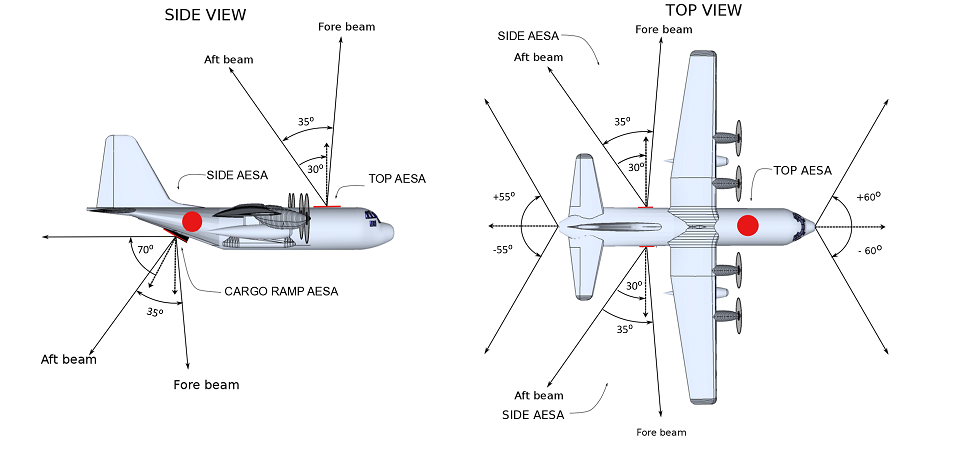
The APAR system will be a significant addition to the existing NSF/NCAR C-130 instrumentation suite, providing new insights and context to weather observations from the aircraft. It will have the following features:
- Dual-Doppler capability and rapid scanning to observe the 3D kinematics of storm structures.
- Dual-polarimetric capability to observe storm microphysics and improve our understanding of in-cloud mixed-phase microphysical processes.
- C-band transmit frequency that can penetrate into heavy precipitation due to less attenuation than X-band airborne radars.
- The ability to form multiple, simultaneous beams using digital beamforming techniques that allows for fast scanning and interrogation of rapidly developing weather systems such as tornadoes.
- An airborne radar mounted on a long duration aircraft to allow sampling of weather in remote locations.
Specifications
The proposed APAR system consists of the radar front and back end subsystems. The radar front end has four AESAs mounted to the exterior of the aircraft. The radar back end resides inside the aircraft and contains the hardware and software required to control the AESAs and to process, display, and archive the data. The NSF/NCAR C-130 nose surveillance radar observations, combined with the APAR surveillance mode reflectivity, will provide enhanced situational awareness to contribute to safe aircraft operations during extreme weather. The 3D volume-scan will help guide real-time radar operations and provide the basis for improved analysis of the phenomena of interest.
| Parameter | Specification |
| Frequency | 5.35 to 5.45 GHz |
| Elements per AESA | ~2400 |
| Beamwidth | <2.2 deg |
| Beamforming | hybrid digital |
| Antenna gain | ~38 dB |
| Sensitivity | -11 dBZ at 10 km range |
| Peak transmit power | ~28 kW |
| Polarization | dual linear |
| Typical Boresight sampling volume | 150 x 395 x 380 m at 10 km range |
| Along track sampling | <=300 m at aircraft speed of 120 m/s |